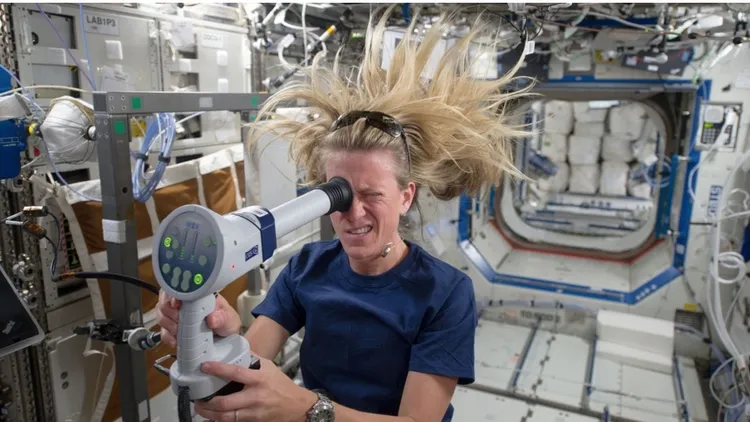
Astronauts spending months aboard the International Space Station develop a peculiar eye condition: their lower eyelids droop and lose elasticity, a phenomenon researchers have now begun to understand at the muscular level.
The condition, known informally among crew members as lower eyelid laxity, occurs because microgravity alters how muscles and tissues in the eye region function. New research identifies the biomechanical mechanisms responsible. When astronauts remain weightless for extended periods, fluid shifts upward throughout their bodies. This cephalad fluid shift increases intracranial pressure and changes the mechanical loading on tissues surrounding the eye. The lower eyelid contains delicate muscles and connective tissue that normally resist gravity. In orbit, those tissues experience different stresses. Over weeks and months, the lower eyelid loses its structural integrity and begins to sag.
The condition affects vision. A drooping lower eyelid pulls the tear film away from the eye surface, causing dry eyes and discomfort. It can distort the eyeball's shape slightly, inducing refractive errors that blur vision at certain distances. For astronauts performing precision work aboard the ISS or during spacewalks, this degradation matters operationally. Some crew members report the condition worsens throughout their mission and resolves slowly after returning to Earth.
This research emerges from the broader study of spaceflight-associated neuro-ocular syndrome, or SANS, a constellation of vision changes documented in ISS crew members and earlier Space Shuttle astronauts. SANS encompasses optic disc swelling, globe flattening, hyperopic shifts, and cotton-wool spots on the retina. Lower eyelid laxity represents one component of this larger syndrome. NASA and other space agencies have made understanding SANS a research priority because it affects mission performance and crew health during long-duration missions. As NASA plans extended lunar operations through Artemis and eventual Mars missions, longer periods in microgravity will intensify these effects.
The findings come at a critical moment for human spaceflight. Commercial orbital stations under development by companies including Axiom Space will eventually host crews on month-long or longer missions. NASA's deep space exploration architecture requires astronauts to endure multiple months traveling to and from the Moon and Mars. Understanding how microgravity degrades visual function directly informs countermeasures and mission planning.
Researchers examined biological samples and imaging data collected from astronauts in orbit and on the ground. They identified specific changes in muscle fiber composition and elastic protein distribution in the lower eyelid region. The study suggests that microgravity accelerates natural aging of these tissues, essentially fast-forwarding the deterioration that normally takes years on Earth into weeks in space.
Potential countermeasures remain under investigation. These range from targeted exercises to pharmaceutical interventions that might preserve eyelid elasticity. Some researchers explore whether modified pressure suits or specialized ophthalmic supports worn during extravehicular activity might help. As space agencies commit to long-duration human exploration beyond low Earth orbit, solving eyelid laxity and the broader SANS condition becomes essential to crew safety and mission success.