# How Meteorites Survive the Fiery Plunge Through Earth's Atmosphere
Scientists have mapped the complete journey of meteorites from space to Earth's surface, revealing seven distinct stages that determine whether falling rocks survive their violent descent through the atmosphere. Researchers at the SETI Institute and NASA Ames Research Center analyzed 75 meteorite falls, including the Saint-Pierre-le-Viger meteorite that streaked over Normandy, France in February 2023, to understand the physics of atmospheric entry and fragmentation.
The research transforms how scientists think about meteor survival. A space rock begins its seven-stage journey as an asteroid orbiting in space. Upon entering Earth's atmosphere, it becomes a meteor. The object then experiences successive stages of heating, fragmentation, and deceleration that determine how much material reaches the ground intact.
Stage one involves initial atmospheric interaction. The rock compresses air in front of it, generating extreme heat that can exceed 1,600 degrees Celsius. This heat doesn't come from friction but from ram pressure, the intense compression of atmosphere ahead of the falling object. The object's composition determines survival rates at this critical phase. Iron-rich meteorites withstand these temperatures better than stony meteorites.
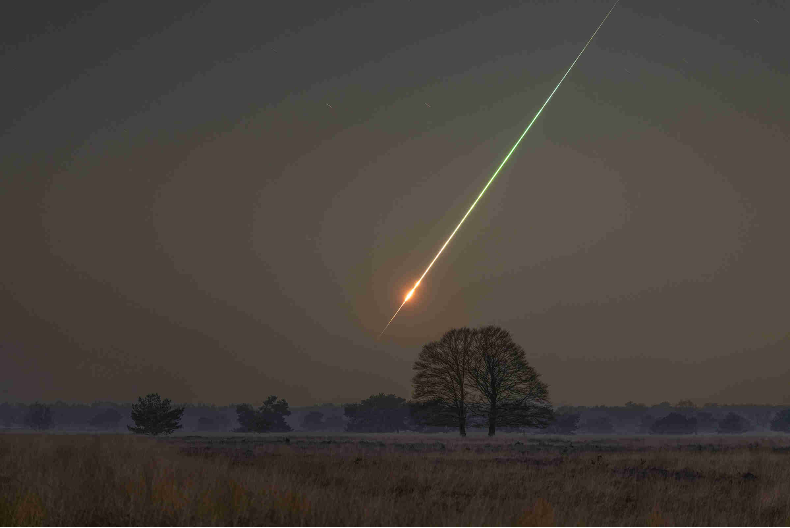
Stage two brings the first major fragmentation. As the meteorite heats, internal stresses build. The object's outer layer expands faster than its interior, creating pressure differentials. Material ablates, or burns away. For larger objects, the structural integrity fails. The meteor breaks into smaller fragments, each following its own trajectory. This is where the bright streak observers see from the ground originates.
Stages three through five involve continued deceleration and secondary fragmentation events. The fragments cool and separate. Smaller pieces fall more slowly and experience less heating. Larger fragments retain momentum and continue heating. Some fragments reach terminal velocity, the point where atmospheric drag equals gravitational pull. At this phase, meteorites slow dramatically, reducing surface temperatures.
Stage six marks the transition from meteor to meteorite. Once the object slows below its ablation point, it stops losing mass to burning. The exterior solidifies and cools. The falling rock becomes a meteorite.
Stage seven occurs after impact. The meteorite has survived the atmosphere and strikes Earth. Depending on composition, velocity, and entry angle, the impact creates a strewn field where fragments scatter across the landscape.
The Saint-Pierre-le-Viger fall illustrates this process in practice. The asteroid 2023 CX1 entered Earth's atmosphere and fragmented multiple times as it descended over northern France. Observers tracked the bright fireball. The resulting meteorite fall produced recoverable fragments that scientists later collected and analyzed.
This seven-stage framework helps planetary scientists predict meteorite recovery zones and understand why some falls produce abundant samples while others yield nothing. Composition matters enormously. Carbonaceous chondrites, primitive meteorites rich in water and organic compounds, fragment more readily than iron meteorites. Entry angle changes survival rates. A shallow angle increases atmospheric passage time, boosting ablation losses. A steep angle minimizes heating duration.
The SETI Institute and NASA Ames research provides crucial data for meteorite recovery teams. When new falls occur, scientists can estimate fragmentation patterns and predict where search efforts will prove most productive. This work also informs planetary defense strategies. Understanding how objects break apart during atmospheric entry affects calculations for deflecting potential hazardous asteroids.