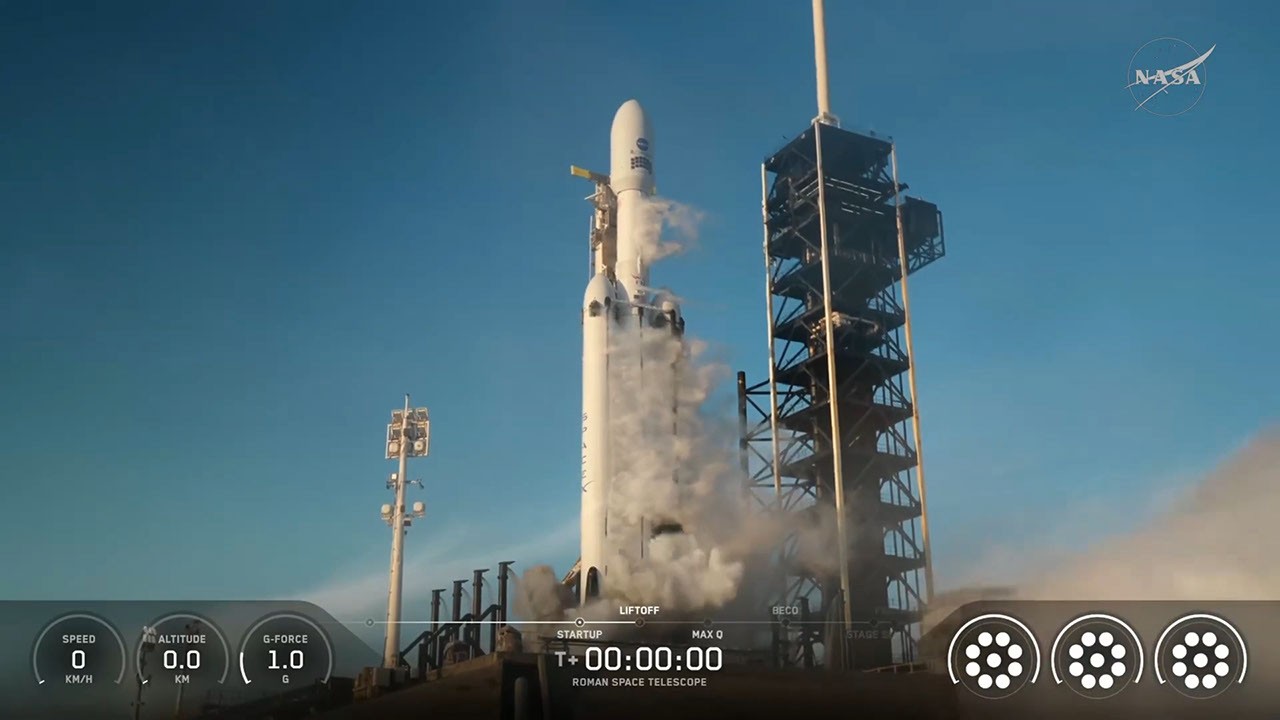
NASA's Nancy Grace Roman Space Telescope will launch in August 2026, marking a watershed moment for wide-field infrared astronomy and the search for habitable exoplanets. The mission represents a generational leap beyond the James Webb Space Telescope, designed to survey vast swaths of the sky simultaneously while peering deeper into cosmic history.
Roman will carry a 2.4-meter primary mirror, identical in aperture to the Hubble Space Telescope but engineered for infrared wavelengths between 0.48 and 2.0 micrometers. This design choice gives Roman extraordinary capabilities for mapping the universe's structure, detecting distant supernovae, and characterizing the atmospheres of exoplanets through transit spectroscopy.
The mission's science agenda targets three primary objectives. First, Roman will conduct a comprehensive survey of Type Ia supernovae across billions of light-years, refining measurements of cosmic expansion and dark energy. Second, it will perform microlensing surveys to discover exoplanets around distant stars, revealing populations of worlds beyond direct detection methods. Third, Roman will image galactic cores and active galactic nuclei at resolutions impossible from ground-based telescopes, unveiling black hole behavior and star formation in the early universe.
The James Webb Space Telescope revolutionized deep-field observations after its 2021 deployment, but it observes only a narrow patch of sky at any given moment. Webb's fixed instruments limit field of view to roughly 11 arcminutes across. Roman inverts this paradigm. Its Wide Field Instrument delivers a field of view spanning 0.28 square degrees, roughly 200 times larger than Webb's comparable infrared capacity. This means Roman can survey an entire galaxy cluster or conduct time-domain astronomy across massive celestial regions in single pointings.
The Coronagraph Instrument represents Roman's second major innovation. This specialized subsystem will block starlight directly, enabling direct imaging of exoplanet atmospheres and circumstellar dust disks around nearby stars. Coronagraphic observations address a critical gap in exoplanet characterization. While transit spectroscopy reveals atmospheric composition, direct imaging of thermal emission provides independent confirmation and reveals planetary mass and atmospheric temperature.
NASA allocated approximately 3.2 billion dollars for Roman's development and operations through its first five years. The mission operates as a joint initiative between NASA, the Canadian Space Agency, and international partners, reflecting the global scientific investment in Roman's capabilities.
Roman's launch from Cape Canaveral on a SpaceX Falcon Heavy rocket will position the telescope at the Earth-Sun L2 Lagrange point, roughly 1 million kilometers from Earth. This location provides thermal stability and minimizes solar interference during observations.
The 2026 launch date anchors NASA's astrophysics roadmap for the next decade. Roman will operate in concert with the James Webb Space Telescope, the Vera Rubin Observatory's Legacy Survey of Space and Time ground-based surveys, and next-generation ground telescopes including the Extremely Large Telescope. This coordinated observational architecture will enable multi-wavelength studies impossible with individual facilities.
The scientific return from Roman will reshape exoplanet discovery, resolve decades-old questions about cosmic acceleration and dark energy, and provide unprecedented census data on planetary systems across the Milky Way and neighboring galaxies. For researchers seeking biosignature-bearing worlds and understanding planetary formation, Roman serves as an essential complement to future missions like the Habitable Worlds Observatory.