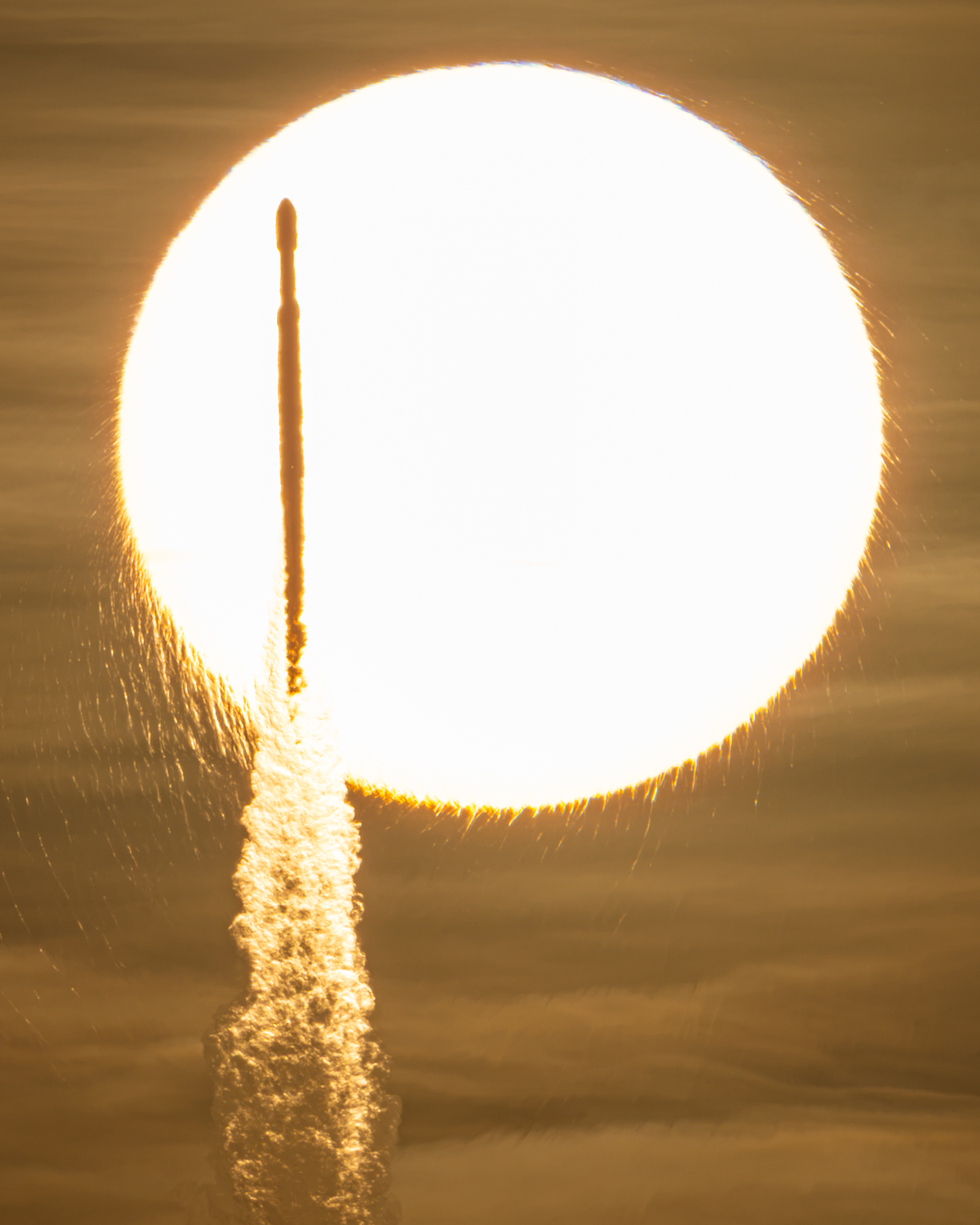
NASA's Nancy Grace Roman Space Telescope launches aboard a SpaceX Falcon Heavy rocket on August 30, 2026, from Kennedy Space Center in Florida. The mission represents a watershed moment for wide-field astronomy, positioning Roman as the successor to Hubble Space Telescope's legacy while exceeding its observational capabilities by orders of magnitude.
Roman carries a 2.4-meter primary mirror, matching Hubble's diameter, but its instruments deliver a field of view roughly 100 times larger. This architectural advantage transforms astronomical survey work. Where Hubble examines small patches of sky in extraordinary detail, Roman sweeps across vast cosmic territories, capturing billions of stars and galaxies in single observations. That efficiency reshapes how astronomers approach fundamental questions about the universe's structure and evolution.
The telescope is named after Nancy Grace Roman, NASA's first chief astronomer, who pioneered space-based astronomy and championed the Hubble Space Telescope concept decades before its 1990 launch. Roman's advocacy proved instrumental in establishing ultraviolet and visible-light astronomy from orbit as a scientific priority.
Roman will operate primarily in infrared wavelengths, complementing rather than replacing Hubble. Its infrared sensitivity penetrates cosmic dust that obscures visible light, revealing star-forming regions, distant galaxies shrouded by dust, and exoplanet atmospheres. The infrared channel also opens windows into the universe's earliest epochs, when light from the first galaxies has been redshifted into infrared bands during its billion-year journey to Earth.
The observatory carries two primary instruments. The Wide Field Instrument provides the expansive survey capability, scanning large sky regions for supernovae, gravitational lenses, and galaxy populations across cosmic time. The Coronagraph Instrument represents technology demonstration hardware designed to directly image exoplanets by blocking starlight, pioneering techniques for future missions dedicated to detecting potentially habitable worlds around other stars.
SpaceX's Falcon Heavy lifts Roman beyond Earth orbit toward the Sun-Earth L2 Lagrange point, approximately one million miles from Earth. This location offers thermal stability and minimal Earth interference, critical for infrared observations. The journey requires roughly one month; operations commence after instrument commissioning and calibration.
Roman's survey strategy addresses open questions in cosmology. Its observations will map dark energy's influence on the universe's expansion, constrain the nature of dark matter through gravitational lensing measurements, and chart how galaxies assembled over cosmic history. For exoplanet science, Roman will conduct surveys identifying microlensing events caused by planets orbiting distant stars, complementing Kepler and TESS transit detection methods.
The mission carries a five-year primary science timeline, with potential extensions extending observations into the 2030s. Annual operational costs run approximately $150 million, positioning Roman as one of NASA's most expensive space observatories. Construction delays and technical challenges extended the original launch date by several years, but the payload now represents peak engineering maturity.
Roman joins an orbital constellation of astronomical facilities. The James Webb Space Telescope, operating since 2022, provides infrared spectroscopy of individual objects. Roman delivers census data across billions of targets. Together, these observatories establish a new foundation for understanding galaxies, stars, and the possibility of life beyond Earth.