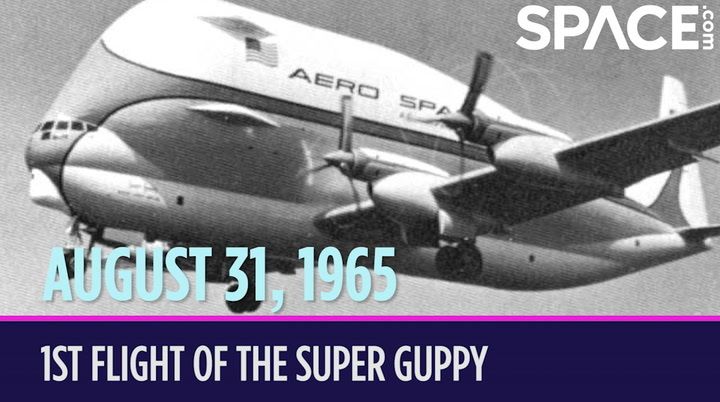
NASA launched an aircraft that looked nothing like conventional planes on August 31, 1965. The Super Guppy, a heavily modified Pregnant Guppy turboprop, completed its inaugural flight. The aircraft earned its distinctive name from its bulbous fuselage, which resembled a whale more than the sleek jets dominating aviation at the time.
The Super Guppy addressed a critical logistical problem for the Apollo program. NASA needed to transport massive rocket components and spacecraft assemblies across the country without disassembling them. Traditional cargo aircraft could not accommodate the Saturn V rocket stages, command modules, or lunar modules that required integration at Kennedy Space Center. Shipping these objects by rail or sea introduced delays and risks of damage during handling.
The original Pregnant Guppy, developed in the late 1950s, proved the concept worked. NASA contracted Aero Spacelines to construct the Super Guppy as an improved version. Engineers removed the fuselage above the wings and replaced it with an enormous cargo compartment. The resulting aircraft measured 143 feet long with a cargo hold stretching 111 feet. Internal dimensions provided 39,000 cubic feet of pressurized space, dwarfing anything else capable of flight at the time.
The Super Guppy carried parts that shaped human spaceflight. It transported complete Saturn V stages, the F-1 engines that powered the first stage, and Apollo command and service modules. Between 1965 and the end of the Apollo program in 1972, the Super Guppy flew hundreds of cargo missions. The aircraft reduced transport time from weeks to hours, allowing NASA to maintain the accelerated schedule required to land humans on the Moon before the decade's end.
This aircraft remained unique in aviation history. No comparable aircraft existed then or now. Modern transport planes like the Airbus A300-600ST (also known as Beluga) and the Antonov An-225 operate on similar principles, but the Super Guppy came first. It proved that unconventional designs could solve real engineering challenges in spaceflight logistics.
The Super Guppy's first flight on August 31, 1965, demonstrated that moving to space required innovations far beyond rocket science. NASA recognized that supporting human spaceflight demanded solutions in manufacturing, transportation, and infrastructure. The aircraft represented engineering pragmatism: when existing tools failed to meet mission requirements, engineers built new ones.
NASA operated multiple Super Guppy variants throughout the space age. The aircraft continued supporting space shuttle development and construction. Later versions transported components for the International Space Station program. The original Super Guppy that flew that August day in 1965 became an icon of Apollo-era logistics and ambition, a flying testament to the infrastructure that sent humans to the Moon.