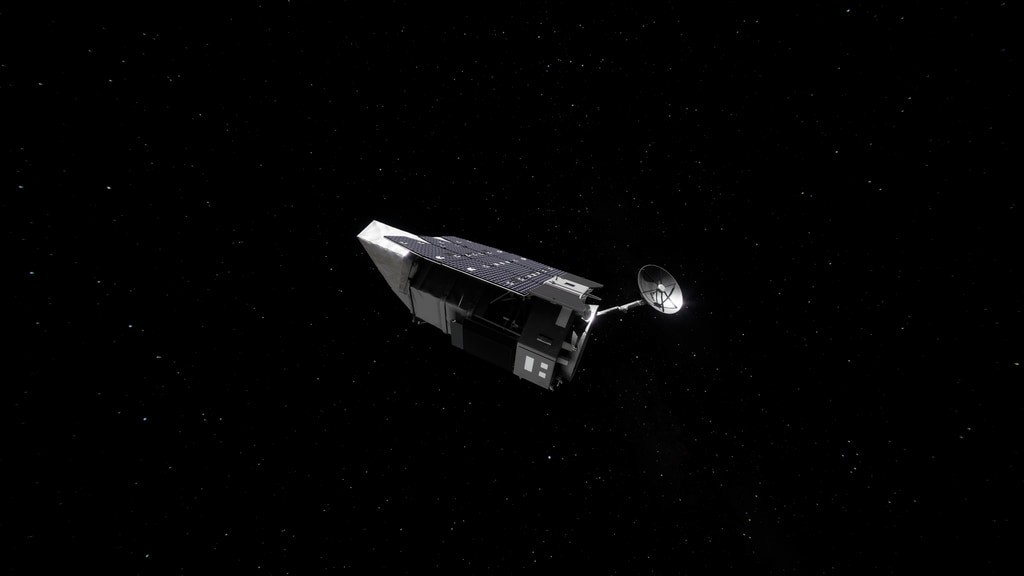
The Nancy Grace Roman Space Telescope has begun its three-month transit to Sun-Earth Lagrange Point 2, the gravitational balance point roughly one million kilometers beyond Earth's shadow. During this journey, NASA engineers and scientists are systematically powering on, testing, and calibrating every subsystem aboard the observatory to prepare it for its mission to study the universe's darkest secrets.
Commissioning represents the critical phase between launch and science operations. Roman's instruments, thermal systems, communications arrays, and pointing mechanisms undergo rigorous evaluation. Engineers verify that each component performs within specifications after surviving the violent accelerations and vibrations of launch. They adjust optical alignments, calibrate detectors, and validate software that will govern the telescope's observations for years to come.
The Roman Space Telescope represents NASA's most ambitious astrophysics mission since the James Webb Space Telescope. Named after astronomer Nancy Grace Roman, a pioneer in space-based astronomy who led NASA's astrophysics program in the 1960s and 1970s, the observatory carries a 2.4-meter primary mirror, the same diameter as Hubble's. But Roman's technology surpasses Hubble in crucial ways. Its instruments span ultraviolet to near-infrared wavelengths with unprecedented sensitivity and field of view.
Roman carries two primary instruments. The Wide Field Instrument will observe vast swaths of sky simultaneously, enabling large surveys of galaxies and supernovae. The Coronagraph Instrument represents a technology demonstration designed to block starlight and reveal planets orbiting distant stars. This coronagraph pushes the boundaries of exoplanet detection, aiming to image worlds similar to Jupiter orbiting sun-like stars at distances comparable to our solar system.
The science objectives drive the commissioning timeline. Roman will measure the expansion history of the universe with unprecedented precision, refining our understanding of dark energy and the cosmos's ultimate fate. It will catalog millions of galaxies to trace cosmic structure formation over billions of years. Its exoplanet hunting capabilities will reveal planetary systems orbiting other stars, offering targets for future biosignature searches.
Lagrange Point 2 provides the ideal vantage point. At this gravitational equilibrium, Roman remains continuously positioned on the sunward side of Earth's shadow. The point requires minimal fuel for station-keeping, extending mission lifetime. The stable environment protects Roman from Earth's thermal radiation and infrared emissions that would interfere with observations.
The three-month journey allows commissioning to proceed methodically. Engineers monitor telemetry continuously, identifying anomalies before they become problems. Systems operate in increasingly realistic configurations. Solar panels maintain thermal balance. The spacecraft's attitude control system fine-tunes its pointing accuracy to within a few arcseconds. Detectors cool to operating temperatures around 37 Kelvin, cold enough to minimize thermal noise that degrades measurements.
Once commissioning concludes, Roman transitions to Early Release Observations. The team selects targets that demonstrate the telescope's capabilities while gathering valuable data. These observations preview the science Roman will enable: high-resolution imaging of galaxy clusters, spectroscopy of distant supernovae, and searches for exoplanet signatures in direct imaging mode.
Roman represents the next chapter in space-based astrophysics. Its capabilities address fundamental questions about the universe's composition, structure, and the prevalence of potentially habitable worlds. The commissioning phase determines whether this investment of billions of dollars and decades of engineering expertise delivers the revolutionary observations NASA's astrophysics program demands.