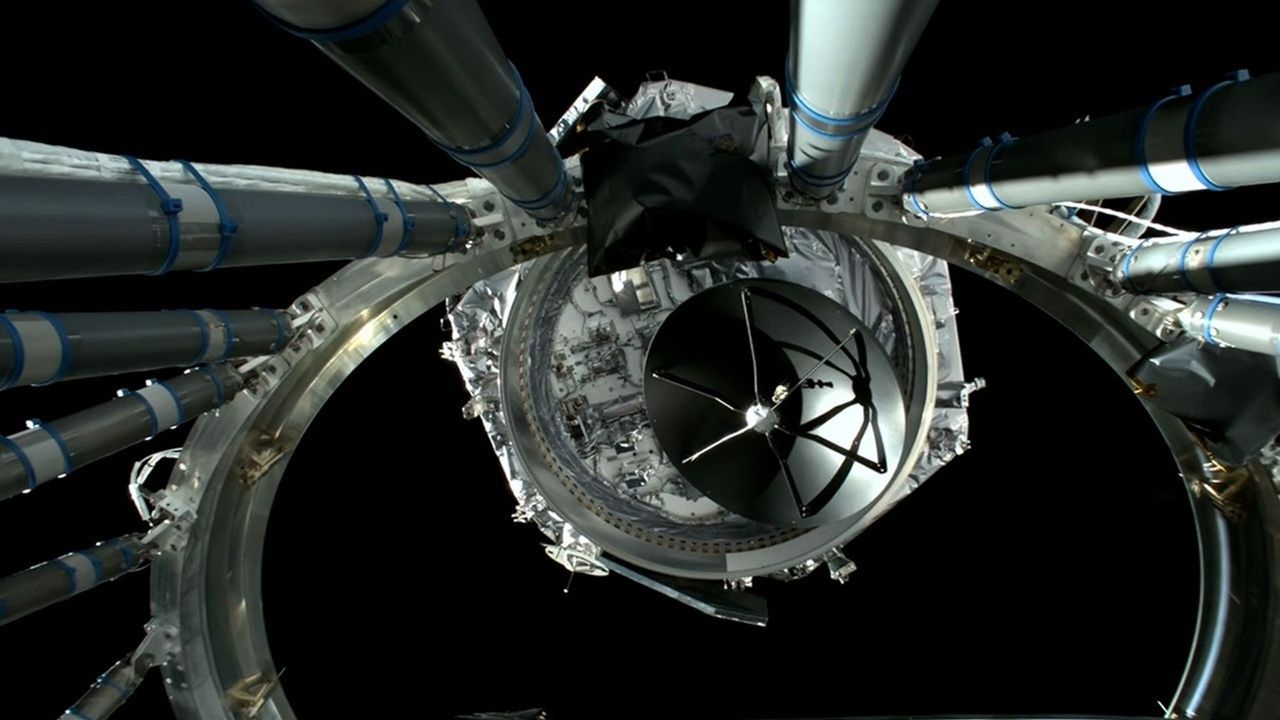
NASA's Nancy Grace Roman Space Telescope has separated from its launch vehicle and begun its deployment sequence, marking the successful start of one of the agency's most ambitious infrared observatories. The separation occurred shortly after liftoff, confirming that the rocket's upper stage performed as designed and delivered the telescope to its intended trajectory.
The Roman telescope represents a generational leap in infrared astronomy. Named after Nancy Grace Roman, the NASA astronomer who pioneered space-based astronomy in the 1960s, this observatory carries a 2.4-meter primary mirror, matching the Hubble Space Telescope in collecting power but optimized for infrared wavelengths. Unlike Hubble, which observes primarily in visible and ultraviolet light, Roman will peer deeper into space and time, penetrating dust clouds that obscure stellar nurseries and capturing light from the universe's earliest galaxies.
The telescope's launch marks the culmination of decades of development within NASA's Astrophysics Division. After separation from its rocket, Roman enters a crucial deployment phase lasting several weeks. Solar panels must unfold to power the spacecraft. A large sunshield, similar in concept to the James Webb Space Telescope's but optimized for Roman's design, must extend to protect the instrument from solar heating. The telescope's mirrors and sensors require careful thermal settling before calibration can begin.
Roman's science objectives span multiple frontiers in modern astronomy. The observatory will conduct unprecedented surveys of exoplanets using a technique called microlensing, detecting planets around distant stars by measuring the subtle bending of starlight as massive objects pass between Earth and background stars. This method proves particularly sensitive to planets in the habitable zones of their host stars, offering new census data on potentially habitable worlds.
Beyond exoplanet science, Roman will map the universe's expansion history with precision never before achieved. By measuring distances to thousands of supernovae across billions of light-years, the telescope will refine our understanding of dark energy, the mysterious force accelerating cosmic expansion. This work builds directly on discoveries that earned the 2011 Nobel Prize in Physics.
The observatory also carries a coronagraph instrument designed to directly image exoplanets and debris disks around nearby stars. By blocking starlight with precision optics, Roman can photograph the light reflected from planetary surfaces and rings, opening new windows onto distant worlds.
Roman operates from a unique vantage point. Unlike Hubble, which orbits Earth at 380 miles altitude, Roman travels to the Sun-Earth L2 Lagrange point, approximately one million miles away. This location provides a thermally stable environment far from Earth's infrared radiation, critical for an instrument designed to detect faint heat signatures from distant galaxies and exoplanets.
The telescope joins an elite group of space observatories that have transformed astronomy. Hubble revolutionized visible-light astronomy for over three decades. The James Webb Space Telescope, launched in 2021, opened the infrared universe with unprecedented sensitivity. Roman will complement these predecessors, excelling at wide-field surveys and time-domain infrared astronomy where Webb's narrow field of view cannot compete.
The separation moment captured by NASA photographers documents one of space exploration's defining achievements. As Roman moves toward its operational station at L2, its instruments begin the long journey toward answering fundamental questions about exoplanets, cosmic expansion, and the universe's composition.