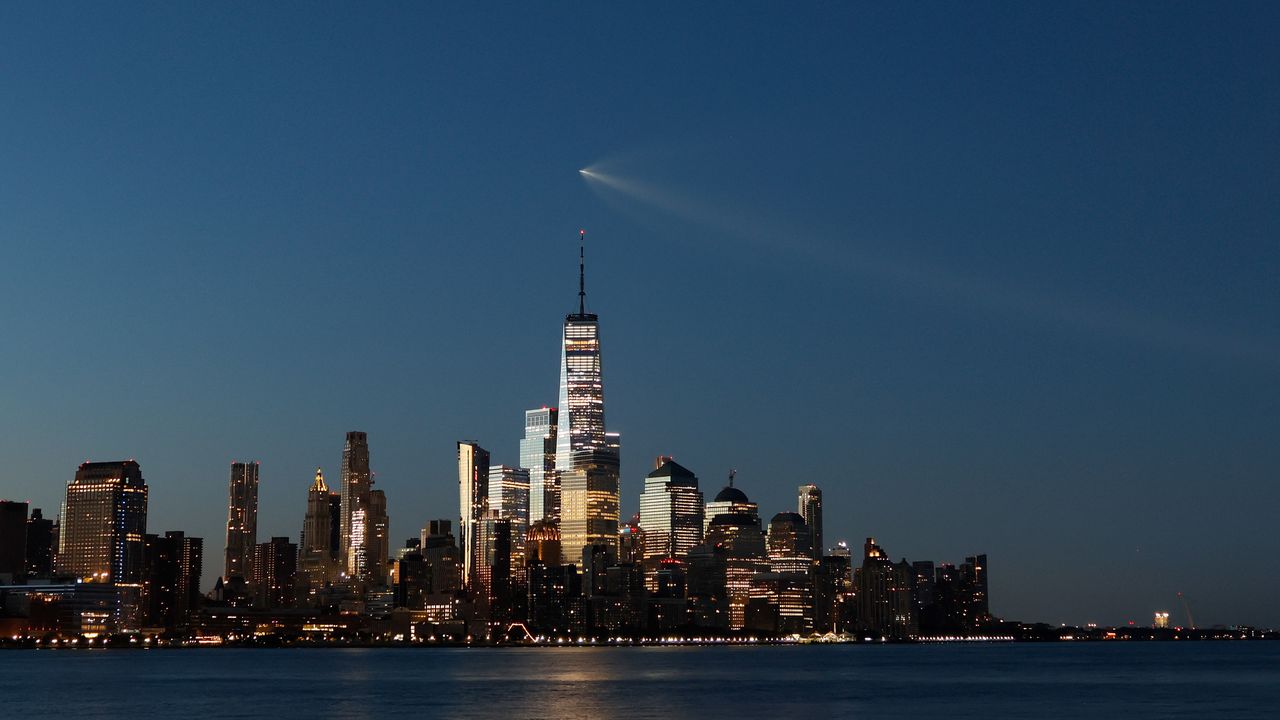
SpaceX executed its final planned Falcon 9 Starlink deployment from Florida on January 8, producing one of the most visually striking twilight phenomena documented in years. The rocket's upper stage venting procedures created an enormous glowing structure across the night sky, visible across multiple northeastern states and most notably photographed from New York City.
The effect occurs because Falcon 9's second stage operates at high altitude where the sun continues to illuminate it even after sunset at ground level. When SpaceX vents unburned propellant and stages separate, the expelled gases and debris catch direct sunlight at orbital altitude, scattering light across a vast area. From New York City, observers witnessed what appeared to be a luminous jellyfish shape, complete with a bright head and trailing tentacle-like formations extending downward through the lower atmosphere.
This particular launch marked a transition point for SpaceX's Starlink deployment strategy. The company has steadily expanded its constellation of internet-providing satellites from multiple launch locations. Florida's Space Coast, hosting numerous Falcon 9 operations from Kennedy Space Center and Cape Canaveral Space Force Station, has been a primary deployment hub. The final scheduled Starlink launch from this location signals SpaceX's shift toward consolidating future missions to other facilities or adjusting deployment cadences as the constellation approaches its designed capacity.
Starlink operates as a megaconstellation system, with SpaceX ultimately planning to deploy tens of thousands of satellites across multiple orbital shells. The constellation provides broadband coverage to remote regions globally, including underserved areas across North America, South America, Europe, and Asia. Each Falcon 9 launch carries approximately 60 Starlink satellites to low Earth orbit. This particular mission continued that pattern while delivering the spectacular visual display that has become characteristic of SpaceX's orbital operations.
The "jellyfish" phenomenon has repeated several times during past Falcon 9 and Falcon Heavy missions, consistently generating public interest and occasional alarm among observers unfamiliar with the effect. Sightings in 2019 and earlier instances sparked numerous UFO reports before SpaceX clarified the cause. The January 8 event demonstrates that despite increased public awareness of rocket operations, these twilight phenomena retain their capacity to captivate observers across wide geographic regions.
SpaceX continues operating Falcon 9 from California's Vandenberg Space Force Base and Texas's Starbase, where additional Starlink launches proceed regularly. The company also maintains deployment options through its Falcon Heavy rocket. As Starlink constellation buildout continues, future launches will service both satellite internet expansion and SpaceX's broader portfolio of government and commercial customers.
For amateur astronomers and space weather observers, these twilight displays serve as unscheduled reminders of the increasingly crowded near-Earth environment. Thousands of active satellites now orbit Earth, with Starlink representing only the largest single constellation. The January 8 spectacle over New York City highlighted how orbital operations, though routine for SpaceX engineers, continue producing awe-inspiring displays for viewers on the ground.