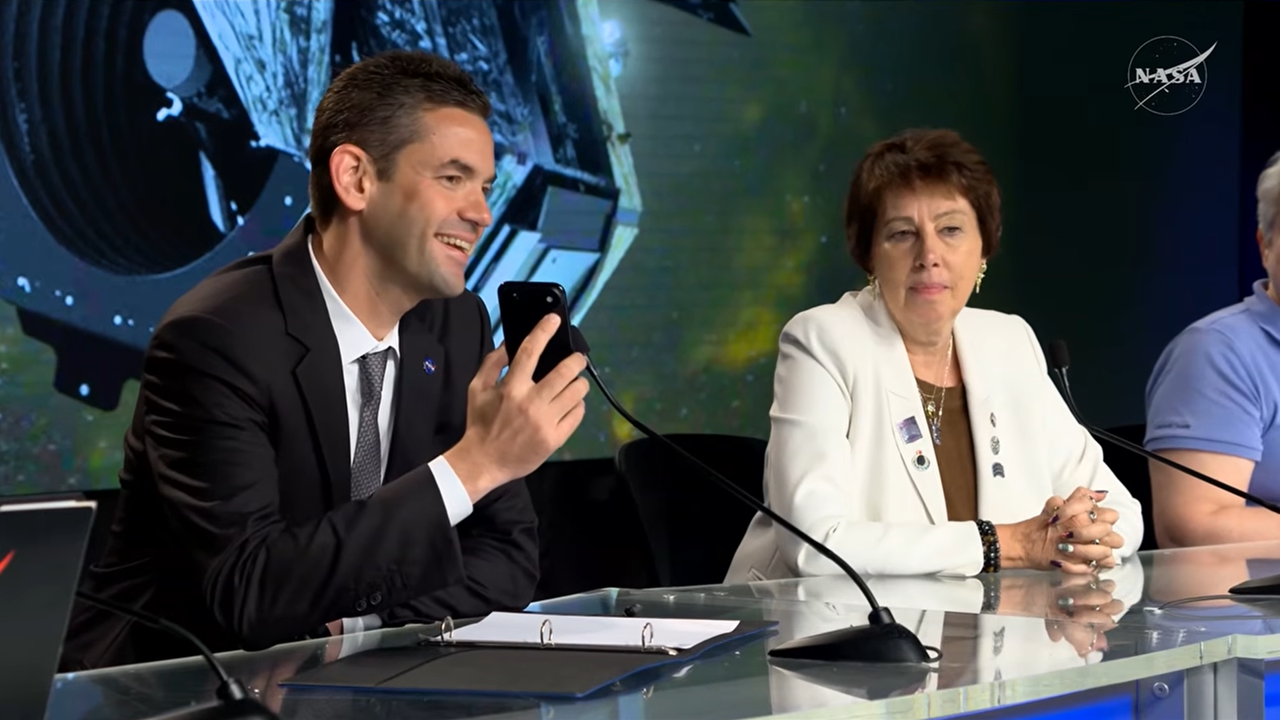
President Trump called into a NASA press conference on August 30 to congratulate the team behind the Nancy Grace Roman Space Telescope following its successful launch. The interruption marked an unusual moment in space policy, given Trump's prior efforts to eliminate funding for the mission during his first term.
The Nancy Grace Roman Space Telescope, named after the pioneering NASA astrophysicist who revolutionized infrared astronomy, launches as one of the most ambitious observatories ever constructed. The telescope will operate in the infrared spectrum, allowing astronomers to peer deeper into space and time than ever before. Its primary mission includes mapping the large-scale structure of the universe, detecting exoplanets, and studying dark energy and dark matter, the invisible forces that dominate the cosmos.
Trump's congratulatory call underscored a complex relationship between his administration and NASA's budget priorities. During his first term, the White House proposed cutting or eliminating several large-format missions, including Roman, to redirect funds toward the Artemis lunar program and other initiatives. Congress repeatedly rejected these proposals, maintaining funding for Roman as key stakeholders recognized its scientific value and the jobs associated with its development.
The telescope represents years of collaboration among NASA, astronomical institutions, and contractors. Goddard Space Flight Center led development of the instrument, with contributions from Ball Aerospace, the Space Telescope Science Institute, and universities across the nation. The mission builds directly on Hubble's legacy while incorporating technological advances that enable faster surveys of the sky and greater sensitivity to faint objects.
Roman's design reflects lessons learned from decades of space telescope operations. The primary mirror measures 2.4 meters in diameter, matching Hubble's aperture but optimized for infrared observations. Two main instruments, the Wide Field Instrument and the Coronagraph Instrument, will conduct parallel science operations. The coronagraph will block starlight to reveal planets orbiting nearby stars, a technique essential for studying potentially habitable worlds. The wide field instrument will map billions of galaxies and detect supernovae across billions of light-years of distance.
The launch itself required coordination between NASA, the launch provider, and support teams. Roman lifted off aboard a United Launch Alliance vehicle, the culmination of testing and preparation across multiple agencies and contractors. Success meant joining an exclusive group of operating space observatories that define modern astronomy.
Roman's deployment unlocks new windows into fundamental questions about the universe's composition, structure, and evolution. By detecting exoplanets directly through the coronagraph, astronomers gain new methods to characterize worlds that might harbor life. Mapping dark energy across cosmic time provides data to test theories of the universe's accelerating expansion, a phenomenon discovered in 1998 that reshaped cosmology.
Trump's call acknowledged the achievement without directly addressing the earlier budget debates. The moment reflected broader bipartisan support for space science, even when disagreement exists over specific funding priorities. For NASA, the successful launch of Roman represents a major milestone in observational astronomy, opening new chapters in how humanity understands the cosmos.