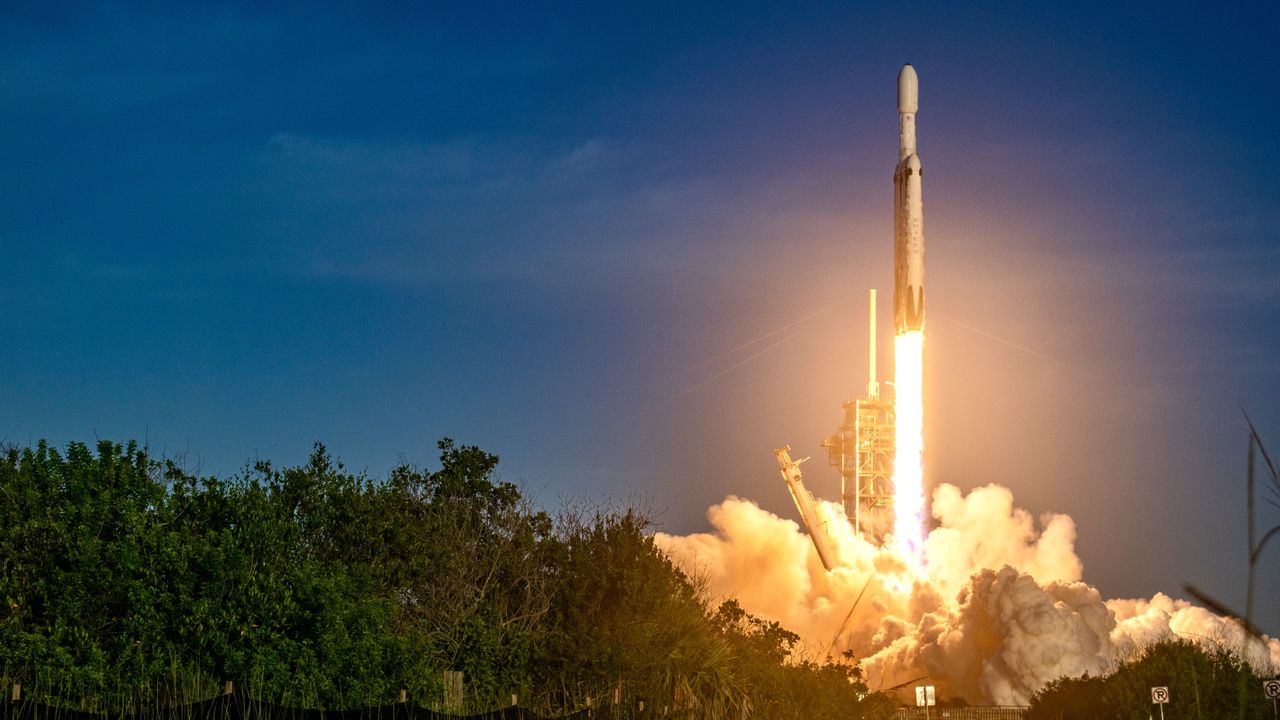
# Roman Space Telescope Prepares for Launch Into Deep Space Exploration
NASA's Nancy Grace Roman Space Telescope stands ready for a transformative mission that will reshape our understanding of the universe's largest structures and the nature of dark energy itself. The observatory's imminent launch represents a watershed moment in observational astronomy, deploying capabilities that will operate at scales and sensitivities no prior space-based instrument has achieved.
The Roman Space Telescope carries a 2.4-meter primary mirror, matching the diameter of the Hubble Space Telescope but equipped with imaging technology engineered for the infrared spectrum. This design allows Roman to peer deeper into space and further back in time than Hubble, observing distant galaxies as they existed billions of years ago. The telescope will capture images with a field of view roughly 100 times larger than Hubble's Wide Field Camera, enabling astronomers to map cosmic structure across unprecedented volumes of space.
Roman's primary science objectives target three fundamental mysteries in cosmology. The mission will map the distribution of dark matter and dark energy across the universe by observing how gravity from massive structures bends light from distant galaxies. This technique, called gravitational lensing, provides direct evidence of dark matter's presence and allows scientists to test competing theories about dark energy, the force accelerating the universe's expansion. Roman will conduct a comprehensive survey of supernovae across billions of light-years, measuring their distances and brightness to refine our understanding of cosmic expansion history.
The telescope will also detect and characterize exoplanets using a coronagraph instrument designed to block out starlight and reveal planets orbiting distant stars. This capability opens possibilities for direct imaging of potentially habitable worlds and studying their atmospheric composition.
NASA, in partnership with the ESA (European Space Agency) and JAXA (Japan Aerospace Exploration Agency), developed Roman over two decades. The mission's estimated cost of approximately 2.4 billion dollars reflects the complexity of building instruments sensitive enough to detect photons from galaxies 10 billion light-years distant while maintaining operational stability in the harsh environment of space.
The launch window places Roman at the Sun-Earth L2 Lagrange point, approximately 1 million kilometers from Earth. This orbital position provides thermal stability and allows Roman to observe the universe without Earth's heat radiating into its infrared detectors. The journey to L2 takes roughly three months, during which mission controllers will deploy the telescope's components and conduct commissioning tests.
Roman's data will feed directly into broader astronomical research addressing how galaxies form and evolve, how stellar systems develop around young stars, and how the universe's expansion rate has changed throughout cosmic history. The telescope's observations will complement concurrent missions like the James Webb Space Telescope, which focuses on earlier cosmic epochs and individual objects rather than statistical surveys of large-scale structure.
The mission opens a new era in space-based astronomy where infrared surveying from beyond Earth's atmosphere becomes routine. Roman's success will inform design decisions for the next generation of observatories and establish methodologies for combining space-based surveys with ground-based telescopes to construct comprehensive maps of the cosmos. Astronomers worldwide anticipate transformative discoveries once Roman's instruments begin collecting light that has traveled across billions of years of expanding space.