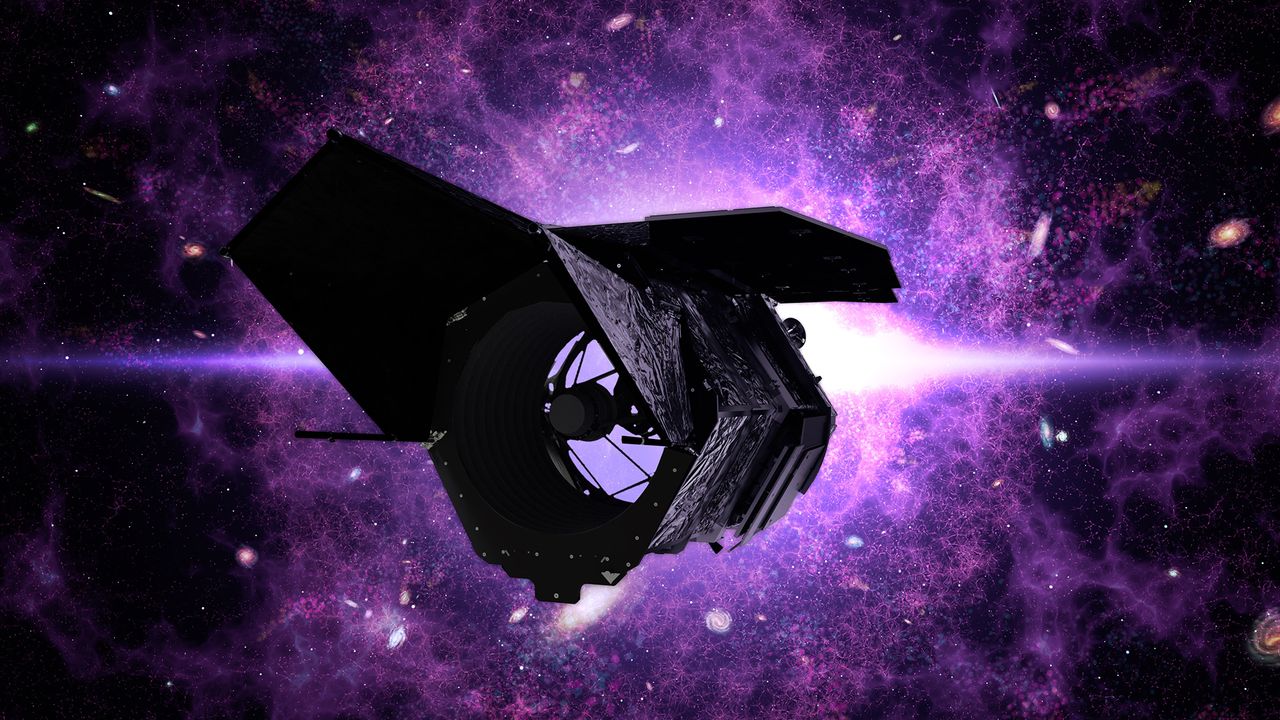
NASA's Nancy Grace Roman Space Telescope launched toward its operational destination, but months of calibration and testing lie ahead before the observatory begins collecting data on dark energy, exoplanets, and infrared observations that will reshape astrophysics.
The Roman Space Telescope, named after the pioneering NASA astrophysicist Nancy Grace Roman, represents a generational leap in infrared astronomy. The mission carries a 2.4-meter primary mirror, matching the Hubble Space Telescope in size but operating across wavelengths invisible to human eyes. Unlike Hubble's visible-light observations, Roman detects infrared radiation, allowing it to peer through cosmic dust clouds and observe some of the universe's most distant objects.
NASA's timeline calls for Roman to reach its destination at Lagrange Point 2, approximately one million miles from Earth. This orbital position, where gravitational forces from Earth and Sun balance, keeps the telescope stable while minimizing thermal interference. The journey itself takes months. Once arrived, the observatory enters its commissioning phase, a critical period spanning several additional months.
During commissioning, NASA engineers will deploy Roman's sunshield, extend its optical systems, and power up the Wide Field Instrument and Coronagraph Instrument. The Wide Field Instrument delivers imaging and spectroscopy across the infrared spectrum. The Coronagraph Instrument, a technological breakthrough, blocks starlight with exquisite precision, allowing Roman to detect and characterize exoplanets and debris disks around distant stars. This capability addresses a core science objective: discovering potentially habitable worlds orbiting other suns.
Technicians will conduct extensive testing of thermal systems, propulsion, data transmission, and each scientific instrument. The team must verify that Roman's optics align perfectly and that thermal controls maintain the infrared detectors at cryogenic temperatures. These systems operate in the harsh vacuum of space, where ground testing provides only partial validation.
Roman's science agenda encompasses three primary objectives. First, the mission will study dark energy, the mysterious force driving cosmic expansion. By measuring the distances and velocities of billions of galaxies, Roman will help astronomers understand why the universe accelerates rather than slows. Second, the observatory will conduct an exoplanet survey, identifying thousands of worlds orbiting other stars and characterizing their atmospheres. Third, Roman will observe supernovae, star-forming regions, and other transient phenomena with infrared sensitivity and angular resolution exceeding current capabilities.
The coronagraph technology aboard Roman represents a gateway technology. While the instrument conducts its primary exoplanet survey, NASA engineers will test techniques that future missions like the Habitable Worlds Observatory could employ. This experimental approach allows NASA to validate approaches before committing to costlier flagship missions.
Cost and schedule pressures have marked Roman's development. The mission budget exceeded initial estimates, and launch delays pushed the timeline into 2024. Despite these challenges, the scientific return justifies the investment. Roman's infrared eyes will detect galaxies formed when the universe was less than one billion years old. It will measure cosmic distances with unprecedented accuracy and identify worlds that future generations might explore.
The commissioning period tests patience, but represents necessary validation. Once Roman achieves full operational status, the observatory will conduct observations lasting its expected ten-year mission lifespan. The data collected will answer fundamental questions about cosmic origin, evolution, and humanity's place within it.