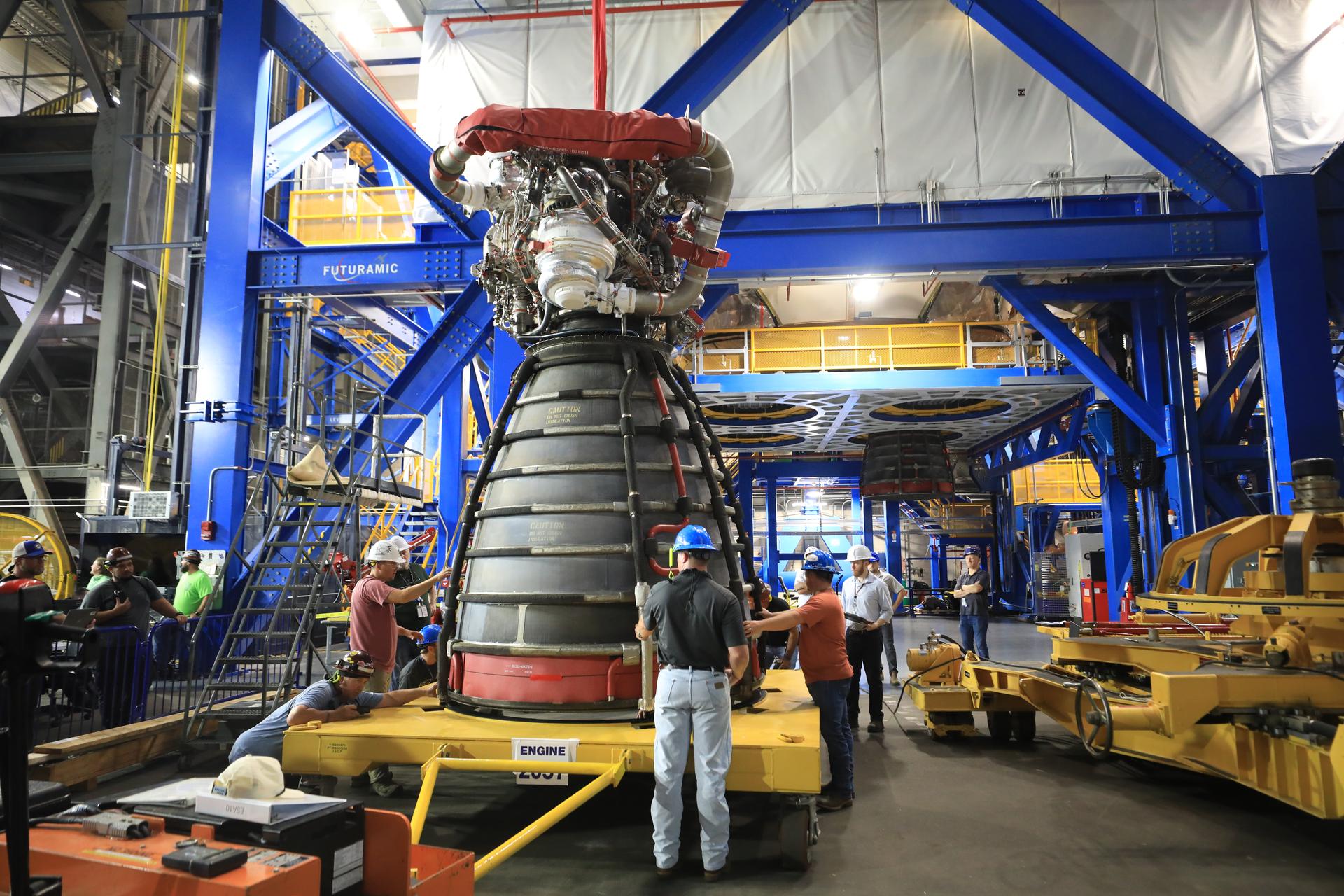
NASA technicians installed the four RS-25 engines into the Space Launch System core stage on August 24 at Kennedy Space Center in Florida. These engines will power the Artemis III mission, scheduled to launch in 2027 with a crew headed to lunar orbit.
The RS-25 engines represent decades of spaceflight heritage. Each of the four engines originally flew on the Space Shuttle, making them among the most flight-proven rocket engines in existence. The serial numbers etched on each engine document their complete flight history, a record spanning multiple shuttle missions. NASA refurbished and certified these engines for use on SLS, extending their operational life and reducing development costs.
The core stage itself represents the heaviest lift-off component SLS produces. Standing 212 feet tall and containing 537,000 gallons of liquid hydrogen and liquid oxygen propellant, the core stage generates 2 million pounds of thrust at launch. The four RS-25 engines fire in parallel, each producing roughly 418,000 pounds of thrust at sea level. Their cluster arrangement allows precise throttling and engine-out capability, critical redundancies for human spaceflight.
The installation milestone marks a concrete step toward Artemis III's 2027 target. Assembly of the SLS core stage has faced delays over several years. Earlier cores experienced technical challenges, supply chain disruptions, and design refinements. The successful installation of these four heritage engines demonstrates that production is advancing on schedule for the upcoming lunar mission.
Artemis III will launch on SLS with the Orion spacecraft, carrying four astronauts into lunar orbit. Unlike Artemis I (uncrewed, 2022) and Artemis II (crewed lunar flyby, 2025), Artemis III includes a Human Landing System component. Two crew members will descend to the lunar south polar region while two remain in Orion orbit.
The south pole represents the most scientifically valuable landing site on the Moon. The region hosts permanently shadowed craters that may contain water ice, a resource essential for sustained lunar operations. Artemis III astronauts will conduct geology, sample collection, and site surveys to advance NASA's Moon-to-Mars exploration architecture.
The RS-25 engines trace their lineage to the National Space Transportation System. Space Shuttle Main Engines, as they were originally designated, flew reliably for 135 shuttle missions across 30 years. The engines withstood extreme thermal and mechanical stresses, operating at chamber pressures exceeding 3,000 pounds per square inch. Their proven track record made them ideal candidates for SLS, which demanded high performance and human-rating certification.
SLS represents NASA's backbone for deep space exploration. The rocket class enables large-payload delivery beyond low Earth orbit, lifting 95,000 pounds to trans-lunar injection and supporting both crewed missions and heavy cargo delivery to lunar orbit. Without this launch capability, sustained human presence on the Moon becomes logistically impossible.
The Artemis program anchors America's space exploration strategy for the 2020s. Artemis III completes the initial crewed lunar missions, followed by extended surface operations through subsequent Artemis flights. These missions establish infrastructure and operational protocols for eventual Mars exploration, the ultimate destination for human spaceflight in the coming decades.