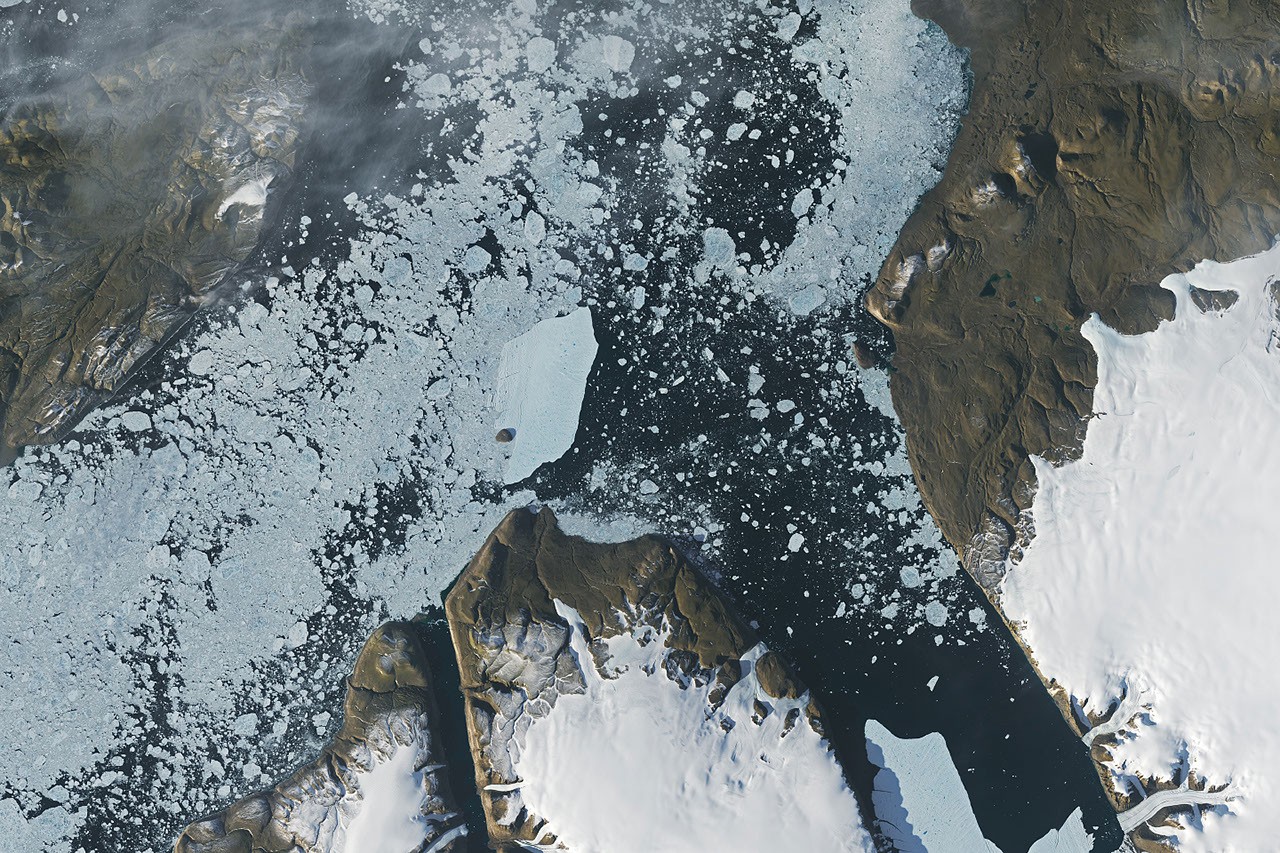
A massive iceberg that broke free from Petermann Glacier in northwest Greenland during summer 2026 drifted through Nares Strait and collided with an island during its journey southward. NASA tracked the event as part of ongoing monitoring of Arctic ice dynamics and glacial retreat in response to climate change.
Petermann Glacier, located in northern Greenland, represents one of the most closely watched ice masses in the Arctic. The glacier has experienced dramatic calving events in recent years, with major icebergs breaking away as warming ocean waters undermine its floating ice shelf. The 2026 event added to a pattern of accelerating glacial loss that scientists attribute to warmer temperatures melting ice from below and above.
Nares Strait, the narrow waterway separating Greenland from Ellesmere Island in Canada, serves as a critical corridor for Arctic ice export. Icebergs that calve from northern Greenland glaciers routinely funnel through this passage, eventually drifting southward along the East Greenland Current. The collision documented in summer 2026 highlights how these massive ice masses interact with fixed geography as they transit toward warmer southern waters where they eventually melt.
NASA's satellite observations provide real-time tracking of such events. The space agency employs a constellation of Earth-observing spacecraft, including Landsat satellites and the Moderate Resolution Imaging Spectroradiometer (MODIS) instruments aboard Terra and Aqua, to document changes across the Arctic. This continuous monitoring reveals patterns in ice calving frequency, iceberg trajectories, and the overall rate of glacial retreat affecting Greenland's ice sheet, which contains enough frozen water to raise global sea levels by approximately 7 meters if completely melted.
The collision between the iceberg and Joe Island represents the type of dynamic interaction that occurs regularly in Arctic waterways but becomes more frequent as glaciers shed larger volumes of ice. Such events have practical implications for Arctic shipping routes and coastal communities that depend on navigation through these waters. They also serve as direct visual evidence of the scale at which climate change reshapes the Arctic landscape.
Petermann Glacier has experienced two major calving events in the past two decades. In 2010, an iceberg roughly the size of Luxembourg broke away. Another substantial calving occurred in 2012. These events underscore how Arctic glaciers respond to warming with accelerated ice loss rather than gradual retreat. Each calving event releases icebergs capable of drifting across vast oceanic distances before melting, with implications for freshwater input into North Atlantic circulation patterns and regional ocean chemistry.
NASA's continued documentation of such events contributes to the broader scientific record of climate change impacts on polar ice. The agency shares satellite data with international climate researchers who incorporate observations into models predicting future sea level rise and Arctic system changes. The 2026 collision in Nares Strait, while a routine event from a geological perspective, reflects the accelerating pace at which Earth's largest ice masses respond to atmospheric warming.