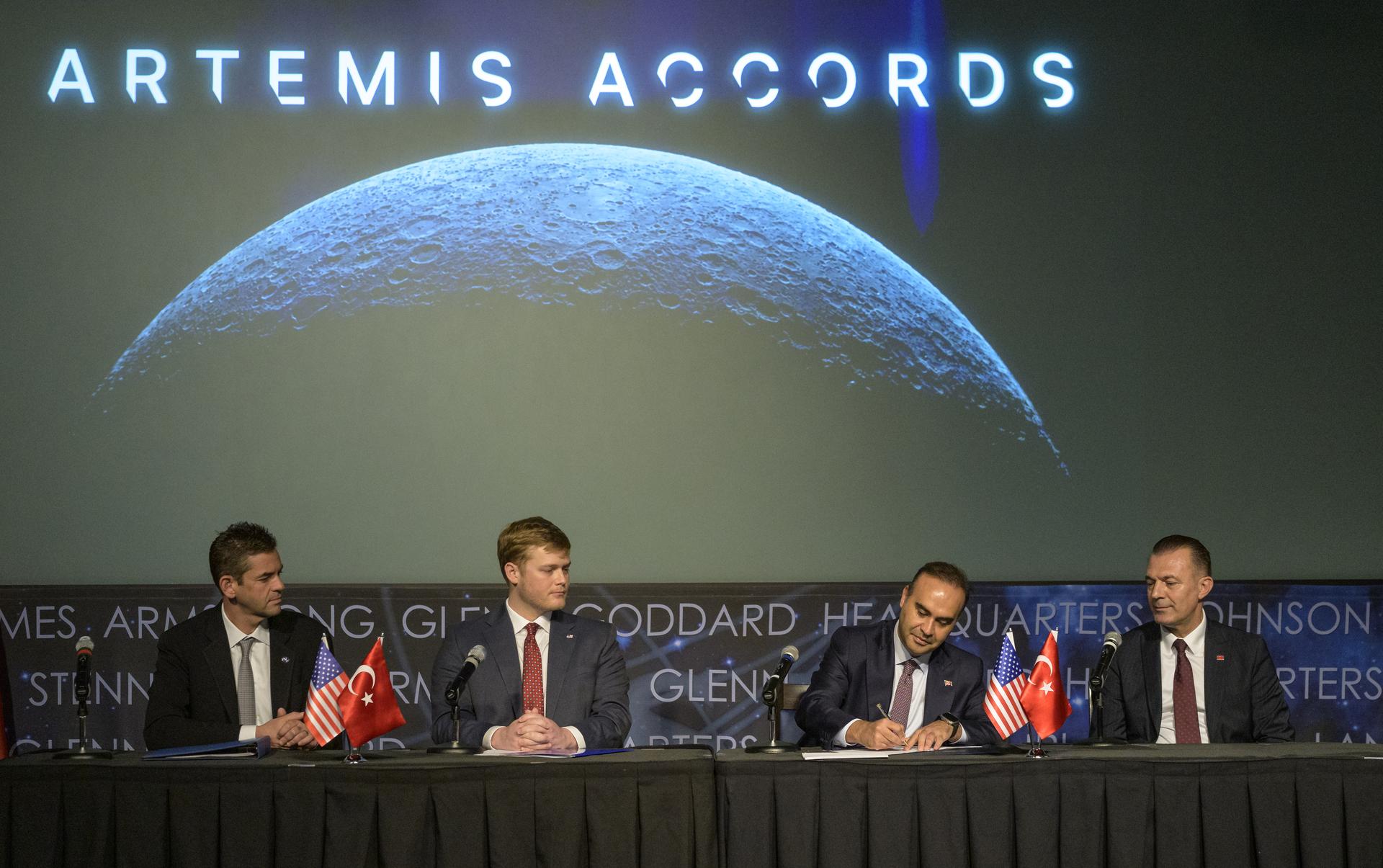
NASA welcomed Turkey as the 71st nation to sign the Artemis Accords during a ceremony at agency headquarters in Washington on Monday. NASA Administrator Jared Isaacman presided over the signing, expanding the international coalition committed to peaceful and transparent space exploration.
The Artemis Accords represent a framework for lunar exploration and broader space activities in the 21st century. NASA established these accords in 2020 as a set of principles governing how nations conduct space operations. Signatories commit to transparency in space activities, safety protocols, the peaceful use of space resources, and interoperability standards for future missions. The agreement reflects Cold War lessons and adapts them for an era when multiple nations pursue lunar return missions simultaneously.
Turkey's accession signals growing consensus around shared space exploration norms. With 71 signatories now enrolled, the Artemis Accords have become the dominant framework for coordinating international space activity outside the United Nations Outer Space Treaty signed in 1967. The newer accords function as practical implementation guidelines for that foundational treaty, establishing concrete expectations for behavior on the Moon and in cislunar space.
Turkey brings considerable space capabilities to the coalition. The Turkish Space Agency, established in 2018, oversees the nation's satellite programs and launch infrastructure. Turkey operates reconnaissance and Earth observation satellites and pursues indigenous rocket development. The country also manufactures satellite components and participates in European space projects through the European Space Agency framework. Turkey's signature reflects its ambitions to expand participation in deep space exploration beyond Earth orbit.
The timing reflects accelerating international engagement with lunar exploration goals. NASA's Artemis program targets lunar human landing missions beginning in the coming years. The program requires international participation for scientific objectives, logistics, and shared resource utilization on the lunar surface. Multiple nations now plan their own lunar missions. India's Chandrayaan program recently achieved a successful lunar landing. China operates robotic exploration missions on the Moon. Japan, the European Space Agency, and other nations plan lunar missions within the decade. Competition and cooperation both intensify.
The Artemis Accords address potential conflicts in this crowded environment. The framework establishes guidelines for establishing safety zones around landing sites, managing resource extraction including ice mining, and sharing data collected during missions. Signatories pledge to register space objects and maintain open communication about mission plans. These provisions reduce collision risks and territorial disputes as the pace of lunar activity increases.
Turkey's addition strengthens NATO representation within the accords framework. Multiple NATO members now participate, alongside allied nations in Asia, the Middle East, and elsewhere. This geopolitical composition reflects conscious coalition building by the United States, though the accords remain open to all nations willing to commit to the stated principles.
The Artemis Accords continue expanding. Each new signatory represents diplomatic achievement and reinforcement of the peaceful exploration model NASA champions. Turkey joins at a moment when space activity transitions from purely governmental missions toward commercial participation. SpaceX, Blue Origin, and other private companies now pursue lunar contracts under Artemis program structures. The accords must accommodate this mixed model of state and commercial actors sharing the same exploration frontier.