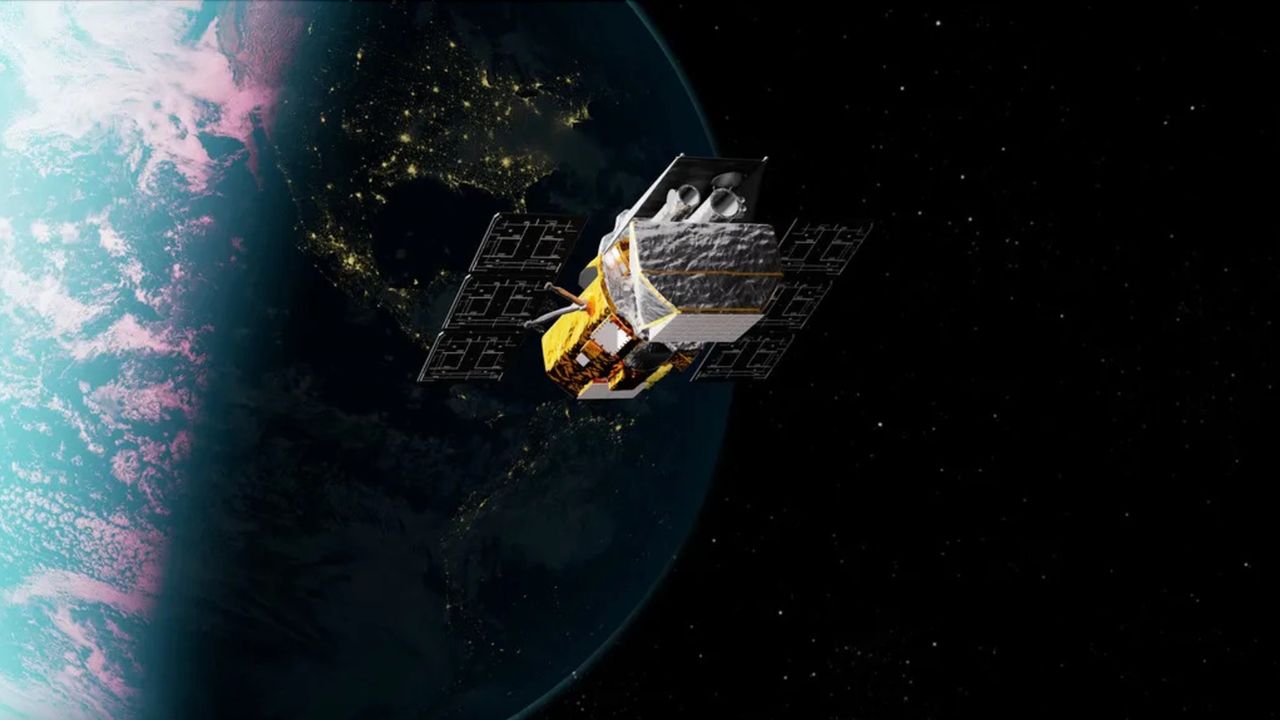
NASA's Swift gamma-ray burst observatory has restarted scientific operations following an unsuccessful orbital rescue attempt, entering what agency officials characterize as its final operational phase. The 21-year-old spacecraft, launched in November 2004, continues to degrade toward eventual atmospheric reentry despite the failed intervention.
Swift has spent two decades detecting and localizing gamma-ray bursts, the most violent explosions in the universe. These transient events release more energy in seconds than our sun will produce in its entire lifetime. The telescope's rapid-response capability has made it the gold standard for burst astronomy, allowing ground-based observatories worldwide to slew toward coordinates within minutes of detection.
The spacecraft's altitude has declined steadily due to atmospheric drag. Without periodic reboosts, all low-Earth orbit satellites eventually succumb to this inexorable decay. NASA contracted with a private spaceflight provider to attempt a servicing mission that would have extended Swift's operational lifespan by several years. When that rescue effort failed to achieve its objectives, the agency pivoted toward maximizing the telescope's productivity during whatever time remains.
Swift's science suite comprises three instruments working in concert. The Burst Alert Telescope detects gamma-ray bursts across a wide field of view. When a burst triggers, the spacecraft autonomously slews to point its X-ray Telescope and UV/Optical Telescope at the same coordinates. This coordinated observation captures multi-wavelength data essential for understanding burst physics and identifying their host galaxies.
The mission has generated discoveries across astrophysics. Swift observations revealed unexpected behavior in supermassive black holes, tracked gravitational wave events detected by LIGO and Virgo, and discovered previously unknown classes of transient phenomena. The spacecraft also provided crucial context for the neutron star merger detected by gravitational wave observatories in 2017, capturing ultraviolet and X-ray data that confirmed theoretical predictions about heavy element synthesis during such collisions.
Restarting science operations after the failed boost mission reflects pragmatic mission management. Rather than enter a dormant state, Swift continues gathering data on its core science targets. Operators have reconfigured observation schedules to maximize burst detections and follow-up observations with remaining fuel reserves. Each successful detection contributes to comprehensive catalogs spanning two decades of gamma-ray burst behavior.
Swift faces competition from newer facilities. NASA's Fermi Gamma-ray Space Telescope, launched in 2008, parallels some of Swift's burst-detection capabilities. The recently deployed JWST possesses infrared sensitivity unattainable by Swift's aging instruments. Yet Swift retains distinct advantages: its rapid autonomous response, ultraviolet capabilities, and multi-wavelength simultaneous observations remain unmatched by contemporary alternatives.
The telescope's remaining operational window extends months to perhaps a few years, contingent on orbit decay rates and remaining propellant reserves. Each burst detection represents borrowed time. When atmospheric drag finally proves irreversible, Swift will reenter Earth's atmosphere, ending one of astrophysics' most productive missions. Until then, the spacecraft continues its original mandate: catching the universe's most violent explosions in real time.