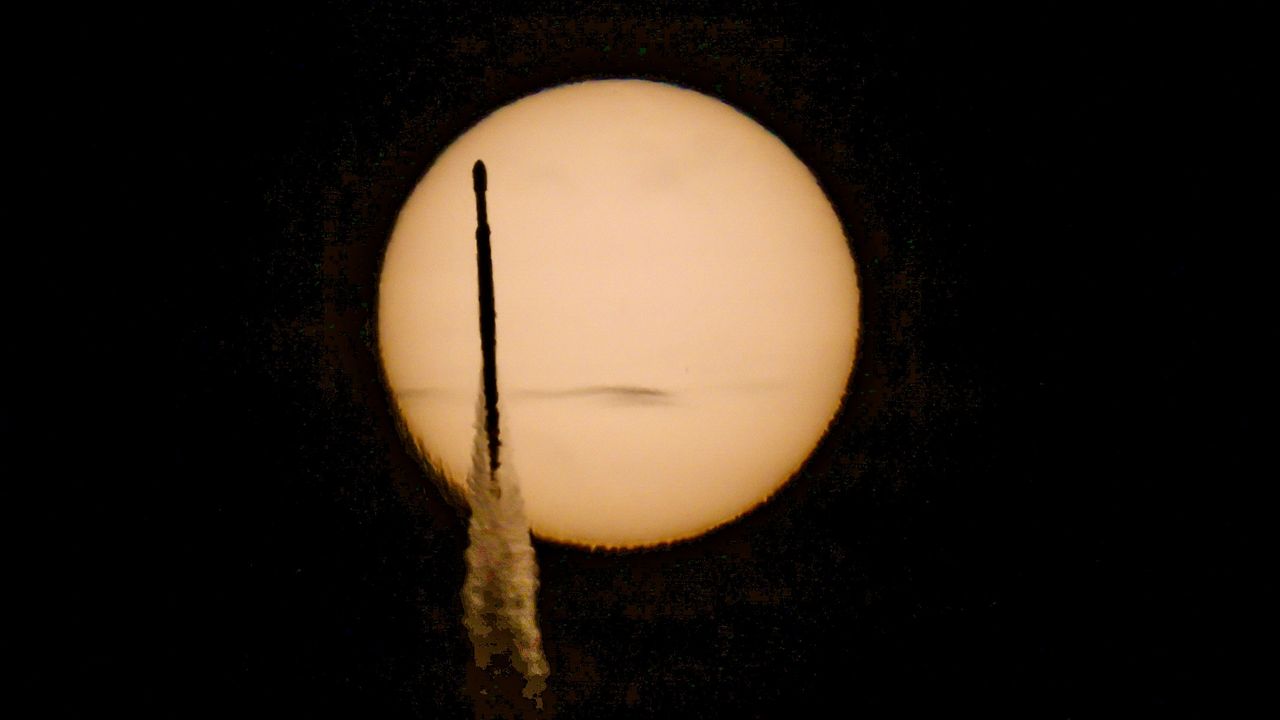
# Photographer Captures NASA's Roman Space Telescope Transit During Falcon Heavy Launch
A photographer caught a rare celestial alignment on May 7, 2024, when NASA's Nancy Grace Roman Space Telescope crossed the sun's disk during its SpaceX Falcon Heavy launch. Josh Dinner, a space photographer, positioned himself in a Hobby Lobby parking lot and captured the transit using specialized solar imaging equipment.
The image represents an extraordinary convergence of timing, trajectory, and luck. Roman lifted off from Kennedy Space Center at 1:04 p.m. EDT aboard the Falcon Heavy rocket. At that precise moment, the telescope's trajectory carried it directly between Earth and the sun, creating an eclipse-like silhouette visible to anyone with proper solar filtering equipment. The window for capture lasted only seconds.
Dinner employed a Coronado H-alpha solar telescope equipped with a high-speed camera to document the crossing. H-alpha imaging isolates a specific wavelength of hydrogen light emitted by the sun, allowing photographers to see solar features and objects transiting the solar disk with extraordinary clarity. The technique requires meticulous setup and advance calculations of the rocket's ground track and altitude.
"No guts, no glory," Dinner wrote, describing his decision to attempt the shot. The commitment paid off with a sharp image showing Roman's roughly 2.4-meter mirror and scientific instruments silhouetted against the sun's disk.
The Roman Space Telescope represents a transformative asset for astronomy. Named after pioneer Nancy Grace Roman, the first chief of NASA's Astronomy Missions Branch, the observatory will study dark energy, exoplanet detection, and supernova surveys. Its 2.4-meter primary mirror matches the Hubble Space Telescope's diameter, but Roman's wide field of view spans 100 times larger than Hubble's, enabling surveys of vast swaths of sky simultaneously.
The Falcon Heavy launch delivered Roman into a heliocentric orbit near the Earth-Sun L2 Lagrange point, approximately 1.5 million kilometers from Earth. This location provides thermal stability and an unobstructed view of deep space, ideal for infrared observations. Roman will operate there for approximately 5 years in its baseline mission, though the spacecraft carries sufficient fuel reserves for potential extension.
SpaceX's Falcon Heavy remains the world's most powerful operational rocket, capable of lifting 63,800 kilograms to low Earth orbit. The triple-core design, featuring two reusable side boosters and a center core, has logged four successful crewed/uncrewed commercial and government missions. Roman's launch marked the rocket's fifth operational flight.
Capturing spacecraft transits across the sun demands expertise, equipment, and favorable weather. Most transit photography occurs during solar eclipses or when satellites pass in front of the solar disk from specific ground locations. Dinner's successful capture required knowledge of orbital mechanics, solar imaging techniques, and precise location selection along Roman's ground track.
The photograph joins a small collection of historic transit images. Amateur astronomers and professionals have previously captured the International Space Station, other satellites, and space shuttle orbiters transiting the sun, but Roman's transit during a Falcon Heavy launch adds rare documentary value to the space program's archive.