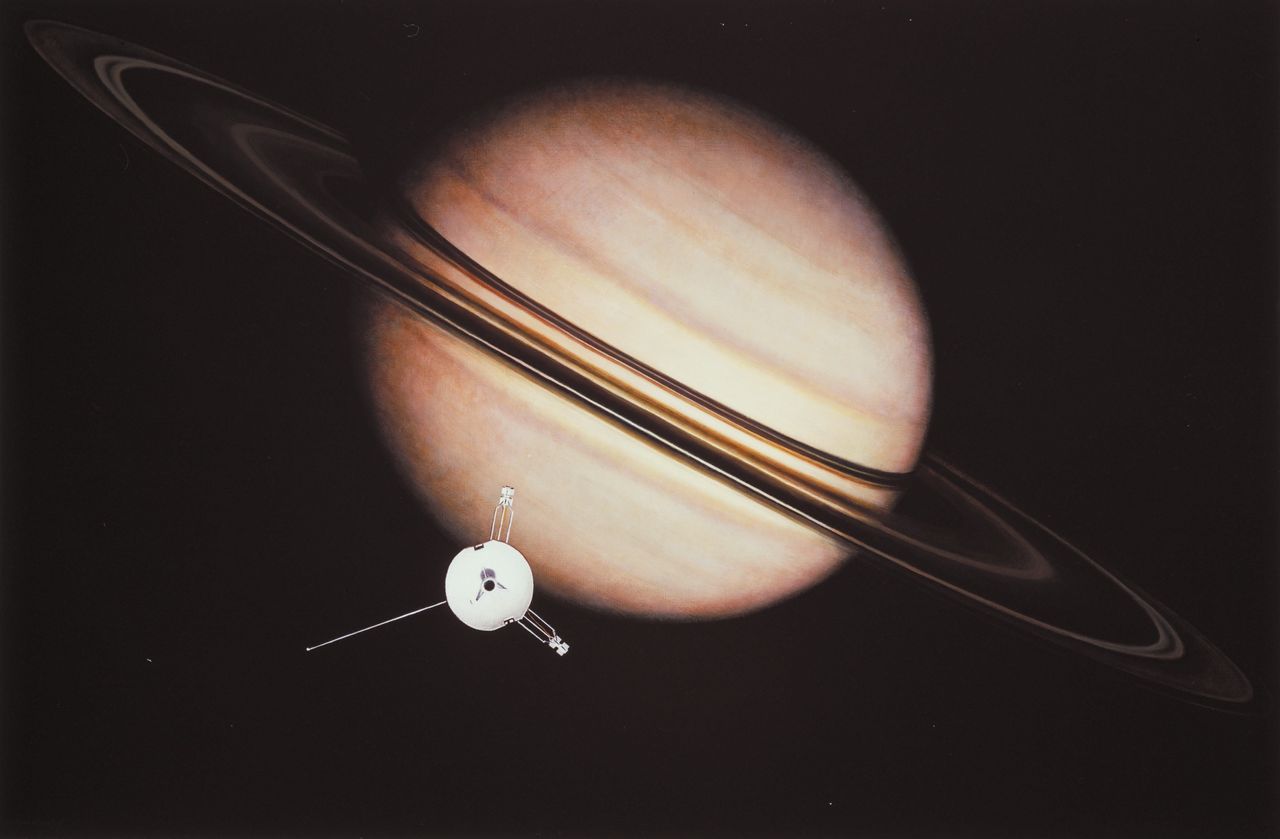
NASA's Pioneer 11 spacecraft became the first human-made object to reach Saturn on September 1, 1979, completing a journey that began four years earlier and fundamentally altered our understanding of the outer solar system.
Launched on April 5, 1973, Pioneer 11 traveled 1.4 billion miles across the inner and outer reaches of the solar system. The probe's flyby of Saturn provided the first close-range observations of the ringed planet, its atmospheric composition, its magnetosphere, and its collection of moons. These findings validated decades of ground-based speculation and opened new questions about planetary formation and structure in the outer solar system.
Pioneer 11 carried instruments that measured Saturn's radiation belts, magnetic field, and particle environment. The probe's imaging systems captured the first detailed photographs of Saturn's ring system, revealing complexity that ground-based telescopes could never resolve. Scientists observed at least 23 previously unknown moonlets orbiting within and near the rings. The spacecraft also discovered two new moons, later named Janus and Epimetheus. Temperature and atmospheric pressure data from the flyby refined models of Saturn's internal structure and weather patterns.
The mission built directly on Pioneer 10's success. Pioneer 10 had flown past Jupiter in 1973, becoming the first spacecraft to venture beyond the asteroid belt. With that triumph confirmed, NASA directed Pioneer 11 on a slightly different trajectory that would bring it to Saturn. The probe carried an identical suite of instruments and shared the same basic design, though engineers optimized it for the colder, darker conditions far from the Sun.
Pioneer 11's data transmission quality remained strong throughout the Saturn encounter. Using the Goldstone Solar System Tracking Station and other antennas in NASA's Deep Space Network, controllers on Earth received clear signals from nearly a billion miles away. This reliable communication backbone enabled real-time data collection and gave scientists confidence in the robustness of spacecraft design for deep-space missions.
The Saturn flyby demonstrated that spacecraft could function reliably in the harsh radiation environment surrounding the gas giants. It proved the viability of the grand tour trajectory concept, which Voyager 1 and Voyager 2 would exploit later in the 1970s to visit Jupiter, Saturn, Uranus, and Neptune in rapid succession. Without Pioneer 11's success, NASA might have proceeded more cautiously with the Voyager missions.
Pioneer 11 continued transmitting data until 1995, when its power supply degraded beyond the point of useful operation. The spacecraft remains the fifth most distant human-made object from Earth, trailing behind Voyager 1, Voyager 2, and the New Horizons probe. It coasts silently through interstellar space at roughly 26,000 miles per hour, carrying a gold-anodized aluminum plaque depicting the human form alongside mathematical and physical diagrams intended to communicate Earth's location to any hypothetical extraterrestrial civilization that might recover it millions of years hence.