# Repairing the ISS 250 Miles Above Earth
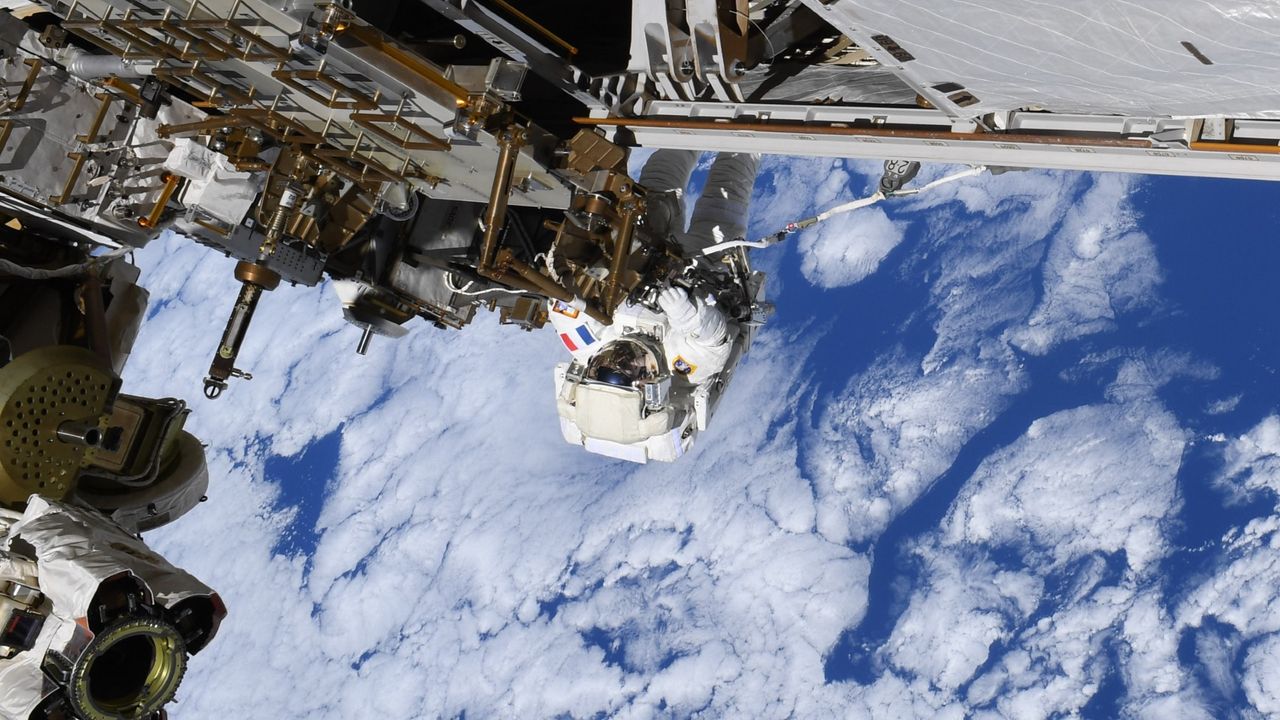
ESA astronaut Sophie Adenot performs critical maintenance work on the International Space Station during a spacewalk captured in a photo released September 1, 2026. The image documents the extraordinary environment in which orbital repairs occur. The ISS orbits at an altitude of approximately 250 miles (402 kilometers) above Earth's surface, moving at 17,500 miles per hour relative to the planet below.
Adenot's spacewalk represents routine but hazardous work that keeps the orbital laboratory operational. The International Space Station, a joint project of NASA, Roscosmos, ESA, JAXA, and CSA, requires regular extravehicular activity to maintain critical systems, replace hardware, and conduct inspections. These spacewalks demand extraordinary training, precision, and courage from astronauts who venture outside their protective vessel.
The photograph illustrates the scale and isolation of orbital operations. At 250 miles altitude, the ISS flies high enough to avoid significant atmospheric drag yet low enough to remain accessible for resupply missions and crew rotation flights. This orbital altitude places the station well above commercial aircraft but below many geostationary satellites. The thin blue line of Earth's atmosphere visible in photographs from this height emphasizes the delicate boundary between space and our world.
Sophie Adenot, a French astronaut selected by the European Space Agency, flew to the ISS as part of a long-duration expedition crew. Her presence on this spacewalk reflects the international cooperation that makes the station possible. ESA astronauts regularly contribute to ISS maintenance alongside colleagues from NASA, Roscosmos, JAXA, and the Canadian Space Agency. Spacewalks from the ISS typically last six to seven hours, during which astronauts work in pressurized spacesuits that provide life support, thermal protection, and mobility aids.
The work performed during these missions varies widely. Astronauts install new modules, repair solar arrays, replace batteries, maintain thermal systems, and upgrade scientific instruments. Each task carries inherent risk. Working in the vacuum of space presents hazards including micrometeorite impacts, extreme temperature fluctuations between sunlight and shadow, radiation exposure, and the constant danger of equipment failure. The spacesuits themselves represent engineering marvels, but they remain vulnerable to damage from sharp surfaces and the harsh environment.
The ISS has maintained continuous human presence since November 2000. Over 260 spacewalks have occurred since assembly began in 1998. These extravehicular activities prove essential for keeping the orbiting laboratory operational. Without regular maintenance, the ISS would degrade and eventually fail. Adenot's spacewalk adds to this remarkable history of sustained human activity in orbit.
The photograph captures more than a single moment. It documents humanity's growing capability to work safely in space and our commitment to maintaining this unique research platform. The International Space Station serves as a laboratory for experiments impossible on Earth. Astronauts conduct research in materials science, biology, physics, and Earth observation. The station orbits at sufficient altitude to provide unique perspectives on our planet while remaining close enough for regular resupply.
Maintaining the ISS requires continuous effort. Adenot's spacewalk ensures that future crews can continue this critical work and that experiments aboard the station progress without interruption.