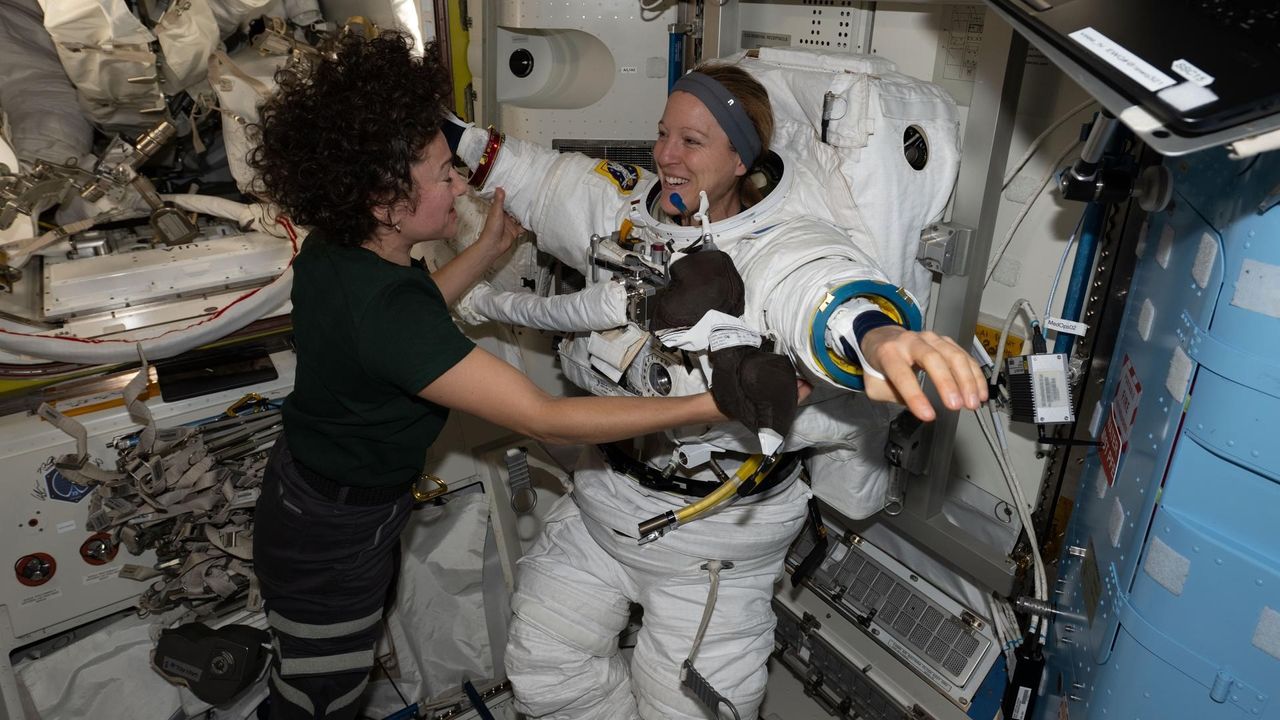
NASA astronaut Jessica Meir and French astronaut Sophie Adenot will conduct the sixth all-female spacewalk in human spaceflight history today, September 1st, working outside the International Space Station.
The spacewalk represents a milestone in the incremental progress toward gender parity in extravehicular activity, the technical term for spacewalks. Since the first all-female spacewalk occurred on October 18, 2019, when astronauts Christina Koch and Jessica Meir ventured outside the ISS together, only five additional all-female spacewalks have launched. This slowness reflects the fundamental reality that spacewalks remain rare operations, requiring years of training and precise alignment of crew schedules, mission objectives, and station maintenance needs.
Adenot, a French Space Agency astronaut and former fighter pilot, arrived at the ISS aboard SpaceX's Crew-7 mission in August 2023. Meir, a trained oceanographer and veteran of two ISS expeditions, brings extensive extravehicular experience to today's operation. Their assignment to work together outside the station reflects deliberate planning by NASA and its international partners to continue normalizing women in spacewalking roles, where they remain statistically underrepresented despite their proven capability and performance.
The spacewalk will tackle essential maintenance and upgrade work on the station's infrastructure. Specific objectives include module replacements, equipment servicing, and other critical tasks that keep the orbiting laboratory operational. Every spacewalk carries inherent risk; astronauts work in pressurized suits in the vacuum of space, tethered to the station, while managing complex tools and procedures in extreme conditions where temperatures swing from 250 degrees Fahrenheit in sunlight to minus 250 degrees in shadow.
The live broadcast begins on NASA's official channels before the spacewalk commences. NASA's website, YouTube channel, and the agency's official app will carry the feed, offering the public a direct view of two professional astronauts executing one of spaceflight's most demanding tasks. Mission Control in Houston will guide every movement, while telemetry streams back to Earth continuously.
This mission underscores the operational maturity of the ISS as a scientific platform. After more than two decades of continuous human occupation, the station requires constant attention from trained personnel. Spacewalks like today's operation ensure that solar arrays, cooling systems, docking mechanisms, and research equipment remain functional and optimized.
For France's space program, Adenot's participation marks another step in European contributions to ISS operations and human spaceflight. The collaboration between NASA and the French Space Agency reflects the station's role as an international endeavor, where astronauts from multiple nations train together, live together, and conduct critical work together in orbit.
The rarity of all-female spacewalks, despite the statistical inevitability that half of all future spacewalkers should be women, indicates that reaching true gender parity in extravehicular activities requires sustained attention and deliberate crew assignment practices. Today's mission continues that work.