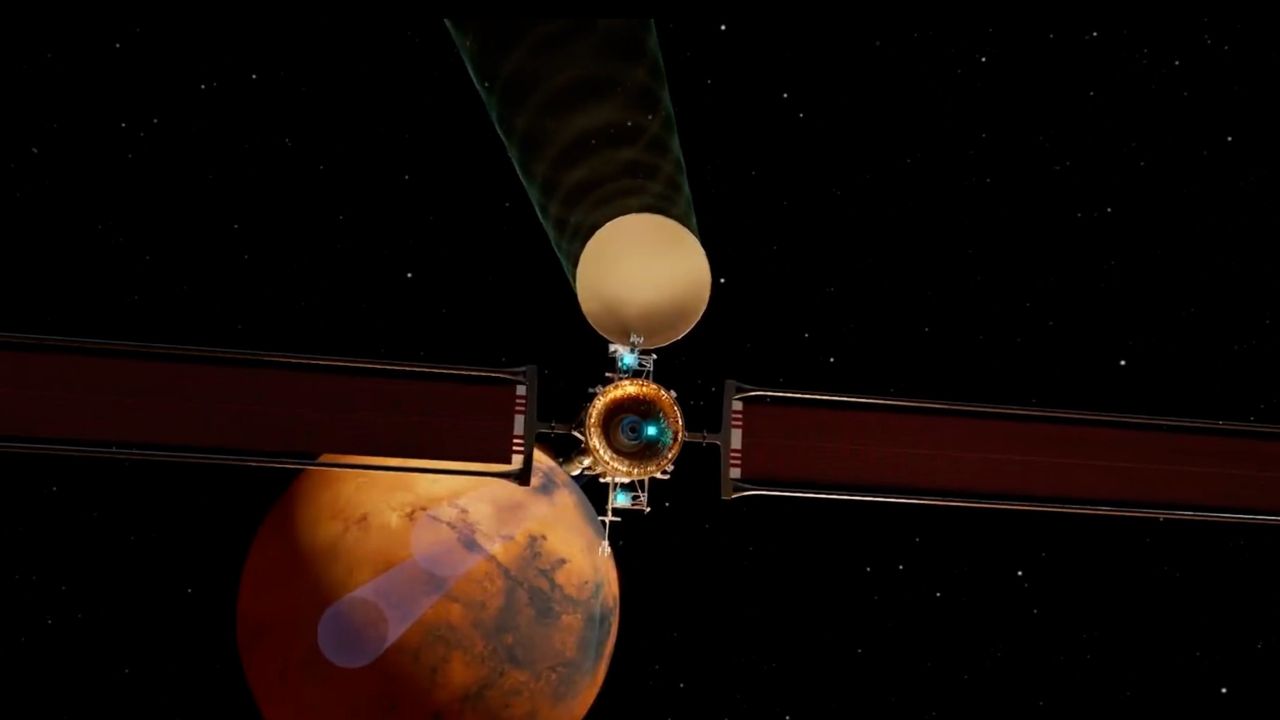
Blue Origin will build NASA's next Mars orbiter under a $700 million contract announced by the space agency. The telecommunications spacecraft will relay communications between Earth and robotic missions operating on the Martian surface, a function that existing orbiters currently provide but which NASA needs to maintain as older spacecraft age out of service.
This contract represents a major win for Blue Origin's space systems division. The company will design, build, and deliver the orbiter, joining a select group of contractors that have built deep space spacecraft for NASA. The mission aligns with Blue Origin's stated focus on cislunar infrastructure and deep space capabilities, areas the company has emphasized alongside its commercial spaceflight operations.
Mars telecommunications orbiters form the backbone of NASA's surface exploration architecture. Rovers and landers on Mars cannot directly transmit high-bandwidth data to Earth due to distance and power constraints. Instead, they relay information through overhead orbiters that relay signals back home. NASA's Mars Reconnaissance Orbiter, launched in 2005, and the Mars Odyssey orbiter, operating since 2001, currently handle much of this relay traffic. As these aging spacecraft near the end of their operational lives, NASA requires a successor to maintain continuous communications with future surface missions.
The new orbiter will support NASA's broader Mars exploration strategy, including the planned sample return campaign that aims to retrieve geological specimens collected by the Perseverance rover. Sustained communications infrastructure remains essential for that operation and any subsequent human or robotic missions to Mars.
Blue Origin competes in the spacecraft market alongside established contractors like Lockheed Martin, which has built multiple Mars orbiters for NASA. The $700 million award reflects the scale and complexity of deep space telecommunications systems. The contract includes design, development, testing, and delivery phases, with the spacecraft scheduled for launch in the early 2030s.
This contract signals NASA's confidence in Blue Origin's engineering capabilities beyond suborbital and orbital tourism. The company has developed expertise in advanced propulsion systems, spacecraft avionics, and thermal management, all critical for Mars missions. Blue Origin's ownership of engine manufacturing and launch vehicle development provides internal capabilities that can streamline orbiter production.
The telecommunications mission represents one of Blue Origin's largest government contracts to date. It positions the company alongside traditional aerospace primes in NASA's deep space architecture planning. Future Mars missions, including potential human exploration efforts, will depend on reliable communication links that this orbiter will help establish.
NASA's selection reflects a strategy to nurture competition among spacecraft builders. Blue Origin joins Lockheed Martin and other contractors in a roster of firms capable of executing complex deep space missions. As NASA accelerates its Mars exploration timeline, having multiple contractors qualified to build essential infrastructure reduces schedule risk and supports the agency's broader exploration objectives.
The spacecraft will operate from Mars orbit, receiving signals from surface assets and amplifying them back to Earth-based receiving stations. It will carry multiple communication antennas and employ advanced power systems to maintain operations across millions of miles of interplanetary distance. Launch aboard a commercial heavy-lift rocket is anticipated, likely SpaceX's Falcon Heavy or Blue Origin's own New Glenn once that vehicle reaches operational status.