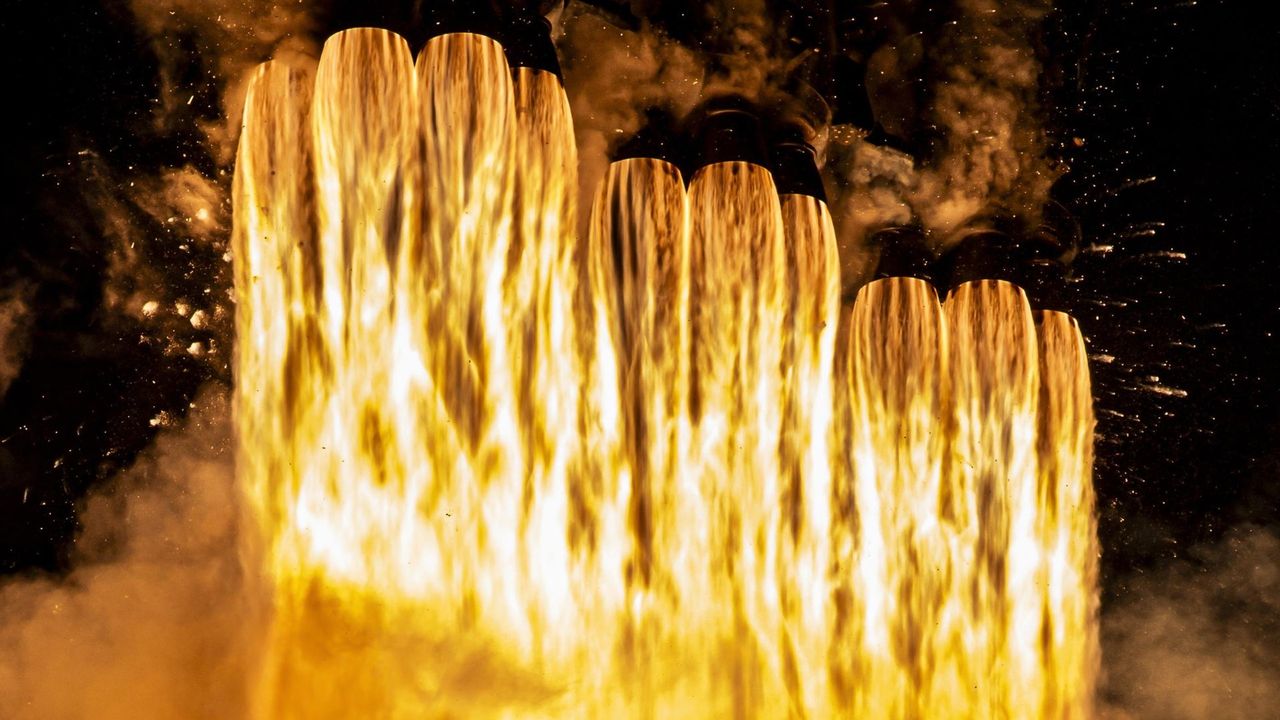
SpaceX's Falcon Heavy ignited its three first-stage engines on August 30, 2026, hauling NASA's Nancy Grace Roman Space Telescope toward orbit in a defining moment for astrophysics and deep-space exploration. The launch photo captures the raw power of the vehicle's nine engines firing in unison, producing 5.1 million pounds of thrust at liftoff.
The Roman Space Telescope represents the next generation of NASA's flagship observatories. Named after astronomer Nancy Grace Roman, who pioneered the science of space-based telescopes during her four decades at NASA, the instrument will conduct wide-field surveys of the universe with a resolution and sensitivity unmatched by ground-based telescopes. Its primary mission involves mapping dark energy and dark matter across billions of galaxies, hunting for exoplanets in visible light, and studying supernova explosions that scientists use to measure the universe's expansion rate.
The Falcon Heavy emerged as the optimal launch vehicle for this 14,000-pound payload because its lifting capacity and proven track record met NASA's requirements. The rocket consists of a center core and two reusable side boosters. All three first-stage cores had successfully landed and been recovered on previous missions, reducing costs for NASA and demonstrating SpaceX's refinement of reusable rocket technology. The side boosters separate roughly two minutes after launch, executing their controlled descent to ground landing sites. The center core continues its climb toward orbital velocity.
Falcon Heavy holds the distinction of being the most powerful operational rocket in the world. Since its maiden flight in 2018, it has launched classified military payloads for the National Reconnaissance Office, deployed the Parker Solar Probe's replacement missions, and served as NASA's preferred solution for high-mass science instruments. The Roman mission represents one of the most ambitious astronomical platforms ever built, following the legacy of the Hubble Space Telescope and the James Webb Space Telescope.
Roman's infrared and visible-light instruments will survey approximately 100 times more sky per unit time than Hubble, accelerating the discovery of distant galaxies and stellar populations. The observatory will spend roughly five to eight years gathering data from the second Lagrange point, a gravitational equilibrium location situated 930,000 miles from Earth on the opposite side from the Sun. This vantage point allows uninterrupted observation of deep space while minimizing thermal interference from Earth and solar radiation.
The launch marked a transition point in NASA's space-based astronomy infrastructure. With Hubble aging after more than three decades of service and JWST now operating beyond its original mission timeline, Roman will provide complementary observational capabilities that neither instrument can replicate. Its wide-field surveys will identify targets for detailed follow-up observations by JWST and other observatories.
The brilliant orange glow captured in the launch photograph reflects the combustion of kerosene and liquid oxygen within the Merlin engines. Each engine expels plasma at temperatures exceeding 3,700 degrees Celsius. This spectacular release of energy propels one of humanity's most ambitious instruments toward its destination. The August 30 launch success opened a new chapter in humanity's effort to comprehend the cosmos.