# Rosetta's Historic Discovery: Finding Philae on Comet 67P
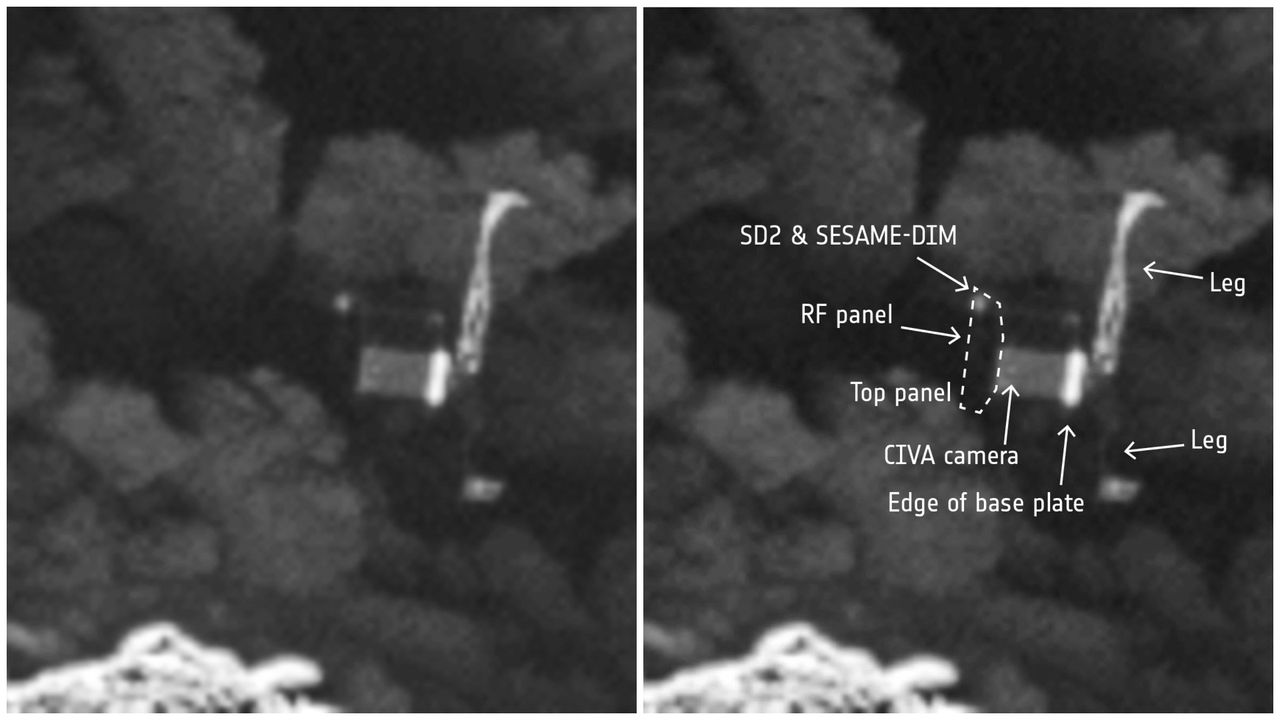
The European Space Agency's Rosetta spacecraft located the Philae lander on the surface of Comet 67P/Churyumov-Gerasimenko on September 2, 2016, ending a two-year search that captivated the planetary science community. This discovery solved one of spaceflight's most compelling mysteries and validated years of perseverance by ESA engineers and scientists.
Philae had vanished in November 2014, just days after becoming the first spacecraft to land on a comet. The lander touched down on 67P as planned but bounced across the icy surface, coming to rest in a location unknown to mission controllers. Its solar panels faced the wrong direction, starving the lander of power. After brief bursts of communication, Philae fell silent. For two years, researchers could only wonder where it had ended up.
The search proved extraordinarily difficult. Philae measured just one meter across. Comet 67P spans roughly four kilometers in diameter. The surface terrain consists of jagged boulders, shadowed crevasses, and deposits of dust and ice. Rosetta's imaging instruments struggled to spot such a small object from orbit.
But persistence paid. Scientists refined their search algorithm, analyzing high-resolution images captured by Rosetta's OSIRIS camera. They looked for changes in surface reflectivity, unusual shadows, and geometric signatures consistent with Philae's shape and size. On September 2, the team finally detected the lander wedged inside a shadowed crack near the comet's terminator line, where sunlight met darkness.
The location explained everything. Philae had landed in a deep crevice where cliff walls blocked direct sunlight. This accounted for why its solar panels generated virtually no electricity. The discovery brought closure to mission planners and validated the trajectory calculations made during Philae's initial descent.
Locating Philae mattered for multiple reasons. The lander had conducted groundbreaking science before losing power, analyzing comet material and detecting organic compounds in samples collected from 67P's surface. Finding the wreckage itself provided new data. Scientists could correlate Philae's geological context with chemical analyses already performed, enriching their understanding of cometary composition and structure.
The discovery also demonstrated the power of orbital reconnaissance combined with computational analysis. Rosetta's year-long proximity to the comet generated unprecedented datasets. The search required sifting through thousands of images and developing novel detection methods. This work advanced techniques applicable to future planetary missions, including lunar orbit reconnaissance and asteroid surveys.
Philae's journey represented a milestone in cometary science. The European Space Agency and its partners achieved the first soft landing on a comet nucleus. Although the lander fell silent, it gathered data on comet outgassing, dust composition, magnetic properties, and surface geology. Finding Philae's resting place completed the mission narrative and provided scientists with direct visual evidence of the lander's final environment.
Rosetta itself continued operating until September 2016, deliberately crashing into 67P's surface. The combined Rosetta-Philae mission fundamentally altered our understanding of comets, showing them to be complex, geologically diverse bodies rather than simple accumulations of ice and rock. Locating Philae vindicated the entire effort.