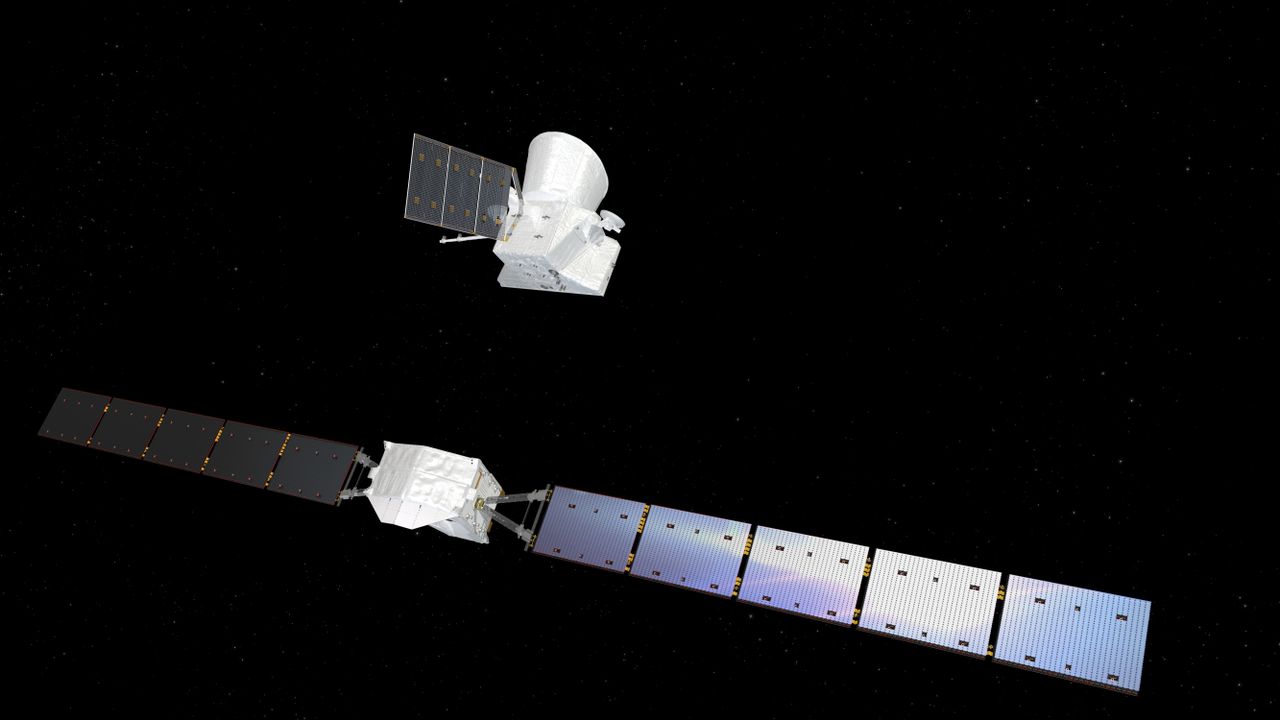
BepiColombo, the European-Japanese Mercury exploration mission, entered its critical approach phase today after traversing nearly eight years through the inner solar system. The spacecraft, launched in October 2018 by the European Space Agency and Japan's space agency JAXA, marks humanity's first comprehensive orbital study of the solar system's smallest planet and closest to the sun.
The mission represents a landmark collaboration between ESA and JAXA, combining European expertise in planetary science with Japanese technological precision. BepiColombo carries two orbiters: the Mercury Planetary Orbiter, built by ESA, and the Mercury Magnetospheric Orbiter, built by JAXA. These instruments will operate in tandem to study Mercury's geological composition, magnetosphere, exosphere, and the planet's mysterious interior structure.
The journey to Mercury demanded sophisticated orbital mechanics. BepiColombo could not travel directly to Mercury due to the sun's immense gravitational pull. Instead, the spacecraft executed a complex sequence of gravity assists, swinging past Venus twice and Mercury itself six times to gradually reduce its velocity and align its trajectory. Each flyby served dual purposes: slowing the spacecraft while also collecting preliminary scientific data about the worlds it passed.
Mercury presents unique challenges for exploration. Surface temperatures swing from 430 degrees Celsius on the sunlit side to minus 180 degrees Celsius on the night side. The planet's thin atmosphere and extreme thermal environment demand that spacecraft remain shielded during approach. BepiColombo features a heat shield designed to withstand these extremes while protecting its instruments and propulsion systems.
The arrival phase launches what mission planners call "a new mission starting today." BepiColombo will execute several orbital insertion maneuvers over the coming weeks, gradually transitioning from a heliocentric orbit around the sun to a stable orbit around Mercury itself. The final insertion burn will place the spacecraft into Mercury orbit by late 2025. Once settled, the two orbiters will separate and begin their dedicated science operations.
Mercury remains one of the least understood terrestrial planets in the solar system. NASA's MESSENGER mission, which orbited Mercury from 2011 to 2015, revealed unexpected findings about the planet's interior composition and magnetic field. BepiColombo will build on MESSENGER's discoveries with more advanced instrumentation, including high-resolution cameras, magnetometers, thermal imagers, and particle detectors.
Understanding Mercury holds implications for planetary science across the solar system. The planet's unusual characteristics, including a disproportionately large iron core and an active magnetic field despite slow rotation, challenge existing models of planetary formation. Mercury's exosphere, composed of sodium, potassium, and other elements, may provide clues about how planets lose atmospheres near the sun.
The eight-year cruise phase tested BepiColombo's systems exhaustively. Solar arrays, communication equipment, and scientific instruments all underwent continuous monitoring throughout the journey. The spacecraft's redundant systems ensured reliability despite radiation exposure and thermal stress during its inner solar system transit.
BepiColombo's arrival marks the beginning of at least one year of intensive science operations. The dual orbiter configuration allows simultaneous measurements from different altitudes and perspectives, enabling researchers to construct three-dimensional models of Mercury's environment. This coordinated observation strategy represents an advancement in planetary exploration methodology that future missions to other worlds may emulate.