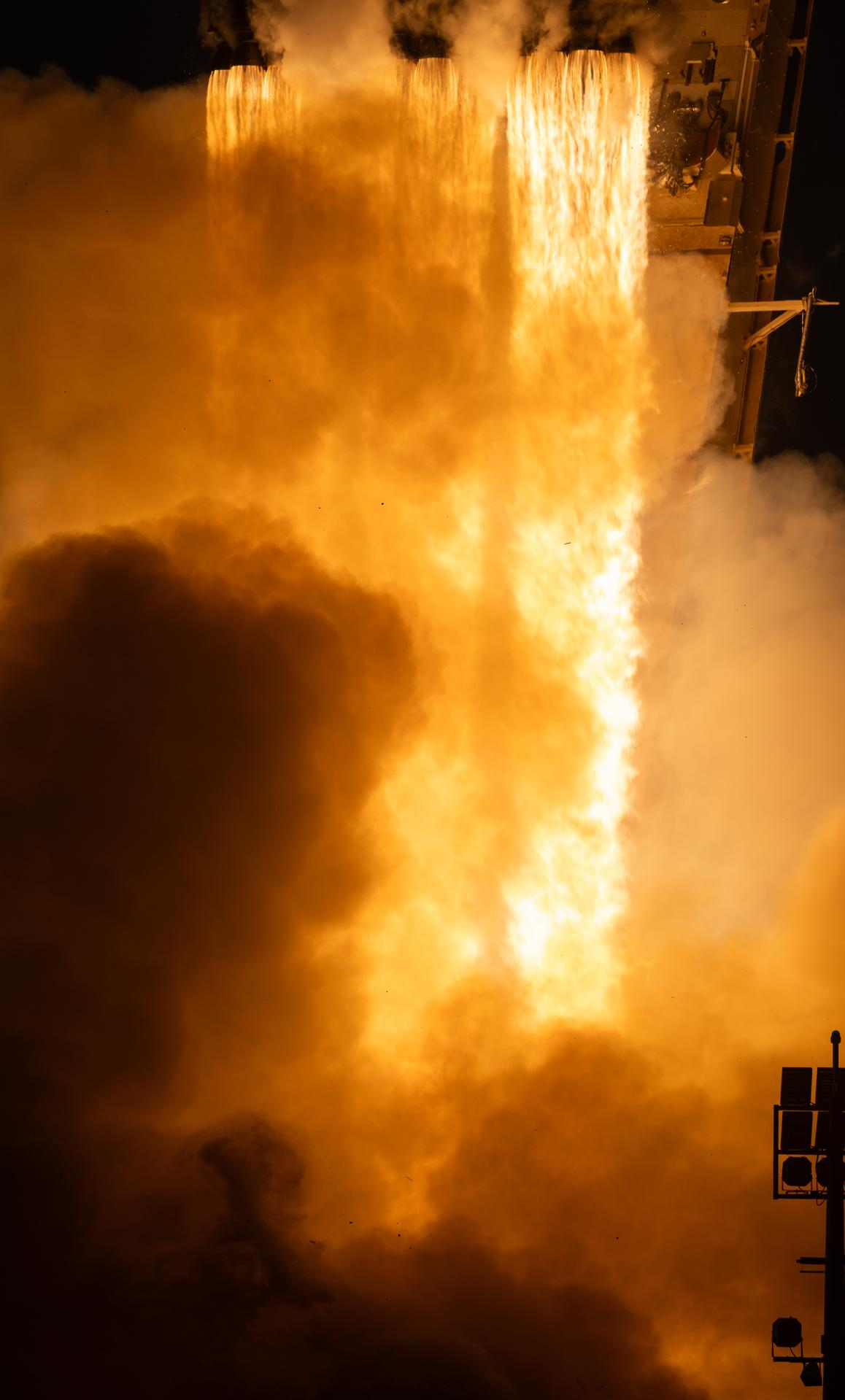
NASA's Nancy Grace Roman Space Telescope launched aboard a SpaceX Falcon Heavy rocket on August 30 at 7:26 a.m. EDT from Kennedy Space Center's Launch Complex 39A in Florida. The observatory now travels across a million-mile trajectory toward its operational orbit at the second Lagrange point, a gravitationally stable region roughly one million miles from Earth opposite the Sun.
Roman carries instrumentation designed to answer fundamental questions about dark energy, dark matter, and the formation of galaxies across cosmic time. The telescope will conduct surveys spanning billions of light-years, cataloging supernovae, measuring galaxy distances, and mapping the structure of the universe itself. This capability represents a leap forward from existing instruments. The Hubble Space Telescope surveys smaller patches of sky with greater depth. The James Webb Space Telescope excels at observing distant, early galaxies but covers limited fields of view. Roman will execute wide-field imaging and spectroscopy simultaneously, covering an area of sky 100 times larger than Webb with comparable resolution.
The mission addresses one of astronomy's most pressing mysteries. Dark energy comprises roughly 68 percent of the universe yet remains entirely undetected and unexplained. Current models describe it as causing the universe's accelerating expansion, yet physicists possess no theoretical framework for its nature. Roman's measurements of Type Ia supernovae across vast cosmic distances will allow astronomers to map the expansion history of the universe with unprecedented precision. These observations will either refine existing dark energy models or demand entirely new physics.
Dark matter presents an equally profound puzzle. This invisible substance comprises 27 percent of the universe and dominates the gravitational architecture of galaxies and galaxy clusters, yet its identity remains unknown. Roman will detect the subtle bending of light around massive structures, a phenomenon called weak gravitational lensing. By measuring this effect across billions of galaxies, Roman will map the distribution of dark matter and constrain theories about its composition.
The three-month transit to the second Lagrange point, designated L2, represents standard procedure for spacecraft heading to this orbit. Unlike Earth orbit, the L2 point requires constant fuel expenditure to maintain position, but it offers a thermal advantage. At L2, Earth, Sun, and Moon remain on one side of the spacecraft, allowing Roman's sunshield to protect sensitive instruments from all three heat sources simultaneously. This configuration maintains cryogenic temperatures essential for infrared observations.
Roman carries a 2.4-meter primary mirror, identical in diameter to Hubble's but optimized for infrared wavelengths and wide-field surveys. Additional instruments include a coronagraph for direct imaging of exoplanets and a spectroscopic capability for analyzing distant objects in detail.
The launch concluded a long development cycle. Originally titled the Wide Field Infrared Survey Telescope (WFIRST), the mission was renamed in 2020 to honor Nancy Grace Roman, a pioneering NASA astrophysicist who established the agency's space telescope program during the 1960s and advocated for Hubble's construction.