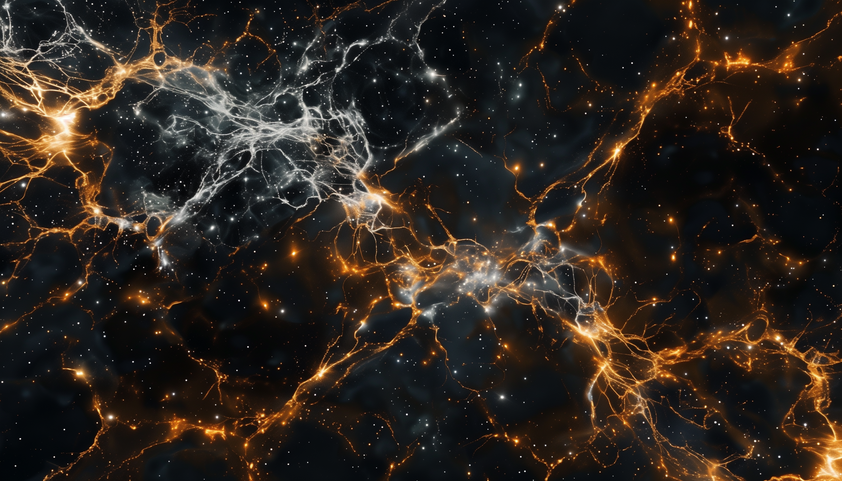
Physicists have expanded the theoretical landscape for dark photons, a hypothetical particle that ranks among the most compelling candidates for dark matter. Research conducted jointly by Perimeter Institute for Theoretical Physics and the University of Maryland challenges conventional assumptions about where these particles might hide in the cosmos and how they interact with ordinary matter.
Dark photons represent a natural extension of standard physics. Just as photons mediate electromagnetic force, dark photons would mediate interactions within the dark sector, an invisible realm comprising roughly 85 percent of the universe's matter. Unlike their ordinary counterparts, dark photons couple to dark matter particles rather than to electrons and other charged particles. This fundamental difference makes them extraordinarily difficult to detect but theoretically elegant.
Previous searches for dark photons operated under restrictive assumptions about their mass ranges and interaction strengths. The new study, conducted across the boundary between theoretical physics and experimental design, demonstrates that dark photons could occupy parameter spaces previously dismissed as unlikely or physically irrelevant. The researchers showed that viable dark photon candidates exist across a broader spectrum than earlier models predicted.
The discovery matters because it reframes the experimental strategy for dark matter detection. Current experiments like those at particle accelerators typically target specific mass and coupling ranges based on theoretical predictions. Expanding the viable parameter space means experiments must either broaden their sensitivity windows or researchers must develop novel detection methods sensitive to dark photons across wider ranges of properties.
Perimeter Institute, located in Waterloo, Ontario, specializes in theoretical physics research funded by the Government of Canada and the Province of Ontario. The University of Maryland team brought expertise in connecting theoretical predictions to experimental design, bridging the gap between mathematical models and laboratory reality.
The implications extend beyond dark photon detection alone. Understanding where dark photons fit within the broader dark matter landscape influences multiple research directions. If dark photons constitute a significant fraction of dark matter, their discovery would fundamentally reshape cosmology and particle physics. The gravitational effects of dark matter reveal themselves throughout the universe, from galaxy rotation curves to the large-scale structure of cosmic web filaments. Identifying the particle responsible for this gravitational influence represents one of physics' grand unsolved problems.
Experimental searches for dark photons occur across multiple facilities. Researchers at the Thomas Jefferson National Accelerator Facility in Virginia run experiments specifically designed to produce and detect dark photons. The Belle II experiment in Japan, originally constructed to study matter-antimatter asymmetry, also contributes to dark photon searches through its sensitive detector systems.
This research advances what physicists call the "hidden sector" hypothesis, which posits that entire classes of particles and interactions exist beyond the standard model but interact only gravitationally with ordinary matter at solar system scales. Dark photons bridge the gap between the visible and hidden sectors, potentially carrying signals that reveal dark matter's true nature.
The expanded parameter space requires corresponding experimental innovation. Researchers must engineer detectors sensitive enough to capture dark photon signatures while rejecting background noise from cosmic rays and natural radioactivity. This combination of theoretical expansion and experimental necessity typically accelerates progress in fundamental physics.