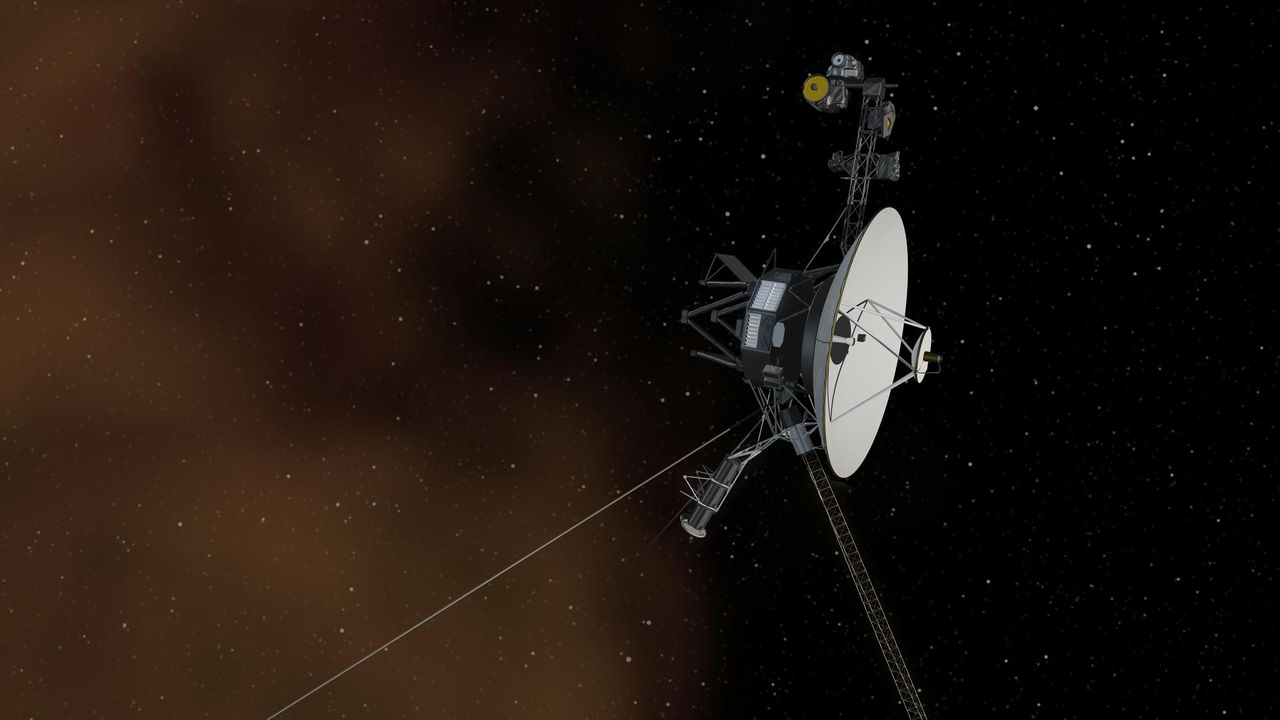
# NASA's Voyager 1 Launches on September 5, 1977
NASA launched Voyager 1 from Cape Canaveral, Florida, on September 5, 1977, initiating humanity's most distant robotic explorer. Nearly five decades later, the spacecraft remains operational and transmits data from beyond the heliopause, the boundary where solar wind gives way to interstellar space.
Voyager 1 carried instruments designed to study the outer planets and their moons. The spacecraft's primary mission targeted Jupiter and Saturn, with controllers planning a gravity assist at Saturn to propel Voyager 1 toward the edge of the solar system and beyond. This trajectory required precise timing and celestial mechanics that NASA's Jet Propulsion Laboratory had calculated years in advance.
The launch itself marked the beginning of an interplanetary race. Voyager 2, its twin, launched 16 days later on August 20, 1977. Despite launching second, Voyager 2 traveled on a different trajectory that would eventually reach Uranus and Neptune, making it the only spacecraft to visit all four gas giants. Voyager 1, meanwhile, pursued a faster path, overtaking its sister probe and arriving at Jupiter first in March 1979.
Voyager 1's instruments revolutionized planetary science. Its cameras returned the first detailed images of Jupiter's atmosphere and revealed volcanic activity on Io, one of the Galilean moons. At Saturn, Voyager 1 discovered new moons, photographed the planet's intricate ring system, and detected complex chemistry in Titan's thick atmosphere. These discoveries transformed understanding of how planetary systems form and evolve.
The spacecraft carried a golden record, a phonograph record containing sounds and images from Earth selected by a committee chaired by Carl Sagan. This artifact represents humanity's attempt to communicate with potential extraterrestrial life, containing music, greetings in 55 languages, and scientific diagrams. Voyager 1 would transport this message deeper into the cosmos than any other human creation.
Power constraints presented the engineers with extraordinary challenges. Voyager 1 relies on plutonium-238 radioisotope thermoelectric generators rather than solar panels, which produce negligible power at such distances from the sun. NASA engineers have systematically powered down non-essential instruments over the decades to preserve electricity for core systems and communication equipment.
As of 2024, Voyager 1 operates in interstellar space approximately 15 billion miles from Earth. It continues transmitting data about cosmic rays, magnetic fields, and plasma conditions that exist in the region between stars. Communication occurs via NASA's Deep Space Network, but radio signals require nearly 24 hours to travel from the spacecraft to Earth.
Voyager 1's longevity exceeds all expectations. Engineers designed it for a mission lasting five years. The spacecraft has functioned reliably for over 45 years, demonstrating the durability of 1970s technology and the brilliance of its original design. The probe will eventually cease operations when its power generators deplete, expected sometime in the 2030s.
The 1977 launch initiated humanity's most successful deep-space mission. Voyager 1 answered fundamental questions about Jupiter, Saturn, and their moons while collecting data that continues to enhance human knowledge about the universe. The spacecraft embodies the ambition that drove the Space Age and remains a testament to scientific achievement.