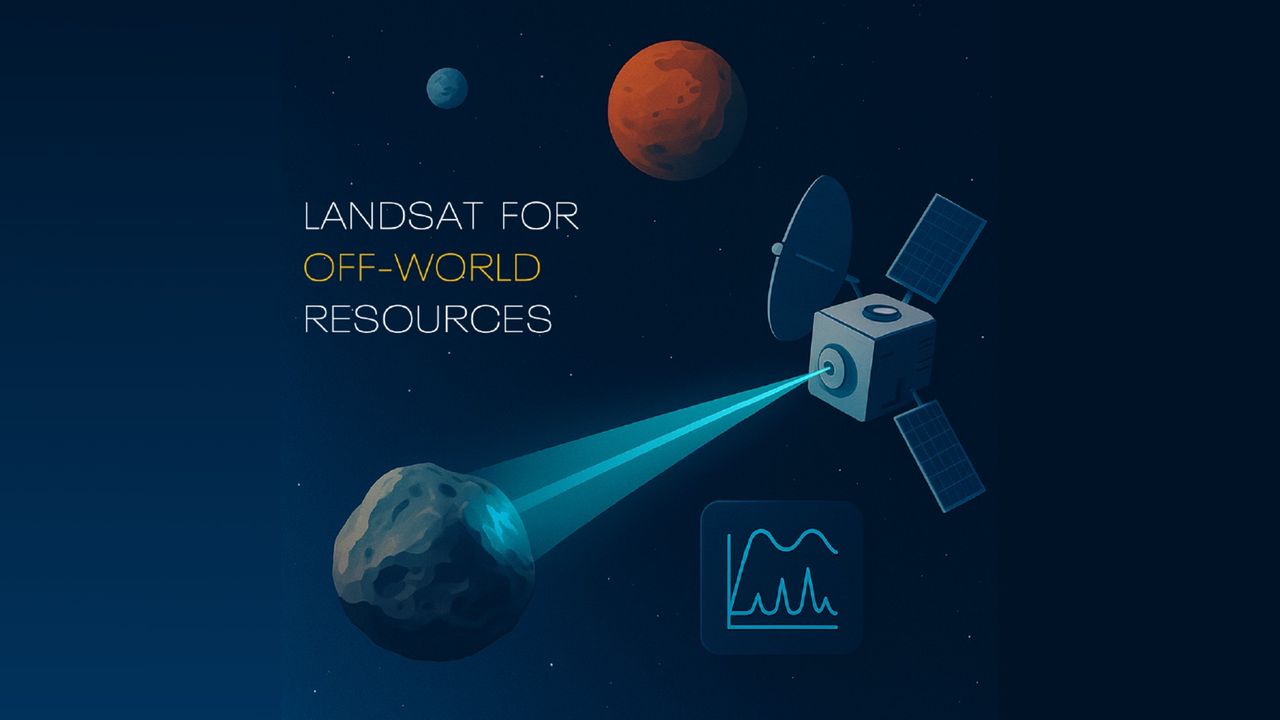
NASA has invested in an innovative early-stage spacecraft concept called "Slingshot" designed to revolutionize how scientists map mineral compositions across the solar system. The technology targets the moon, asteroids, and the Martian moons Phobos and Deimos, offering a new approach to planetary reconnaissance that could reshape how future missions explore planetary bodies.
The Slingshot concept represents a departure from traditional orbital mapping instruments. Rather than relying solely on passive spectroscopy from fixed orbital positions, the design incorporates novel techniques for analyzing mineral compositions with greater precision and efficiency. The technology could enable faster, more detailed surveys of celestial bodies, providing critical data about resource distribution and geological history that informs both scientific discovery and future human exploration plans.
NASA's funding through its early-stage innovation programs signals agency confidence in the approach's feasibility. These preliminary grants typically support concepts that show promise but require additional research before advancing to full mission development. The Space Agency has identified mineral mapping as a strategic capability for several reasons: it supports the search for water ice and other resources that could sustain human lunar bases, identifies geologically interesting sites for sample return missions, and helps characterize asteroids for potential future mining or planetary defense applications.
The lunar application holds particular urgency. NASA's Artemis program aims to establish sustained human presence on the moon by the late 2020s, and detailed knowledge of mineral and ice distribution across multiple lunar regions will prove essential for selecting landing sites and resource exploitation zones. Current lunar mapping comes primarily from orbital instruments aboard NASA's Lunar Reconnaissance Orbiter and instruments from other nations' missions, but these tools have coverage limitations and resolution constraints.
For Mars, Phobos and Deimos remain poorly understood despite their significance for future crewed missions to the red planet. These small moons could serve as waypoints for human exploration or as remote research outposts, but their composition and internal structure remain largely mysterious. Better mineral mapping of these bodies would advance both scientific understanding and mission planning.
The asteroid application addresses the growing commercial interest in asteroid science and potential resource utilization. Companies and space agencies increasingly view asteroids as both scientific laboratories for understanding the early solar system and potential sources of valuable materials. Detailed mineral surveys enable better target selection for future sample return missions or robotic prospecting operations.
The Slingshot concept emerges amid broader technological evolution in space exploration. Recent missions like NASA's OSIRIS-REx and JAXA's Hayabusa2 have demonstrated sophisticated sample collection from asteroids, while instruments aboard the James Webb Space Telescope have opened new windows into planetary atmospheres and compositions. Adding improved mineral mapping capabilities to this toolkit would create more complete portraits of planetary bodies.
How Slingshot translates laboratory promises into operational spacecraft remains the next challenge. Early-stage concepts funded by NASA typically proceed through multiple technical review gates before advancing toward actual mission development and launch. Success would depend on demonstrating the technology's durability in space environments, validating its mineral identification accuracy against ground truth samples, and proving its operational efficiency compared to existing approaches.