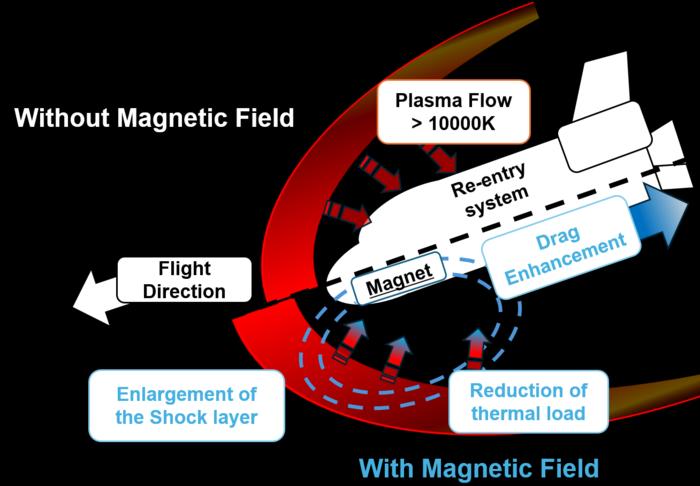
Engineers pursuing radical alternatives to traditional ablative heat shields have constructed the first practical test apparatus for magnetohydrodynamic braking, a plasma-based reentry system that could transform spacecraft recovery and payload economics.
Ablative heat shields work through sacrifice. Materials burn away predictably during reentry, dissipating thermal energy while protecting the spacecraft beneath. The method works reliably but demands complete replacement after each flight, extending turnaround times and consuming valuable mass that could carry instruments or cargo instead. Rocket reusability amplifies this inefficiency. SpaceX's Starship and Blue Origin's New Shepard already demonstrate that orbital hardware can fly multiple times. Heat shields cannot.
Magnetohydrodynamic braking offers a fundamentally different approach. The system uses powerful magnetic fields to create a plasma sheath around the descending spacecraft. This ionized gas layer deflects the supersonic airflow, reducing aerodynamic heating and drag simultaneously. Unlike ablative shields, MHD systems remain intact after reentry, requiring only electrical power and maintenance rather than replacement. They also weigh less for equivalent thermal protection.
The physics demands extraordinary conditions. During atmospheric entry, temperatures exceed 1,600 Kelvin. Air itself becomes plasma. A spacecraft must generate a magnetic field strong enough to shape this energized gas flow while withstanding the electromagnetic and thermal stresses. The challenge has kept MHD braking largely theoretical for decades.
The new test apparatus represents a concrete step toward demonstration. Researchers have constructed a facility capable of simulating reentry plasma conditions in controlled laboratory settings. The setup allows engineers to measure magnetic field effectiveness, plasma behavior, and heat transfer rates with precision impossible in flight tests. They can iterate designs, test different magnet configurations, and validate computational models before committing to expensive orbital experiments.
This matters urgently for several reasons. The emerging commercial space industry needs cheaper operational costs. Every pound of heat shield that survives reentry is a pound that cannot be payload. Reusable spacecraft amplify the problem. Furthermore, ambitious programs like NASA's Artemis lunar architecture and potential Mars missions require massive payload delivery. Reducing mass dedicated to thermal protection frees resources for life support, scientific instruments, or propellant.
International space agencies recognize the opportunity. China, Russia, and the European Space Agency all pursue MHD research. Whoever demonstrates reliable, flight-ready magnetohydrodynamic braking first gains operational advantage in the emerging space economy.
The test apparatus does not represent a finished product. Laboratory validation precedes flight testing, which precedes operational deployment. Years of development remain. But establishing the first serious ground test infrastructure means researchers can now answer critical engineering questions: Can magnetic coils withstand repeated reentry conditions? How much power does the system consume? What material degradation occurs? Does actual plasma behavior match computer simulations?
Success would reshape spacecraft design. Vehicles would shrink and lighten. Launch costs would decline. Turn-around times for reusable spacecraft would compress from weeks to days. Magnetohydrodynamic braking transforms reentry from a destructive event into a controlled electromagnetic process, aligning spacecraft operations with the efficiency demands of affordable spaceflight.