# Snapping the Sun's Grand Magnetic Border at 0.3 AU
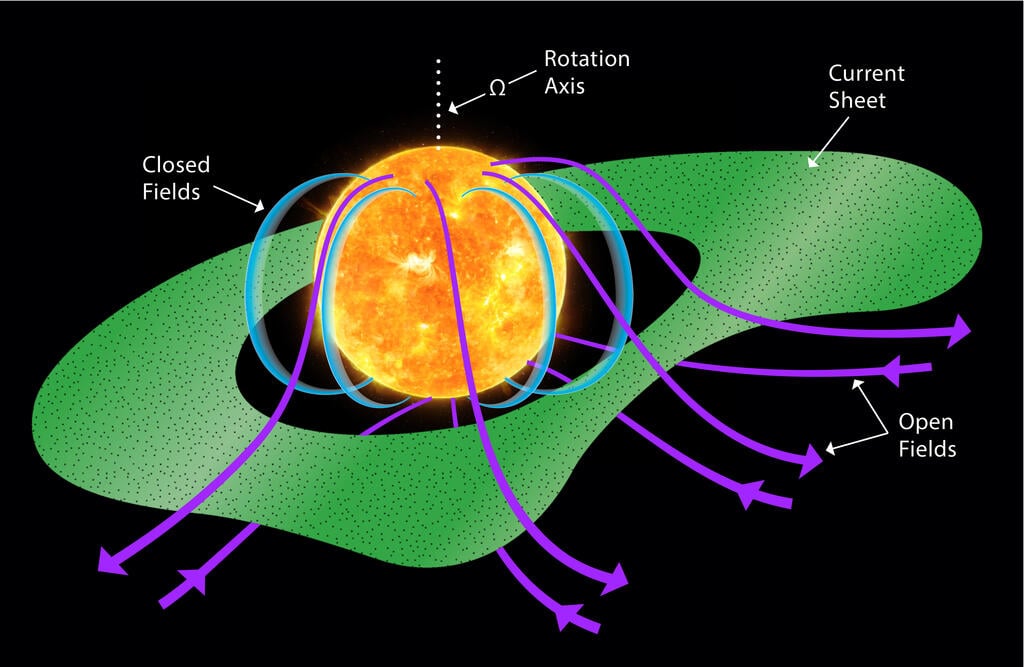
Astronomers have captured detailed images of the heliospheric current sheet, the solar system's largest structural feature, using data from spacecraft positioned far closer to the Sun than Earth. The heliospheric current sheet, or HCS, marks the boundary where the Sun reverses its magnetic polarity, creating a rippling curtain of charged particles that extends throughout the solar system.
Keiichi Ogasawara and his team at the Southwest Research Institute published findings that leverage observations from the joint ESA/NASA Solar Orbiter mission. Previous studies of the HCS relied exclusively on measurements near Earth's orbit, approximately 1 AU from the Sun, using instruments aboard the SOHO satellite and the Wind spacecraft. This new research pushed observations to roughly 0.3 AU, placing measurements three times closer to the Sun than Earth.
The heliospheric current sheet emerges directly from the Sun's surface, where enormous loops of plasma called helmet streamers create the sheet's structure. These streamers extend outward from regions where the Sun's magnetic field lines curve back and reconnect. The HCS itself represents the three-dimensional surface where the Sun's northern and southern magnetic hemispheres meet. As the Sun rotates, this surface warps into a wave-like pattern, resembling a corrugated sheet spiraling outward through the solar system.
Understanding the HCS carries implications for space weather prediction and solar physics. The sheet's location and orientation directly influence how the solar wind carries magnetic energy throughout the heliosphere. When Earth crosses the HCS, scientists observe distinct changes in solar wind properties and magnetic field direction. Studying the sheet's structure at distances closer to the Sun reveals how it forms and evolves before reaching Earth's neighborhood.
Solar Orbiter, launched in 2020, has achieved progressively closer approaches to the Sun than any previous spacecraft except the Parker Solar Probe. Orbiter's suite of instruments includes the Metis coronagraph and magnetometers sensitive enough to detect subtle variations in magnetic field strength and direction. By observing the HCS at 0.3 AU, researchers can see the sheet at earlier stages of its development, capturing details about how solar magnetic reconnection and plasma dynamics shape its structure.
The heliospheric current sheet serves as one of the fundamental organizing principles of the solar system's extended atmosphere. All planets orbit within or near this magnetic boundary, meaning their magnetospheres interact with it regularly. Mars, Mercury, and Venus experience direct HCS crossings due to their proximity to the sheet's variable position. Earth's magnetosphere typically deflects the HCS, but the planet nonetheless sits embedded within the larger heliospheric environment the sheet defines.
This research demonstrates how closer observations refine understanding of solar mechanisms that operate throughout the solar system. The high-resolution imagery and data from Solar Orbiter reveal fine structures and dynamics invisible from Earth's distance. Such observations feed directly into models that predict solar wind behavior, coronal mass ejection trajectories, and the propagation of energetic particles throughout interplanetary space.
Future close approaches by Solar Orbiter and continued observations from Parker Solar Probe will provide even richer datasets about the HCS. These measurements anchor our understanding of how the Sun's magnetic field influences the entire heliosphere and shape predictions for human space exploration missions heading deeper into the solar system.