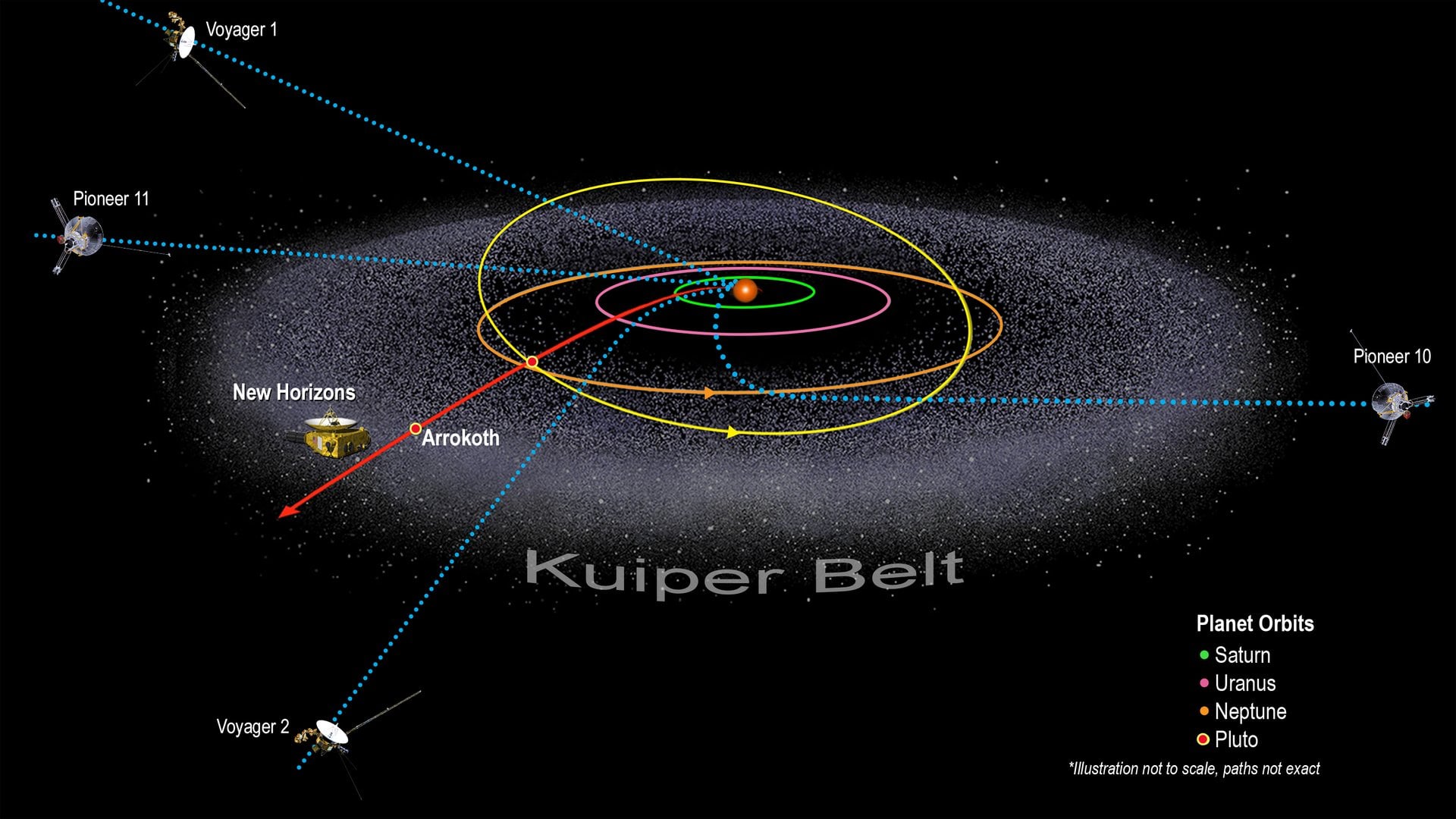
NASA's New Horizons probe faces potential funding cuts that could silence its heliospheric science instruments within months, threatening the loss of irreplaceable data from the outermost reaches of the solar system.
The New Horizons spacecraft, which conducted the historic 2015 flyby of Pluto and continues operating in the Kuiper Belt today, generates the only real-time measurements of the heliosphere at extreme distances from the Sun. The heliosphere is the bubble of solar wind and magnetic fields that extends billions of kilometers into space. New Horizons transmits critical data about how the solar wind interacts with the interstellar medium, information no other active spacecraft can provide.
New Horizons launched in 2006 and has operated for nearly two decades. It joined Pioneer 10 and 11, along with Voyager 1 and 2, as humanity's deep space scouts. Unlike the Voyagers, New Horizons carries modern heliospheric instruments that collect data with greater precision and different scientific objectives. The mission has already yielded discoveries about the Kuiper Belt's structure, the behavior of dust beyond the Sun's gravitational reach, and the properties of cosmic rays at solar system boundaries.
The spacecraft recently completed another hibernation cycle and returned to full operations. Its instruments remain functional and productive. The Solar Wind Around Pluto (SWAP) instrument and the Plasma and High-Energy Particle Spectrometer (PEPSSI) continue detecting particle populations and solar wind behavior. These instruments operate from approximately 50 astronomical units from Earth, roughly 50 times the Earth-Sun distance.
Budget pressures at NASA's Science Mission Directorate have forced difficult prioritization decisions across planetary science missions. New Horizons requires minimal power to operate and transmits data through NASA's Deep Space Network at rates of just 1 to 4 kilobits per second. The operational costs remain modest compared to other active spacecraft, yet budget constraints have created a scenario where mission extensions face elimination despite their scientific return.
The threat to New Horizons heliospheric science represents a loss more than a spacecraft retirement. The data stream New Horizons provides remains unique in the scientific context. While future missions like the Interstellar Probe concept continue in planning stages, no funded replacement exists. The heliospheric sciences community relies on this distant probe to understand how the Sun's influence diminishes into interstellar space and how cosmic rays penetrate solar system boundaries.
New Horizons continues moving outward at roughly 15 kilometers per second. It will remain technically capable of science operations for years to come, with adequate fuel for maneuvers and power from its radioisotope thermoelectric generator. The spacecraft's trajectory and instruments position it uniquely to answer questions about the heliosphere's structure and the transition zone between solar and interstellar environments.
The decision regarding New Horizons funding represents a choice between immediate budget relief and long-term scientific return. Once the funding cuts take effect, retrieving that heliospheric data becomes impossible. No spacecraft currently operates at comparable distances, and building and launching a replacement mission would require decades and substantial resources. The data New Horizons collects today cannot be gathered again for generations.