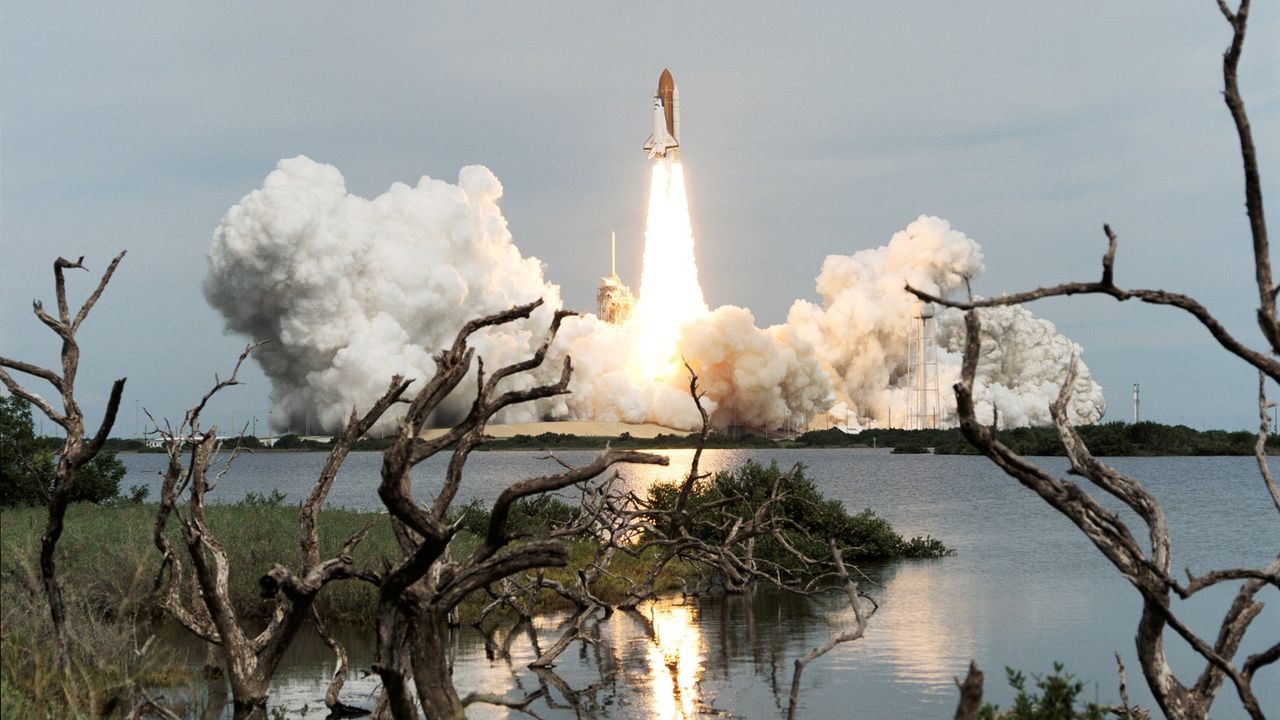
On September 7, 1995, Space Shuttle Endeavour lifted off from Kennedy Space Center carrying seven astronauts on mission STS-69, marking a watershed moment in human spaceflight. This launch represented NASA's 100th crewed mission since the Mercury program began in 1961, a milestone that underscored three decades of sustained commitment to exploring beyond Earth's atmosphere.
Commander David Walker, Pilot Kenneth Cockrell, and Mission Specialists James Newman, Michael Gernhardt, Wendy Lawrence, Thomas Jones, and Jeff Wisoff crewed the Endeavour for an 11-day mission. The shuttle carried the Shuttle Pointed Autonomous Research Tool for Astronomy (SPARTAN) instrument package, designed to observe ultraviolet radiation from the Sun and measure its impact on Earth's atmosphere and upper ionosphere. This data proved essential for understanding solar-terrestrial interactions and the space environment surrounding our planet.
Beyond SPARTAN, STS-69 executed two pivotal extravehicular activities, or spacewalks. Mission Specialists Newman and Gernhardt conducted spacewalks to retrieve the Instrument Pointing System attached to SPARTAN, demonstrating NASA's expanding capability to service and repair sophisticated equipment in orbit. These EVAs validated techniques that would prove vital for future Hubble Space Telescope servicing missions and construction of the International Space Station.
The mission also deployed the Wake Shield Facility, a free-flying platform designed to operate in the vacuum wake of Endeavour's payload bay. Working in this ultra-high vacuum environment, the facility collected data on materials processing and thin-film deposition techniques that terrestrial laboratories could not replicate. The results informed manufacturing processes for semiconductors and other advanced materials.
Reaching the 100th crewed spaceflight represented far more than a numerical achievement. The statistic reflected the space program's evolution from Project Mercury's suborbital hops through the two-person Gemini program to the advanced multipurpose capabilities of the Space Shuttle era. By 1995, NASA had transitioned from simply reaching orbit to conducting complex scientific operations, deploying satellites, servicing spacecraft, and preparing for construction of an international orbital outpost.
The timing of STS-69 held particular significance. NASA was in the midst of intensive preparation for the Shuttle-Mir program, which would begin docking American spacecraft with the Russian space station in 1995. The 100th mission demonstrated that the Space Shuttle had matured into a reliable platform for international cooperation and sustained orbital operations. The vehicle's ability to conduct multiple spacewalks and deploy sophisticated instruments proved that human spaceflight could serve ambitious scientific and engineering objectives.
By the time Endeavour touched down at Kennedy Space Center on September 18, 1995, the mission had generated extensive data on solar physics, materials science, and extravehicular operations. The 100th crewed spaceflight celebration quietly acknowledged that human space exploration had transcended novelty and entered an era of routine operational capability. NASA would continue flying the shuttle for another 15 years, launching hundreds more astronauts into orbit and constructing the International Space Station with equipment and modules delivered by vehicles that traced their heritage directly back to those early Mercury capsules.