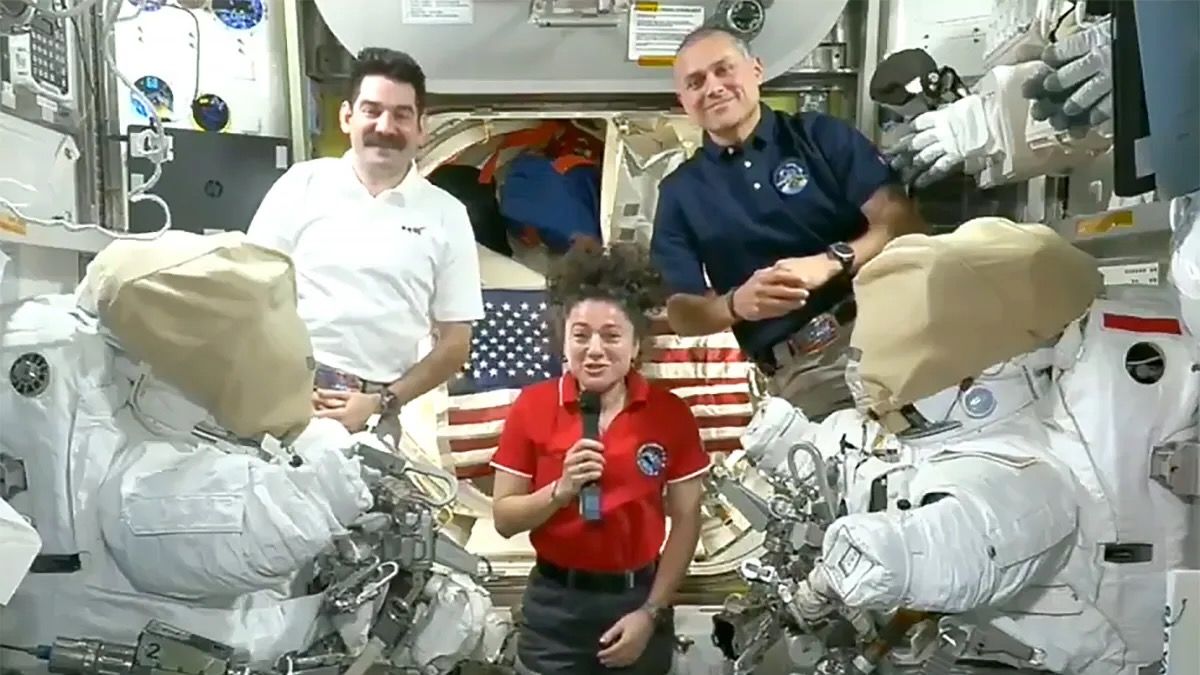
Three NASA astronauts aboard the International Space Station will observe Labor Day on Monday, September 2, taking a scheduled break from their regular research and maintenance duties. The astronauts join millions of Americans celebrating the federal holiday, though their "day off" carries unique constraints tied to life in low Earth orbit.
The ISS operates on a continuous schedule. Astronauts rotate through expedition crews lasting roughly six months, maintaining critical systems, conducting microgravity experiments, and performing external repairs. Their workdays typically span eight hours of structured tasks, similar to ground-based research schedules. However, the station never truly shuts down. Life support systems run perpetually. Experiments continue collecting data. The orbiting laboratory completes sixteen sunrises and sunsets daily at its 17,500-mile-per-hour velocity.
NASA and its international partners build flexibility into crew schedules. Astronauts receive designated rest days roughly once per week, protecting mental health and work-life balance during months of confinement in a compressed environment. Federal holidays create additional breaks when possible. Labor Day, marking the unofficial end of summer and honoring American workers' contributions to the nation's prosperity, typically means lighter schedules aboard the station.
"Day off" in space differs fundamentally from Earth. Astronauts cannot simply leave. The ISS remains their workplace and home. Rest involves reduced work assignments, time for personal communication with family, recreational activities, and physical exercise. The station includes a treadmill and resistance equipment to combat bone density loss and muscle atrophy from prolonged weightlessness. Leisure options include reading, watching movies, photography, and simply gazing at Earth below.
The current expedition crew represents international partnership central to ISS operations. NASA works alongside Roscosmos, the Russian space agency, the European Space Agency, the Japan Aerospace Exploration Agency, and the Canadian Space Agency. Astronauts from multiple nations live and work together, creating a multinational community 250 miles above Earth's surface.
Scheduled rest days serve critical functions beyond morale. Research confirms that fatigue degradation increases error rates in technical environments. Space operations demand precision. A single mistake during a spacewalk or system repair carries potentially catastrophic consequences. NASA applies rigorous fatigue management protocols developed through decades of human spaceflight experience and validated through Mission Control communication analysis.
The ISS rotates crews every six months. A typical expedition sees three astronauts working full expeditions while three others arrive or depart during overlap periods. This continuous rotation ensures operational continuity while allowing individual astronauts to return to Earth for recovery, family time, and Earth-based training for future missions.
Labor Day carries historical weight tied to workers' rights, labor organization, and the dignity of work. For astronauts, the holiday acknowledges that even those pursuing extraordinary work in extraordinary environments deserve rest, family connection, and recognition of their professional contributions to scientific advancement and exploration.
The three NASA astronauts aboard the ISS continue supporting humanity's permanent presence in space while honoring the traditions and values their nation celebrates below.