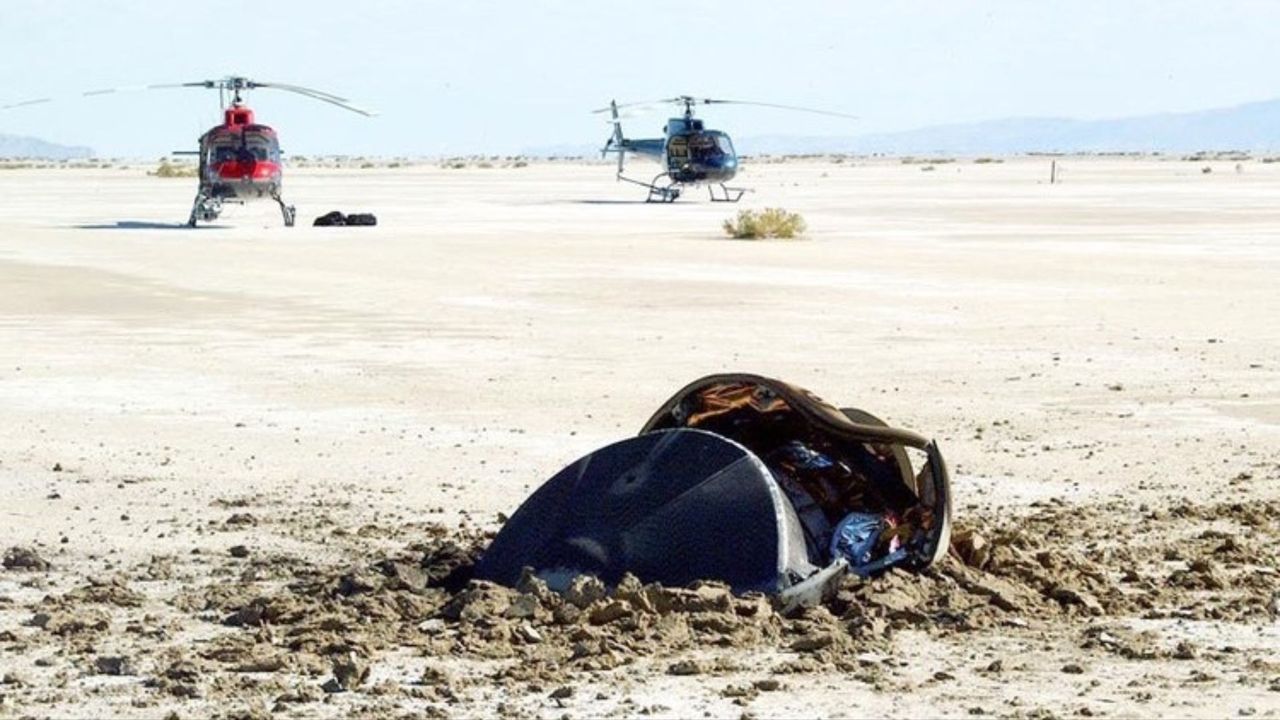
On September 8, 2004, NASA's Genesis spacecraft plummeted into the Utah desert at high speed, its parachutes failing to deploy during re-entry. The impact shattered the spacecraft's precious cargo, but the mission's scientific legacy proved far more resilient than the hardware.
Genesis launched in August 1998 on a three-year mission to collect samples of the solar wind, the constant stream of charged particles flowing from the sun. The spacecraft traveled roughly one million miles from Earth to the Sun-Earth L1 Lagrange point, where gravitational forces balance and allowed extended monitoring of unfiltered solar material. For 886 days, Genesis captured ions from the solar wind in specially prepared collection materials.
The catastrophic crash occurred during the spacecraft's return to Earth. At approximately 193 miles per hour, Genesis impacted the desert floor near the town of Wendover on the Utah-Nevada border. Investigators later determined that a critical microswitch inside the spacecraft had been installed backward during assembly, preventing the parachute deployment system from activating. The physical damage appeared total. Researchers feared the solar wind samples, exposed to Earth's atmosphere and minerals during the crash, had become contaminated beyond scientific value.
Yet scientists salvaged the mission. Teams recovered collector materials from the wreckage and developed rigorous protocols to identify and separate the original solar wind particles from terrestrial contamination. Using isotopic analysis and other analytical techniques, researchers successfully extracted usable data from the samples. The recovered material provided direct measurements of solar wind composition, particularly isotopic ratios of oxygen, nitrogen, and other elements. These ratios offered unprecedented detail about the sun's composition and the early solar system's chemical makeup.
The Genesis samples proved transformative for solar physics and planetary science. The isotopic data allowed researchers to refine models of solar composition and the chemical evolution of the solar system. Comparisons between solar wind measurements and Earth's isotopic signature revealed important information about planetary formation processes and volatile element distribution.
The mission exemplified scientific resilience. Despite equipment failure, lost spacecraft systems, and contamination concerns, the core scientific objective succeeded. Genesis produced over 800 scientific papers since the crash. The samples remain in continuous study, yielding discoveries decades after collection.
NASA implemented lessons from the Genesis failure into subsequent spacecraft design. Redundant system checks and verification procedures became more rigorous. The incident reinforced that human error in assembly processes required multiple safeguards. The single backward microswitch became a cautionary tale in aerospace engineering.
The Genesis recovery operation also demonstrated the value of planetary material analysis. Direct sampling of the sun's atmosphere provided information impossible to obtain through remote sensing alone. Future missions to collect samples from asteroids, comets, and planetary atmospheres benefited from protocols and techniques developed during Genesis sample recovery.
Today, Genesis stands as a mission that overcame catastrophic hardware failure to advance human knowledge of the sun and solar system's origins. The spacecraft's crash did not define its legacy. The science extracted from its broken remains did.