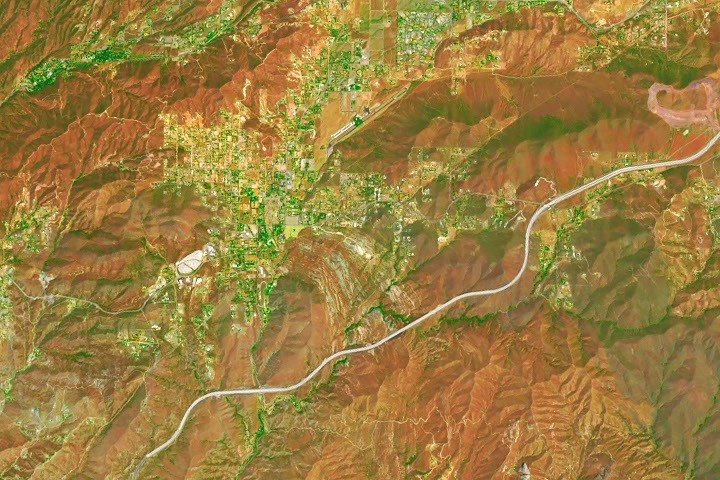
# The Otherworldly Geology of Vasquez Rocks
Vasquez Rocks, located in the Soledad Basin north of Los Angeles, presents one of Earth's most dramatic geological theaters. Massive sedimentary layers thrust upward at steep, almost vertical angles create a landscape so alien that Hollywood has consistently chosen it as a stand-in for extraterrestrial terrain. The original Star Trek series filmed there repeatedly, drawn to formations that naturally evoke otherworldly vistas without requiring expensive set construction.
The rocks tell a story of tectonic violence. Sedimentary layers, deposited horizontally over millions of years, were tilted to extreme angles by fault movement and crustal deformation. The San Gabriel Fault runs through the region, part of the broader San Andreas Fault system that defines California's earthquake geology. Compression and shearing forces twisted what were once flat-lying strata into the nearly vertical formations visible today. This process began roughly 25 million years ago and continues as the Pacific and North American plates grind past each other.
The Soledad Basin itself formed as a pull-apart basin, a depression created where fault lines separate and allow crustal material to subside. Within this basin, sediments accumulated and hardened into stone. Later tectonic events folded and faulted these rocks into their present configuration. The exposed cross-section reveals bands of sandstone, siltstone, and conglomerate, each layer recording specific environmental conditions from its deposition.
NASA scientists study sites like Vasquez Rocks for insights into planetary geology and landscape evolution. The dramatic folding and faulting provide textbook examples of deformation mechanics applicable to understanding crustal processes on Earth and other terrestrial bodies. Mars, for instance, displays evidence of similar tectonic activity in its ancient past, with folded and faulted rocks preserved in high-resolution orbital imagery from NASA's Mars Reconnaissance Orbiter and the European Space Agency's Mars Express.
The visual drama that attracted filmmakers serves a scientific purpose as well. The exposed geology allows geologists to read the rock record directly, tracing changes in sedimentation patterns, depositional environments, and deformation styles through vertical sections. Each tilted layer represents time compressed into stone, accessible for study without drilling or excavation.
Vasquez Rocks remains an active site of geological research and public education. The California Department of Parks and Recreation manages Vasquez Rocks Natural Area Park, which attracts visitors and researchers alike. Hikers encounter the same formations that captivated Star Trek producers, gaining visceral understanding of how tectonics reshape landscapes. The site demonstrates that Earth's geology can rival any science fiction production in sheer visual spectacle while offering real scientific value for understanding planetary evolution.
The intersection of geology and popular culture at Vasquez Rocks highlights how natural wonders can serve dual purposes: entertainment and education. Geologists benefit from public interest in dramatic landscapes, while audiences develop intuitive grasp of geological processes through exposure to these formations. In this way, Hollywood's choice to film at Vasquez Rocks inadvertently promoted geological literacy among millions who encountered the site through television screens.