# Artemis II Crew Visits Marshall Space Flight Center Ahead of Lunar Return
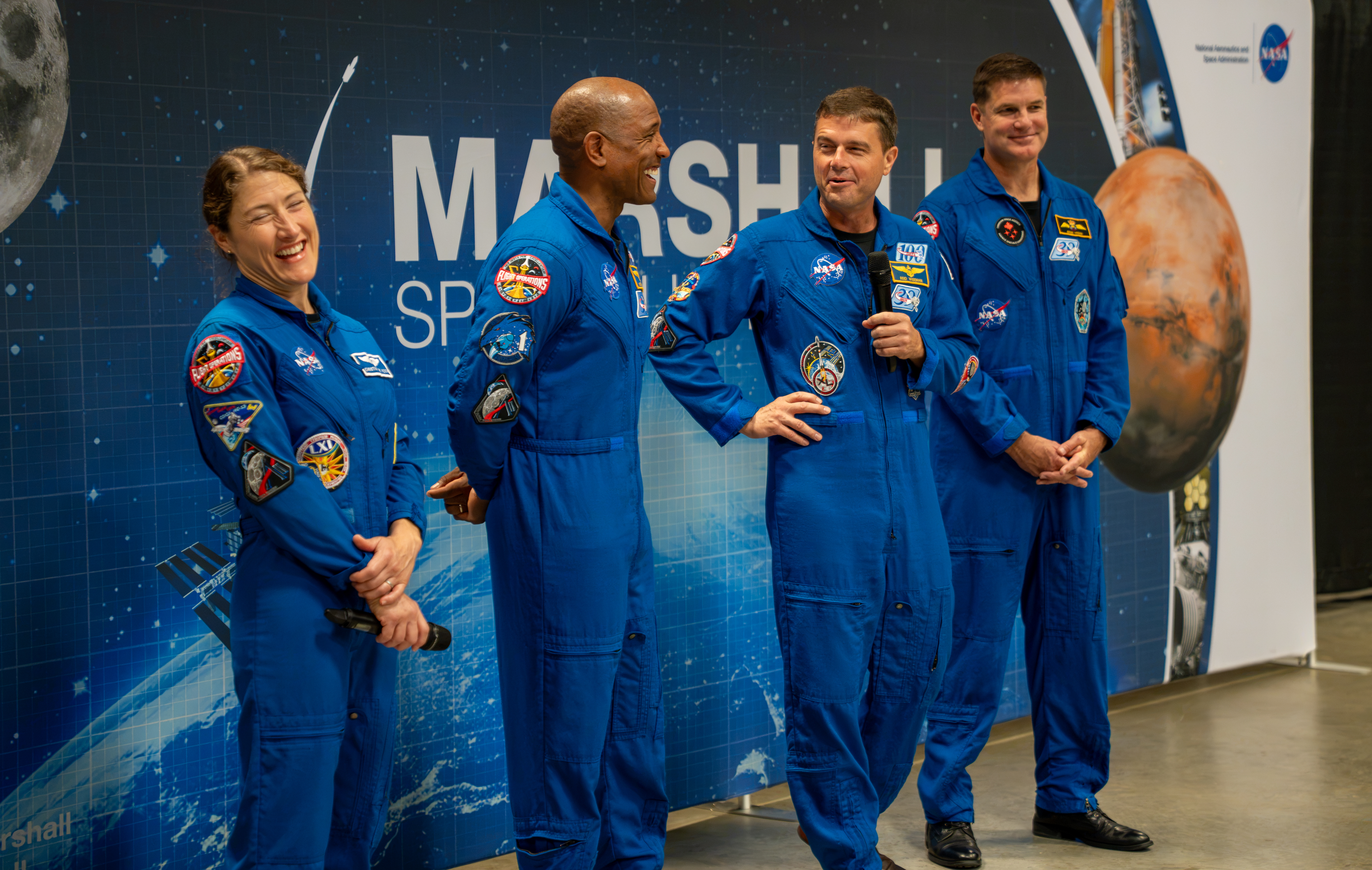
The four astronauts selected for NASA's Artemis II mission traveled to Huntsville, Alabama on September 1, 2026, to meet with engineers and scientists at Marshall Space Flight Center. The visit brought together the crew that will execute humanity's return to lunar orbit for the first time since the Apollo program ended in 1972.
Artemis II will carry NASA astronauts Christina Koch, Victor Glover, and Reid Wiseman, along with Canadian Space Agency astronaut Jeremy Hansen. The mission represents a critical stepping stone in NASA's broader Artemis program, which aims to establish sustainable lunar exploration and eventually send humans to Mars.
Marshall Space Flight Center, located in Huntsville, plays a central role in Artemis hardware development. The center leads work on the Space Launch System (SLS) rocket's core stage and engines, the Interim Cryogenic Propulsion Stage (ICPS), and components of the European Service Module. The visit allowed crew members to interact directly with the thousands of Marshall employees building and testing the systems they will depend on during flight.
Christina Koch brings extensive spaceflight experience to the commander role. She has logged over 300 days in space across multiple missions to the International Space Station and holds the record for the longest single spaceflight by a woman. Glover, a former Navy pilot, will serve as pilot. Wiseman has flown to the ISS twice and brings deep knowledge of spacecraft systems. Hansen becomes the second Canadian to fly beyond Earth orbit and the first since Marc Garneau's STS-45 mission in 1992.
The Artemis II mission will launch aboard the Space Launch System, NASA's most powerful rocket. The crew will travel in the Orion spacecraft, which will perform a high-energy translunar injection trajectory taking the crew around the Moon before returning to Earth. The mission will conduct critical validation of life support systems, avionics, guidance and navigation systems, and thermal protection performance in the deep space environment.
This flight comes after the successful uncrewed Artemis I mission in November 2022, which completed a 25.5-day journey to the Moon and back. Artemis II will push further, sending crew into lunar orbit to conduct observations and test procedures that will inform the Artemis III landing mission.
Marshall's engineers have logged hundreds of thousands of hours preparing flight hardware. The core stage that will power Artemis II has completed testing and qualification. The ICPS upper stage underwent critical test firing in 2023. Every engine, valve, and sensor has undergone rigorous analysis and validation.
The crew visit serves dual purposes. It strengthens connection between astronauts and the engineers whose work keeps them alive in the unforgiving vacuum of space. It also energizes the Marshall workforce by putting faces to the mission they have dedicated years to building. For many engineers, seeing the crew who will ride their rockets to the Moon represents validation that decades of dedication to America's lunar exploration program matters.
Artemis II's crew will be among the first humans to see the lunar far side from a crewed spacecraft. The experience will inform procedures for the subsequent Artemis III landing mission, which targets the lunar south pole's permanently shadowed craters. Those regions contain water ice deposits critical for establishing human presence on the Moon.