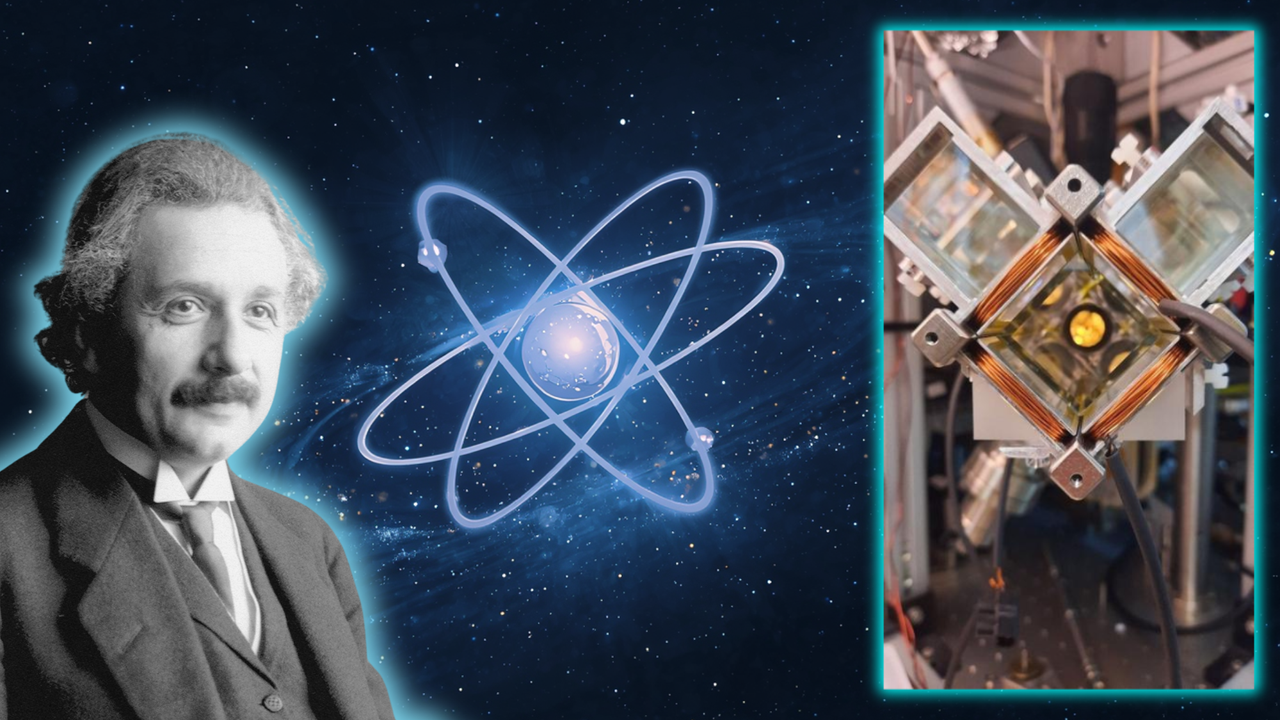
Physicists have detected the first experimental evidence that Einstein's general relativity behaves like a quantum theory at subatomic scales, a breakthrough that challenges decades of theoretical assumptions about how gravity works at the smallest distances.
The finding emerges from research examining gravity's behavior when matter reaches quantum dimensions. General relativity, Einstein's 1915 theory describing gravity as curved spacetime, has never been directly tested at quantum scales. Quantum mechanics governs the subatomic world, yet gravity stubbornly resists integration into quantum frameworks. This incompatibility has haunted physics for over a century.
Until now, scientists operated on the premise that general relativity and quantum mechanics were fundamentally separate regimes. General relativity dominated at large scales, from planetary orbits to galaxies. Quantum mechanics ruled atoms and particles. Gravity appeared too weak at quantum scales to matter. The math suggested these two pillars of physics could not merge.
The new experimental results suggest otherwise. Researchers detected quantum signatures within gravitational effects, indicating that gravity itself obeys quantum rules at sufficiently small scales. This represents the first direct observation of "quantum gravity" in action, a concept physicists have pursued since the 1980s.
The discovery carries profound implications for theoretical physics. If gravity operates quantum mechanically at small scales, it demands rethinking how the universe functions at its most fundamental level. Quantum gravity theories have remained speculative because testing them required energy scales beyond current experimental capacity. This observation provides empirical grounding for models that unify general relativity and quantum mechanics.
The breakthrough also advances work toward a "theory of everything." Physicists have long sought a single framework encompassing all four fundamental forces: electromagnetism, strong nuclear force, weak nuclear force, and gravity. The electromagnetic and nuclear forces already fit within quantum field theory. Gravity's quantum behavior opens pathways toward complete unification.
Previous attempts to detect quantum gravity effects relied on indirect methods or theoretical extrapolations. Gravitational wave detectors like LIGO have revolutionized gravitational astronomy, yet they operate at scales where classical general relativity dominates. This new evidence comes from direct quantum-scale observations, marking a methodological leap.
The research does not resolve all tensions between general relativity and quantum mechanics. Phenomena like singularities in black holes and the quantum structure of spacetime itself remain poorly understood. String theory, loop quantum gravity, and other quantum gravity candidates each predicted different behaviors at quantum scales. The new results offer data to evaluate these competing frameworks.
This discovery positions physics at an inflection point. For decades, quantum gravity existed as a theoretical necessity without experimental validation. Physicists could debate endlessly whether gravity truly becomes quantum at small scales. The evidence now demands that experiments and theory converge on this question. Further observations will determine whether current quantum gravity models require modification or whether entirely new physics emerges.
The implications extend beyond academic physics. Quantum gravity theories drive research into quantum computing, spacetime structure, and fundamental physics at extreme densities and temperatures. Understanding how gravity quantizes informs approaches to black hole thermodynamics and early universe cosmology.