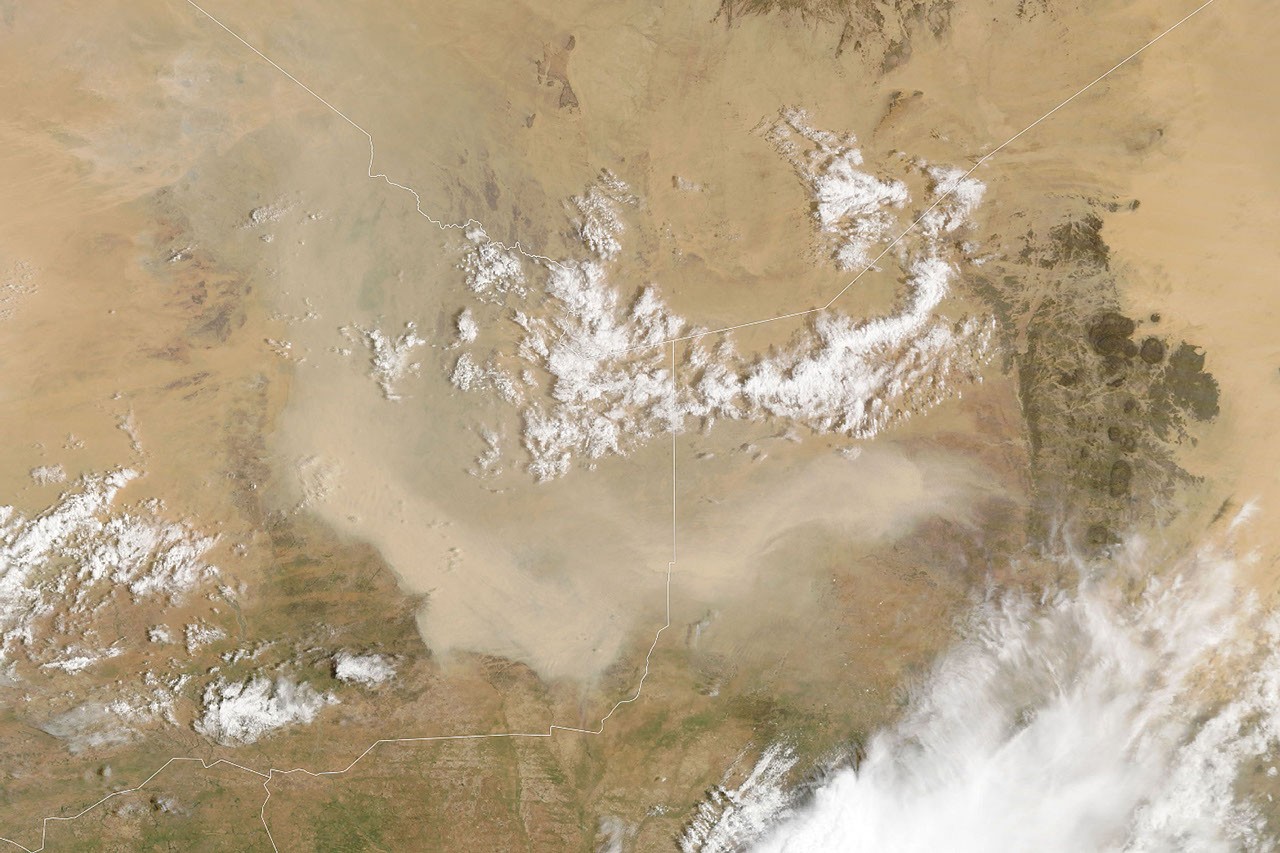
# Dust Storm Sweeps Over Mali as Season Winds Down
A massive dust plume blanketed Mali and neighboring West African nations recently, defying typical seasonal patterns. NASA satellite observations captured the event as the Saharan dust season enters its decline phase.
Dust storms dominate West African weather during late winter and spring, driven by strong winds that lift fine particles from the Sahara Desert into the atmosphere. These storms transport mineral-rich sediment across thousands of kilometers, affecting air quality, climate patterns, and human health across the region and beyond. The plume that swept over Mali arrived during a period when dust activity normally diminishes, making this event meteorologically noteworthy.
NASA's Earth-observing satellites, including instruments aboard the Moderate Resolution Imaging Spectroradiometer (MODIS), detected and tracked the dust plume's progression. These sensors distinguish dust from clouds through spectral analysis, allowing scientists to map aerosol concentrations and movement with precision. The data reveals the scale and density of atmospheric particles suspended across Mali and adjacent territories.
Dust storms originate primarily from the Bodele Depression in Chad and the Sahara's broader surface, where wind erosion lofts fine particles into the Sahel and beyond. The mineral composition includes iron oxides, silicates, and other compounds that travel on atmospheric currents. Prevailing winds during this season typically move dust westward toward the Atlantic and northwestward into Europe, though localized storms can smother downwind communities.
The timing of this event carries implications for atmospheric science. Most Saharan dust activity peaks between January and March, when thermal contrasts and wind patterns achieve maximum strength. A significant dust storm occurring as activity typically subsides suggests either anomalous atmospheric conditions or the tail end of an extended active season. Understanding these patterns helps scientists refine climate models and predict future aerosol distribution.
Dust storms present dual impacts on the region. The transported minerals deliver nutrients to soils and ocean ecosystems, a process that has shaped African and Caribbean ecosystems for millennia. However, the same storms degrade air quality, reduce visibility, and carry potential respiratory hazards. Fine particulate matter damages equipment and affects solar radiation reaching Earth's surface, influencing local temperatures and weather systems.
Mali faces particular vulnerability to dust storms. The nation's geography places it directly in the Sahara's southern margin, where dust plumes originate and intensify. Infrastructure, agriculture, and public health systems experience regular disruption from intense dust events. Satellite monitoring provides early warning and tracking data that inform emergency responses and public health advisories.
NASA's continuous Earth observation missions generate datasets spanning decades, allowing scientists to track long-term trends in dust storm frequency and intensity. These records reveal how climate change, land-use patterns, and desertification influence aerosol activity. Such information proves essential for predicting how Saharan dust patterns may evolve in coming decades.
The dust plume that swept Mali demonstrates why NASA maintains a network of Earth-monitoring satellites. These assets capture atmospheric phenomena in real time, providing data that governments, researchers, and humanitarian organizations require to understand and respond to environmental events that cross borders and continents.