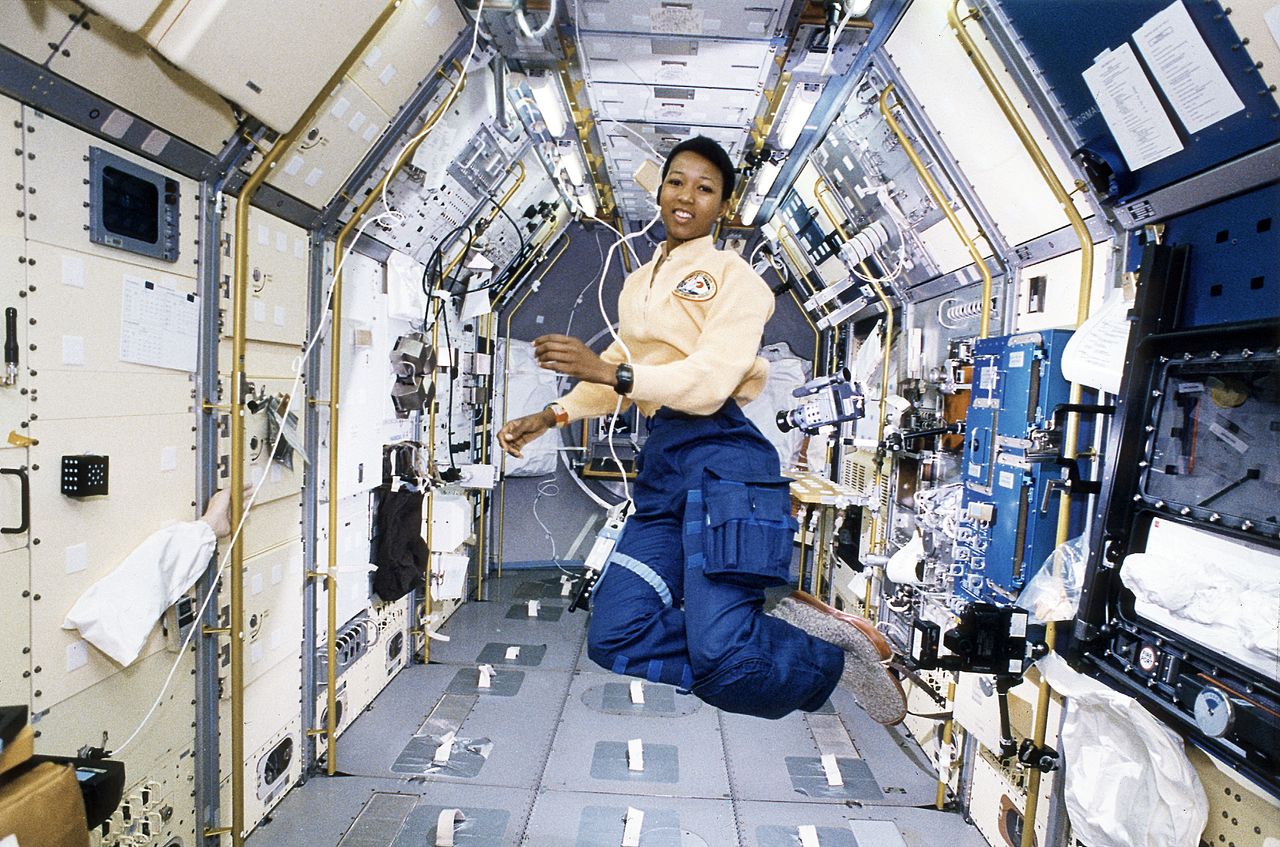
Mae Jemison launched aboard Space Shuttle Endeavour on September 12, 1992, breaking through one of spaceflight's most visible barriers. The mission marked not merely a symbolic milestone but a transformative moment for diversity in the American space program and a watershed in the history of human spaceflight.
Jemison flew as a mission specialist on STS-47, a seven-day orbital mission. Her selection reflected the changing composition of NASA's astronaut corps in the late 1980s and early 1990s, yet her achievement carried weight beyond representation. She arrived at the Kennedy Space Center with credentials forged in rigorous scientific training. Before joining NASA's astronaut program in 1987, Jemison worked as a medical officer in the Peace Corps in West Africa and practiced general medicine in Los Angeles. This background shaped her mission focus: she conducted experiments in materials science and life sciences aboard Endeavour's Spacelab module.
The shuttle program itself was at a critical juncture when Jemison flew. Space Shuttle Challenger had disintegrated in January 1986, killing all seven crew members, including educator Christa McAuliffe. The subsequent Return to Flight missions rebuilt public confidence in the shuttle system and demonstrated NASA's commitment to returning humans to orbit safely. STS-47 represented that resilience. Endeavour itself, built as a replacement for Challenger, carried Jemison and six other astronauts on this mission of scientific investigation.
Jemison's work during the mission focused on life science payloads and materials processing experiments. She operated experiments involving bone cells and conducted other biological research designed to advance understanding of how organisms respond to microgravity. These investigations fed directly into broader NASA priorities for using the shuttle and the orbiting Spacelab as platforms for research that could not be conducted on Earth.
The barrier Jemison crossed extended beyond race. She became only the second African American astronaut to fly in space. Robert Lawrence Jr. had been selected as an astronaut in 1967, though he died in a test flight accident before flying a mission. Guion Bluford Jr. became the first African American to reach space in 1983 aboard STS-8. Yet Jemison's mission represented a distinct threshold. The visibility of a Black woman astronaut in the payload specialist role captured national attention and redefined who belonged in the space program.
Jemison's seven days in space produced lasting changes in how NASA recruited, trained, and supported diverse astronauts. She left the astronaut corps in 1993 to pursue other scientific endeavors, founding The Jemison Group and focusing on technology and research for developing nations. Her post-NASA work underscored that her space mission was not the culmination of her scientific career but one chapter in a longer trajectory of innovation and service.
The STS-47 mission logged 190 orbits around Earth and deployed scientific instruments that contributed to multiple research efforts. Endeavour itself became one of the space program's workhorse orbiters, flying 25 missions over its operational lifetime. The shuttle returned safely to Kennedy Space Center on September 20, 1992, carrying Jemison home as the first African American woman to have journeyed to space.