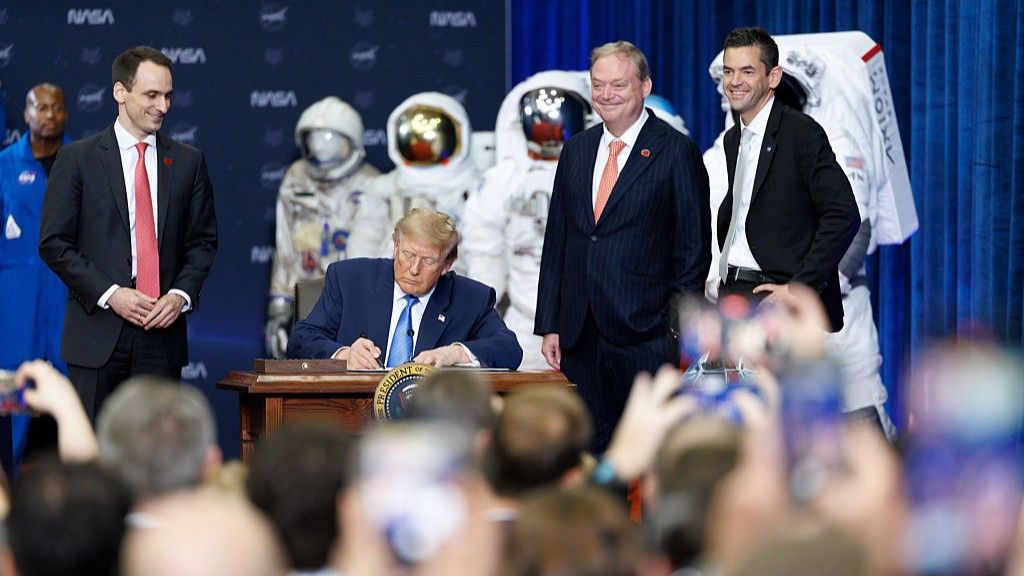
President Trump's proposed U.S. Space Academy raises fundamental questions about the boundary between civilian space exploration and military space operations, according to space policy experts analyzing the executive order.
The proposal centers on establishing a dedicated academy to train space professionals. Trump's administration frames this as necessary infrastructure for American space leadership. Yet the initiative introduces ambiguity about institutional roles that have remained relatively distinct for decades.
NASA has operated as the civilian space agency since its founding in 1958. The Department of Defense and the Space Force, established as an independent branch in 2019, handle military space operations and national security missions. This separation of civilian and military space activities reflects Cold War-era policy designed to prevent militarization of space exploration.
A Space Academy could alter this structure. If the institution trains personnel for both NASA and Space Force operations, it blurs the traditional dividing line. Personnel pipeline integration might gradually shift NASA's culture or priorities toward defense objectives. Alternatively, a military-led academy could deprioritize scientific missions in favor of strategic capabilities.
The timing matters. The Space Force already operates under the Department of Defense. Its United States Space Command coordinates military space operations globally. Adding a dedicated academy means investing federal resources in space workforce development. The question becomes whether this academy serves both civilian and military needs equally, or tilts toward one mission set.
Space policy experts raise practical concerns. Academy graduates require different training paths depending on their eventual employers. NASA scientists need deep expertise in astrophysics, planetary geology, and climate science. Space Force personnel need training in satellite operations, cyber defense, and strategic communications. A single institution cannot effectively train both without significant structural complexity.
Budget allocation presents another problem. Federal resources devoted to a Space Academy mean fewer dollars for existing workforce development programs at NASA, universities, and private space companies. SpaceX, Blue Origin, and other commercial operators also need trained personnel. A government academy could create inefficiencies rather than fill genuine gaps.
International law adds another layer. The Outer Space Treaty of 1967, ratified by the United States, prohibits placing weapons of mass destruction in orbit and bars national appropriation of celestial bodies. It permits military space activities for national defense. However, blending civilian and military institutional structures could trigger diplomatic questions about American intentions in space.
The executive order lacks implementation details. Congress would need to appropriate funds and authorize the academy's structure. Lawmakers will face pressure from multiple constituencies. NASA leadership will want to protect civilian space science. The Space Force will seek personnel for growing operations. Private industry will argue for market-based workforce development.
Historical precedent exists. The Air Force Academy, founded in 1954, successfully trains officers for the Air Force mission. However, aerospace operates differently than space. Air Force personnel primarily work within Earth's atmosphere. Space personnel operate across satellites, launch systems, and deep space missions with fewer established operational models.
The proposal reflects genuine American space workforce demands. Competition with China and Russia for space capabilities intensifies. Personnel shortages exist in specialized fields. Yet establishing a dedicated academy requires answering hard questions about governance, mission priorities, and institutional purpose before implementation proceeds.