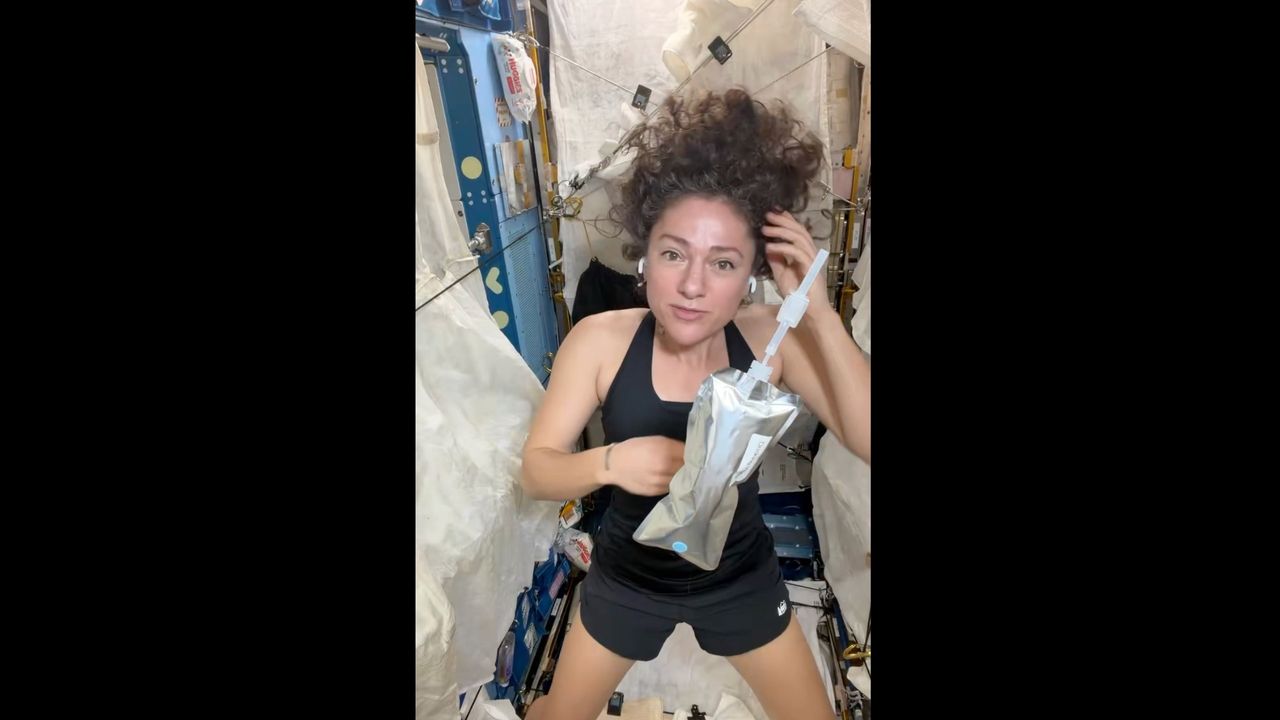
# NASA Astronaut Jessica Meir Demonstrates Zero-Gravity Hair Care From Orbital Laboratory
NASA astronaut Jessica Meir offered a practical demonstration of curly hair management in microgravity from the International Space Station, addressing a question that rarely receives attention in spaceflight documentation. The video, captured aboard the orbiting laboratory, shows how hair behaves and can be styled when gravity ceases to pull downward.
Meir's appearance on the ISS crew serves multiple roles. Beyond commanding spacecraft systems and conducting scientific experiments, astronauts document life in space for public engagement. These moments, seemingly casual, reveal fundamental differences between orbital and terrestrial environments. Hair styling in microgravity presents distinct challenges and unexpected advantages that differ markedly from Earth-bound grooming.
In zero gravity, hair does not fall or respond to traditional brushing techniques. Strands float independently, making conventional styling impossible. Water-based styling products behave differently when they cannot pool or drip. Astronauts must adapt grooming routines to microgravity physics. Meir's tips provide practical information for both current space station residents and future crew members bound for long-duration missions.
The ISS, continuously inhabited since November 2000, orbits Earth every 90 minutes at an altitude of roughly 250 miles. Crews rotate every six months, with typically six to seven astronauts and cosmonauts aboard at any time. Living and working in this environment for months requires developing new habits across all personal routines, from hygiene to rest to exercise.
Meir's career demonstrates the evolving role of NASA astronauts in public communication. She logged two spacewalks during her 2019 expedition, conducting critical maintenance on the station's solar power systems. Her dual expertise in engineering and science, combined with her ability to engage audiences, makes her an effective ambassador for spaceflight. Content from the ISS reaches millions through NASA's social media channels and traditional outlets.
The ISS serves as humanity's only permanent microgravity laboratory. Scientists conduct experiments in materials science, life sciences, combustion research, and Earth observation that cannot occur in ground-based facilities. Understanding how the human body adapts to long-duration spaceflight informs planning for deep space missions, including returns to the Moon and eventual Mars exploration.
Astronaut wellness during ISS missions extends beyond exercise equipment and dietary supplements to include psychological well-being and quality of life. Small moments like hair care routines contribute to maintaining morale during isolation in the space station's confined quarters. NASA and other space agencies recognize that astronaut comfort directly affects crew performance and mission success.
Meir's demonstration illustrates how space agencies balance serious scientific work with public outreach. NASA regularly releases behind-the-scenes content that humanizes space exploration while educating audiences about orbital operations. These moments transform astronauts from distant figures into relatable professionals navigating ordinary challenges in extraordinary circumstances.
As commercial spaceflight companies like SpaceX and Blue Origin expand beyond cargo transport into crew missions, understanding life support systems and human adaptation becomes increasingly important. Private space stations in development will eventually rely on similar knowledge about maintaining crew health and comfort in microgravity. Meir's practical tips contribute to the collective knowledge base that supports all future orbital activities.