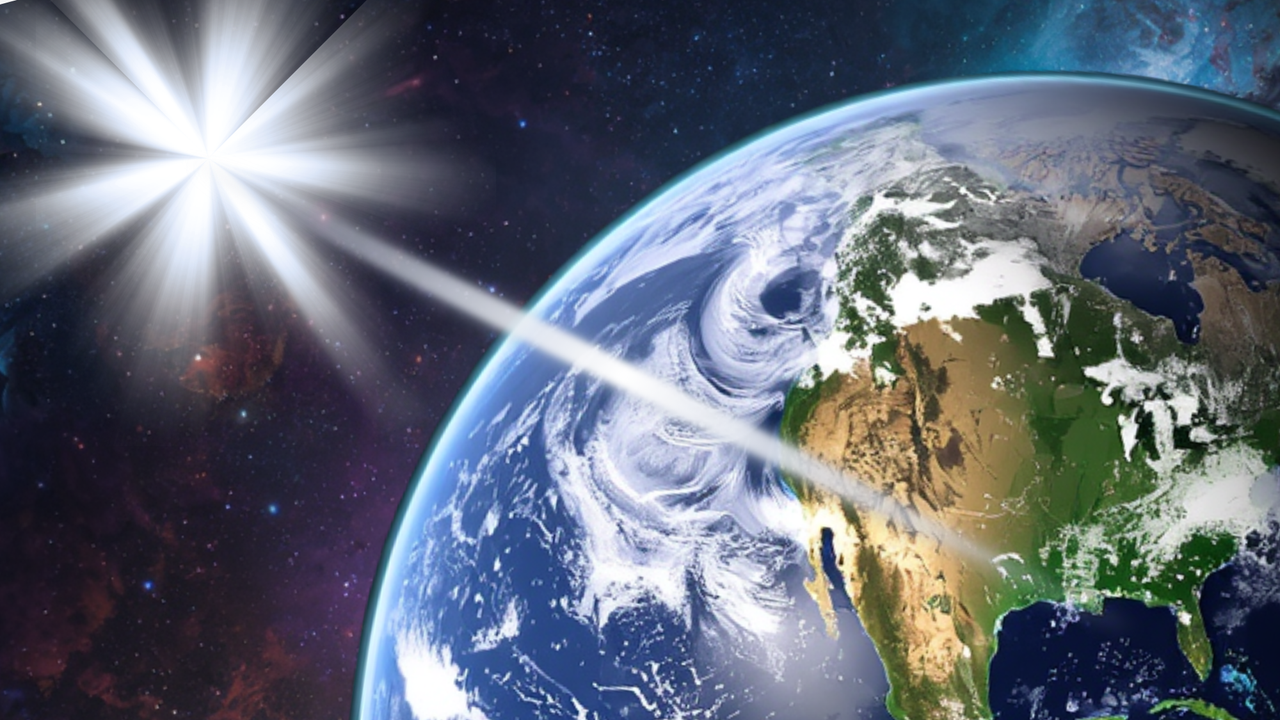
A gamma-ray burst so intense it earned the nickname "the BOAT" (Brightest of All Time) has yielded a mystery that touches the foundations of modern physics. In October 2022, astronomers detected photons from this explosion that should not have survived the journey to Earth if Einstein's theories hold universally. Now researchers believe they understand the mechanism that allowed these particles to arrive intact.
The BOAT erupted on October 9, 2022, as a GRB 221009A, the most luminous gamma-ray burst observed since astronomical records began. Gamma-ray bursts rank among the universe's most violent events. They release more energy in seconds than the Sun will emit in its entire 10-billion-year lifetime. The BOAT struck so brightly that it saturated detectors on multiple space telescopes, including NASA's Swift and Fermi missions, as well as instruments aboard the International Space Station.
Here lies the puzzle. Einstein's theory of special relativity predicts that high-energy photons traveling through the universe should pair-produce when they encounter low-energy background light, a process called opacity. In theory, photons with energies exceeding 100 gigaelectronvolts (GeV) should almost never reach Earth from distant sources. Yet the BOAT delivered photons with energies reaching 18 teraelectronvolts (TeV), roughly 180 times more energetic than the predicted opacity threshold.
The Fermi telescope recorded these extreme-energy photons. Ground-based gamma-ray observatories including MAGIC and the Major Atmospheric Gamma-ray Imaging Cherenkov Telescope in the Canary Islands confirmed the detection. The photons arrived within seconds of the burst's initial detection, traveling across billions of light-years from a region near the constellation Sagitta.
Scientists considered several explanations. The leading hypothesis involves Lorentz invariance violation, a concept suggesting that the fundamental laws of physics might operate differently at extreme energies. This would mean Einstein's relativity, while remarkably accurate at observable scales, breaks down in specific regimes. The alternative explanation involves the extragalactic background light being dimmer than current models predict, reducing opacity across cosmic distances.
Recent analysis points toward a third mechanism: relativistic beaming effects within the jet itself. The burst originated from a collapsing star or neutron star merger, producing a narrow jet pointed nearly directly at Earth. Within this jet, magnetic fields and particle accelerations create conditions where photons can travel at angles that reduce pair-production interactions. This geometric advantage would allow high-energy photons to escape without annihilation.
The 2023-2024 publications from teams analyzing BOAT data have narrowed the field. Researchers from institutions including the Max Planck Institute and multiple universities now favor a combined model where both relativistic beaming and reduced background light opacity work together. The burst's extraordinary proximity and alignment proved crucial for detection.
This investigation matters beyond academic interest. Gamma-ray bursts serve as laboratories for testing physics at energy scales unreachable in Earth-based particle accelerators. Each extreme event refines our models of quantum gravity and fundamental forces. The BOAT provided an unprecedented natural experiment in physics validation. Future observations of similarly luminous bursts will either reinforce these findings or force reconsideration of even deeper physical principles. NASA's upcoming Vera Rubin Observatory and next-generation gamma-ray detectors will monitor the cosmos for such events, promising continued refinement of our understanding of nature's extremes.