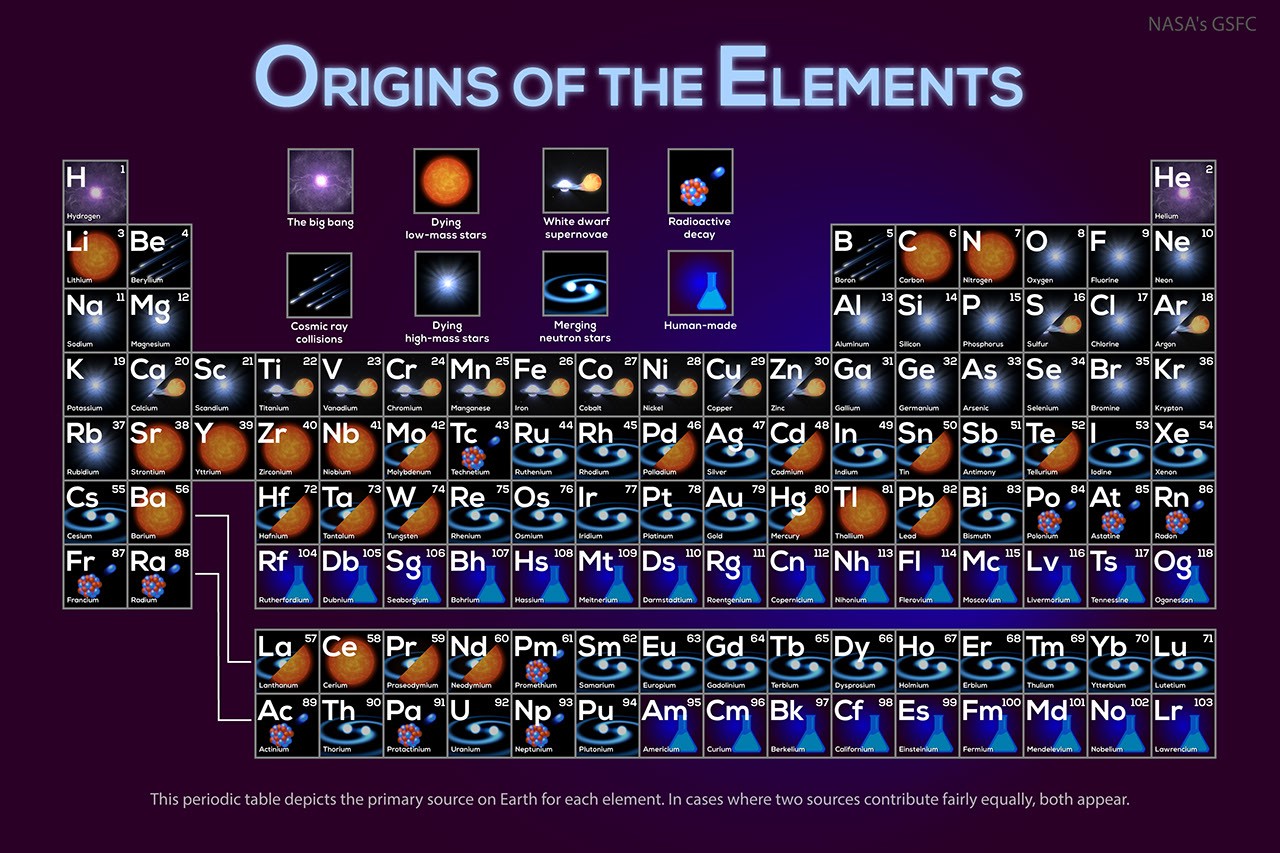
# The Cosmic Origin of Every Atom in Your Body
NASA's Astronomy Picture of the Day series has long served as a window into the universe's most compelling phenomena. Today's entry explores one of astronomy's most profound revelations: the stellar origins of the chemical elements that comprise all matter on Earth, including the human body itself.
Every atom heavier than hydrogen and helium was forged in the cores of stars or created during stellar explosions. This process, called nucleosynthesis, began in the earliest moments after the Big Bang and continues in active stars throughout the cosmos today. The carbon in your cells, the oxygen you breathe, the calcium in your bones, the iron in your blood. all trace their ancestry to stellar furnaces that burned billions of years ago.
The story unfolds across multiple cosmic stages. Hydrogen and helium formed during Big Bang nucleosynthesis, roughly 13.8 billion years ago. The first generation of massive stars then converted hydrogen into heavier elements through nuclear fusion in their cores. When these early giants exhausted their fuel, they exploded as supernovae, scattering newly created elements across space. These ejected materials mixed with interstellar gas clouds, which eventually collapsed to form second and third-generation stars, planets, and ultimately, life itself.
This chain of stellar alchemy explains why our solar system's composition reflects the galaxy's chemical evolution. The Sun formed about 4.6 billion years ago from a cloud of gas and dust enriched by billions of years of stellar processing. The rocky planets, including Earth, coalesced from this chemically mature material. We are, quite literally, made of stardust.
Modern astrophysics traces specific elements to their creation sites. Carbon and oxygen form in massive stars during their late stages of evolution. Iron accumulates in stellar cores until a supernova explosion terminates further fusion. Elements heavier than iron, including gold, silver, and uranium, require the extreme conditions found only in supernova explosions or neutron star collisions. The LIGO gravitational wave observatory provided direct evidence of this when it detected the merger of two neutron stars in 2017, an event that produced substantial quantities of heavy elements.
Observational astronomy continues to map this cosmic origin story. Spectroscopic analysis of stars, galaxies, and the intergalactic medium reveals the abundance patterns of different elements across space and time. These measurements confirm theoretical models of nucleosynthesis and help astronomers understand how galaxies chemically evolve.
The implications extend beyond academic curiosity. Understanding stellar nucleosynthesis illuminates how habitable worlds form. Planets require sufficient heavy elements to develop rocky surfaces. Stars must complete multiple generations before enough stellar processing creates the chemistry needed for biology. Earth's existence depends on this cosmic history spanning billions of years and countless stellar generations.
APOD's focus on this topic connects observers with the larger narrative of cosmic history. Every viewing becomes a meditation on origins. The nitrogen in your proteins, the phosphorus in your DNA, the sodium in your nerves. all journeyed from distant stars. This perspective reframes humanity's place in the universe not as separate from it, but as an integral expression of cosmic processes that continue operating throughout space.