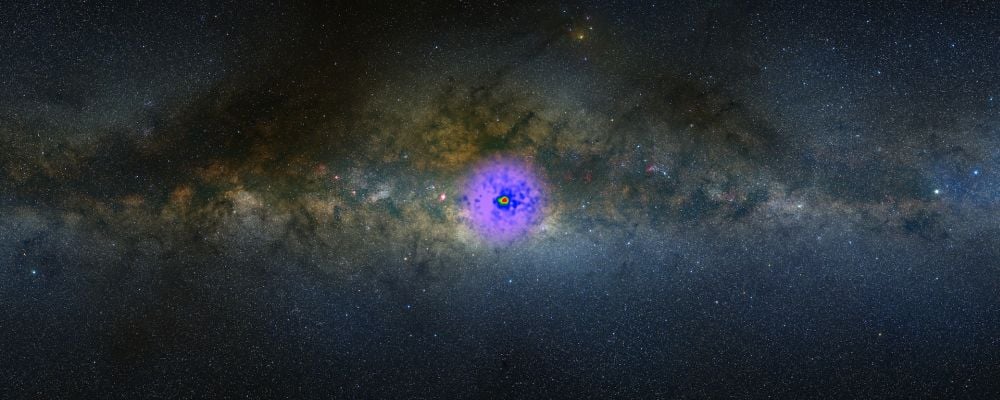
The Fermi Gamma-ray Space Telescope detected an anomalous burst of gamma radiation emanating from the Milky Way's center over a decade ago. This excess, known as the Galactic Center Excess (GCE), remains unexplained. Astronomers continue to narrow down competing theories, with dark matter annihilation emerging as a plausible candidate alongside conventional stellar objects.
Fermi first registered the GCE in 2009. The signal persists at the galactic center, a region dominated by Sagittarius A*, the supermassive black hole anchoring our galaxy. The excess gamma-ray flux defies easy categorization. Standard astrophysical sources cannot fully account for the observed radiation pattern.
Three primary explanations exist. Sagittarius A* itself generates intense radiation, but its known output does not match the GCE's characteristics. Millisecond pulsars, rapidly spinning neutron stars, populate the galactic center and emit gamma rays. Their collective contribution could theoretically explain some portion of the excess. Yet accounting fully for the GCE through pulsars requires an implausibly large population.
Dark matter self-annihilation offers a third pathway. Weakly Interacting Massive Particles (WIMPs) represent the leading dark matter candidate. If WIMPs constitute the galactic halo, regions of high density near the supermassive black hole become annihilation hotspots. When paired WIMPs collide, they convert mass into energy, producing gamma rays alongside other particles. The spatial distribution of the GCE aligns with theoretical dark matter density profiles around galactic centers.
The evidence remains inconclusive. Fermi's observations reveal a gamma-ray surplus concentrated toward the galactic center, with intensity peaking near Sagittarius A*. The morphology suggests a spherically symmetric excess rather than a point source, a pattern consistent with dark matter annihilation. However, alternative explanations involving unresolved pulsar populations or other exotic stellar remnants persist.
Recent analyses employ machine learning and refined statistical methods to parse competing models. Astronomers cross-reference Fermi data with observations from other instruments, including radio telescopes and X-ray observatories. This multi-wavelength approach constrains the possible sources. A dark matter interpretation requires the GCE to persist independent of stellar activity or accretion events around Sagittarius A*. Observations confirming this independence strengthen dark matter hypotheses.
The implications prove profound. Direct detection experiments on Earth search for WIMPs scattering off atomic nuclei. These underground observatories have yielded null results thus far. If the Galactic Center Excess originates from dark matter annihilation, it provides indirect evidence for WIMPs and constrains their mass and interaction cross-sections. Such data accelerates theoretical models and guides next-generation detector design.
Fermi continues operating in low-Earth orbit, accumulating photon counts. The Large Area Telescope aboard Fermi maintains sensitivity to gamma rays spanning eight orders of magnitude in energy. Future observations will accumulate additional statistics, refining models and narrowing parameter space for dark matter candidates. The Cherenkov Telescope Array, scheduled for construction, will observe very-high-energy gamma rays from the galactic center with enhanced sensitivity.
The Galactic Center Excess remains a tantalizing mystery. Whether it signals the first indirect detection of dark matter annihilation or traces forgotten stellar populations, solving this riddle advances fundamental physics. The gamma rays cascading from our galaxy's core carry information encoded across billions of years. Deciphering that signal reveals the universe's deepest composition.