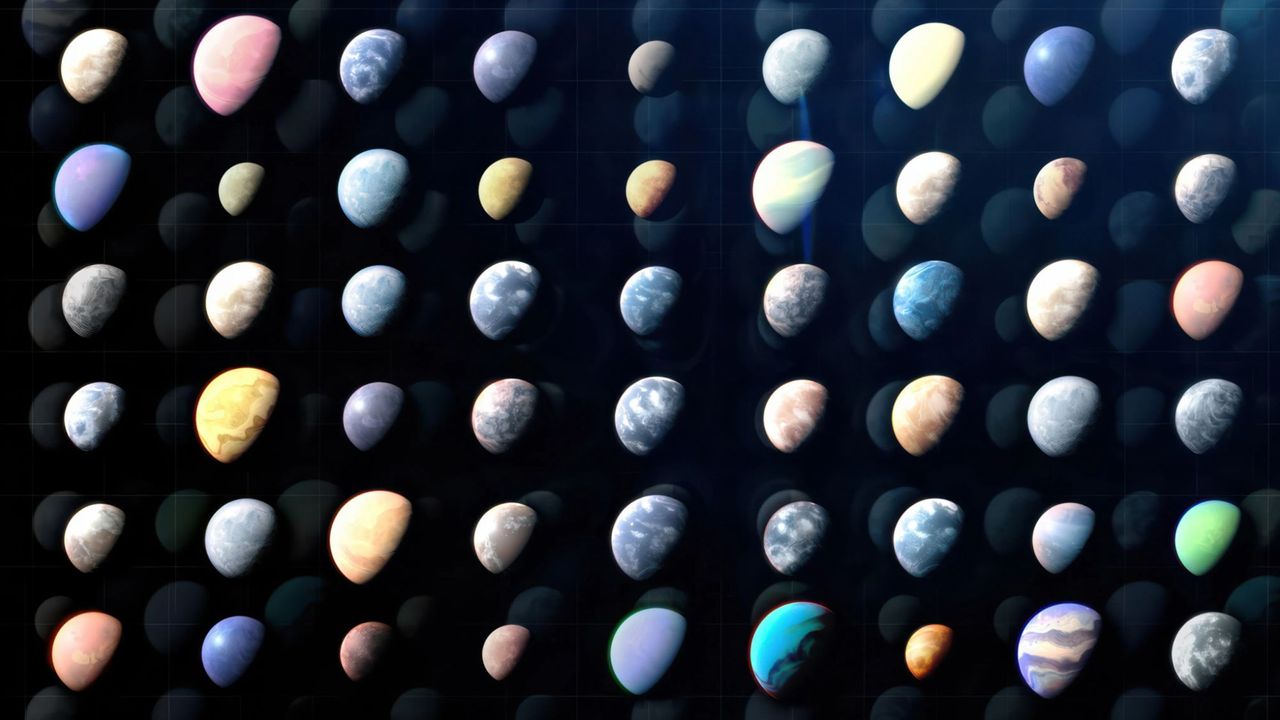
# NASA's Roman Space Telescope Will Do Something Revolutionary: See Exoplanets Directly
NASA's Nancy Grace Roman Space Telescope, launching in 2027, will achieve what ground-based observatories and previous space missions have struggled to accomplish. The mission will directly image exoplanets, capturing actual photographs of worlds orbiting distant stars rather than inferring their presence through indirect methods.
Direct imaging differs fundamentally from the detection techniques that have defined exoplanet discovery for three decades. The radial velocity method, which dominates current detection, measures stellar wobble caused by a planet's gravitational pull. Transit photometry, used by Kepler Space Telescope, detects the tiny dip in starlight when a planet crosses in front of its host star. These methods tell us planets exist, their orbital periods, and rough mass estimates, but they never show us the planets themselves.
Roman changes that equation. The telescope will employ a coronagraph, an instrument that blocks a star's overwhelming light and reveals the faint glow of orbiting planets. Think of it as sunglasses for a space telescope. This capability opens entirely new scientific avenues. Astronomers can analyze the chemical composition of exoplanet atmospheres by studying light reflected from or emitted by distant worlds. They can measure surface temperatures and cloud coverage. They can identify potentially habitable worlds by detecting biosignatures in atmospheric spectra.
The significance extends beyond mere observation. Direct imaging prioritizes young, massive planets orbiting distant stars. These worlds orbit far from their parent stars and radiate substantial heat from their formation, making them brighter and easier to detect than Earth-like planets around Sun-like stars. This focus reveals planetary formation mechanisms. How do massive gas giants form? What determines their orbital architectures? How do planetary systems evolve?
Roman's coronagraph technology represents a decade of development. Engineers solved the challenge of suppressing starlight by a factor of ten billion while maintaining image quality. The telescope's 2.4-meter mirror, identical in diameter to the Hubble Space Telescope's mirror, provides the resolution necessary for planetary detection. At distances of tens of light-years, an exoplanet appears impossibly tiny and faint against its star's glare. Only advanced space-based optics make direct imaging feasible.
The mission builds on pioneering work from ground-based observatories and the Hubble Space Telescope, which have directly imaged a handful of young exoplanets. Roman will extend this capability dramatically. Astronomers expect the mission to directly image hundreds of exoplanets throughout its five-year primary mission, with potential for extended operations.
This capability matters for the search for life beyond Earth. Future missions, including concepts like the Habitable Exoplanet Observatory, will build on Roman's foundation to study Earth-sized worlds in habitable zones. Roman provides the technological bridge from detection to characterization to eventual biosignature detection.
The Roman Space Telescope represents a watershed moment for exoplanet science. It transforms planets around other stars from invisible objects we infer into actual subjects of direct study. For the first time, humanity will see what worlds beyond our solar system genuinely look like.