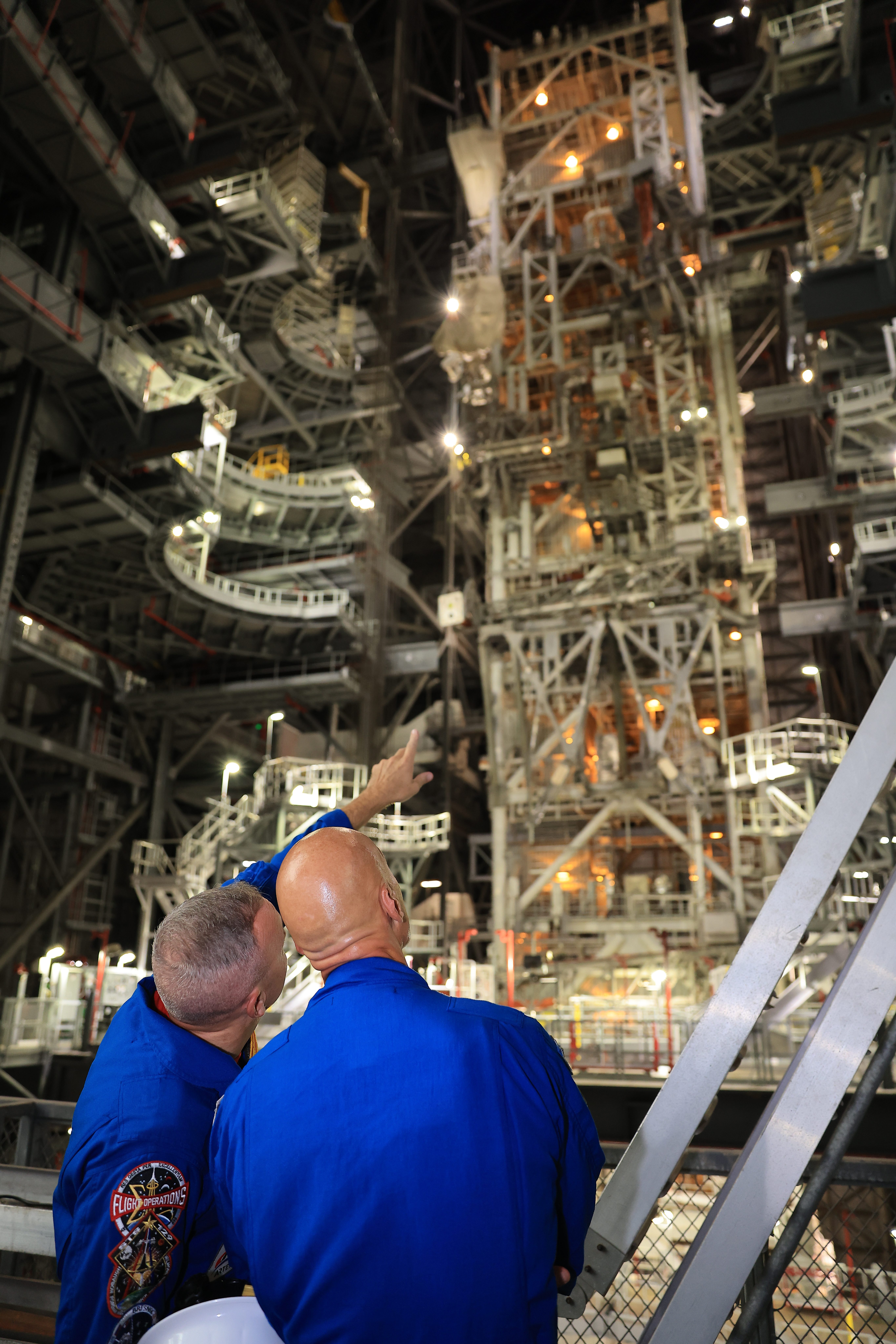
NASA's Artemis III crew visited Kennedy Space Center's Vehicle Assembly Building on Wednesday, September 2, 2026, to observe critical assembly work on the Space Launch System rocket that will carry them to the lunar surface. The tour included commander Randy Bresnik, pilot Luca Parmitano of the European Space Agency, and lunar module pilots Andre Douglas, Frank Rubio, and Bob Hines.
The five astronauts inspected solid rocket booster integration work underway in High Bay 3, one of the most consequential manufacturing spaces in American spaceflight. The Vehicle Assembly Building, a 52-story structure built for Apollo missions, remains the only facility capable of stacking the SLS core stage with its twin solid rocket boosters and upper stage. This hands-on inspection represents a rare opportunity for the crew to examine the precise engineering that will propel them beyond low Earth orbit.
The Artemis III mission represents NASA's return to lunar exploration with a permanent footprint in mind. Unlike the Apollo missions of the 1960s and 1970s, which focused on brief surface visits, Artemis III aims to establish sustainable operations on the Moon. This crew will land in the lunar south polar region, where permanently shadowed craters harbor water ice and other volatiles. The site selection reflects a strategic shift in lunar exploration, prioritizing resource locations over the equatorial landing zones of Apollo.
Bresnik commands the mission as an accomplished STS-129 shuttle pilot with prior ISS experience. Parmitano brings international collaboration to the effort and boasts two prior ISS expeditions. Douglas, Rubio, and Hines round out a crew selected specifically for lunar operations, with expertise spanning systems engineering, medical specialization, and long-duration spaceflight.
The SLS remains the most powerful operational rocket in the world, capable of delivering 130 metric tons to trans-lunar injection. Its solid rocket boosters, derived from Space Shuttle components, produce 3.6 million pounds of thrust at ignition. The integration work Bresnik and his crew observed represents months of precision engineering, from booster stacking to verification of thousands of electrical connectors and fluid systems.
Kennedy Space Center's role as launch site adds another layer of historic significance. The same launch pads that sent Apollo astronauts to the Moon in 1969 and 1972 now support SLS operations. Infrastructure modifications since the shuttle era have adapted these facilities for the heavier, more powerful SLS configuration.
Crew visits to assembly facilities serve multiple purposes beyond morale. They allow astronauts to gain intimate familiarity with their spacecraft, identify potential concerns before flight, and build confidence in ground teams. The interaction between flying crews and manufacturing personnel creates accountability and drives quality assurance at every stage.
The Artemis program operates on an accelerated timeline compared to Apollo. Where NASA took eight years to develop Saturn V operations between first crewed flight and lunar landing, the agency aims to achieve lunar surface operations faster with SLS. Schedule pressure demands that every system, from booster integration to avionics, reaches operational readiness without compromise.
Artemis III remains targeted for launch within the next several years, contingent on completing SLS testing and uncrewed Artemis II operations. This crew's visit to the Vehicle Assembly Building marks another milestone in the path toward returning humans to the lunar surface for extended exploration and science operations.