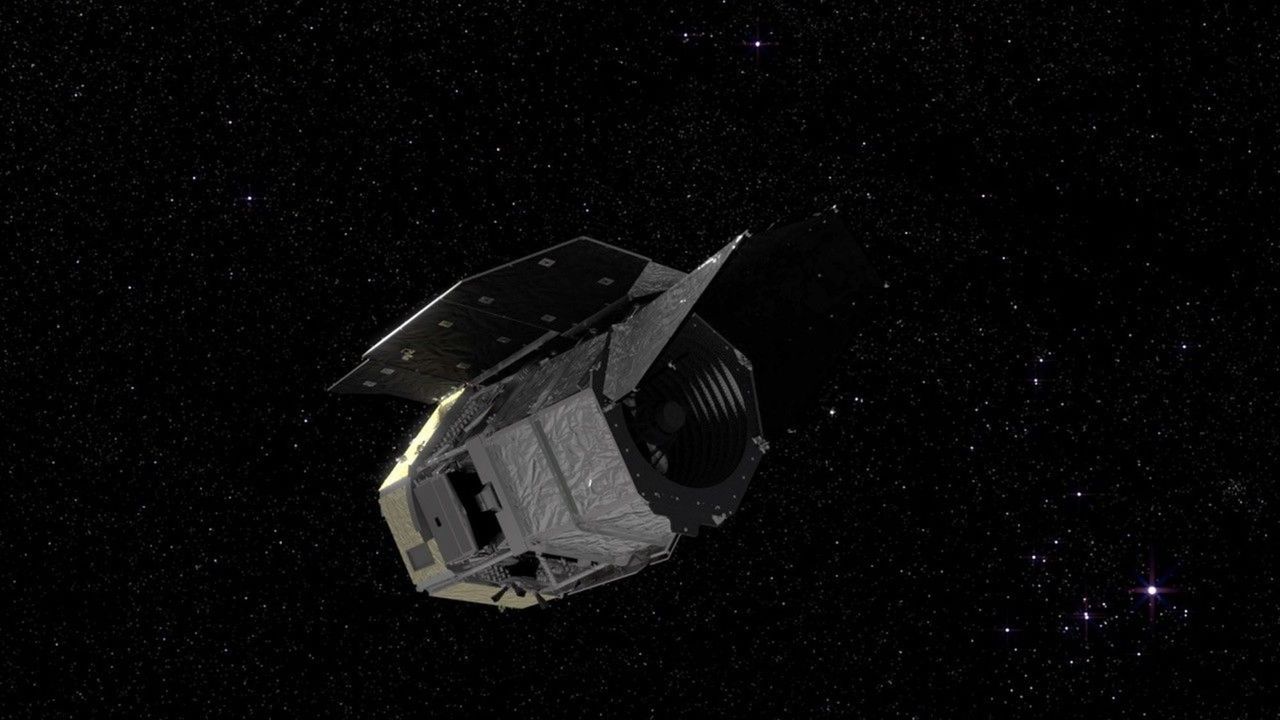
NASA's Nancy Grace Roman Space Telescope has secured an operational lifespan of more than 20 years, doubling its original planned lifetime through a precisely executed engine burn that adjusted the spacecraft's orbital trajectory. The maneuver consumed minimal fuel while positioning Roman to remain at its designated location in space far longer than initially anticipated.
Roman launched in May 2023 and began science operations in 2024 as the successor to the Hubble Space Telescope. The mission was originally designed for a ten-year operational window: a primary five-year mission plus a five-year extended mission. The spacecraft's longevity now extends beyond two decades, fundamentally changing the scope of what this observatory can accomplish.
The engine burn that extended Roman's lifetime represents a significant orbital mechanics achievement. Spacecraft at Lagrange Point 2, located roughly one million miles from Earth on the side opposite the sun, must periodically adjust their trajectories to maintain their position. These station-keeping maneuvers consume fuel, which directly limits mission duration. By optimizing this particular burn, NASA engineers reduced fuel consumption enough to add over a decade to Roman's operational window.
Roman carries two primary scientific instruments designed to answer fundamental questions about the universe. The coronagraph detects visible and near-infrared light from planets orbiting distant stars, enabling direct imaging of exoplanets in ways previous telescopes could not achieve. The Wide Field Instrument surveys enormous swaths of sky with resolution comparable to or exceeding Hubble's capabilities while covering areas many times larger in single observations.
This extended lifetime transforms Roman from a focused mission into a comprehensive survey instrument. The telescope will conduct deeper searches for distant supernovae used to measure the universe's expansion rate and dark energy. It will map the distribution of dark matter across cosmic time. It will identify ancient galaxies formed within the first billion years after the Big Bang. Longer operational time means Roman can revisit objects multiple times, tracking changes in stellar populations, variable stars, and dynamic cosmic events.
The fuel optimization reflects NASA's approach to maximizing science return from every mission. Roman's engineers calculated the minimum delta-v necessary to maintain the spacecraft's halo orbit around Lagrange Point 2 across the extended timeframe. Precision navigation and station-keeping represent routine but critical operations that often receive less attention than a mission's scientific instruments. These engineering efforts directly enable the discoveries that follow.
The Nancy Grace Roman Space Telescope is named after the NASA astrophysicist who pioneered observational methods proving the universe's expansion. Roman's contributions to observational cosmology shaped generations of research. Naming this successor after her honors both her legacy and the scientific tradition it carries forward.
Extended mission durations benefit not only individual observatories but the broader astronomical community. Longer operational windows permit complementary observations with other space telescopes including the James Webb Space Telescope and future missions. Ground-based observatories can coordinate observations with Roman's schedules. The ability to monitor cosmic phenomena across multiple years yields insights impossible within shorter timeframes.