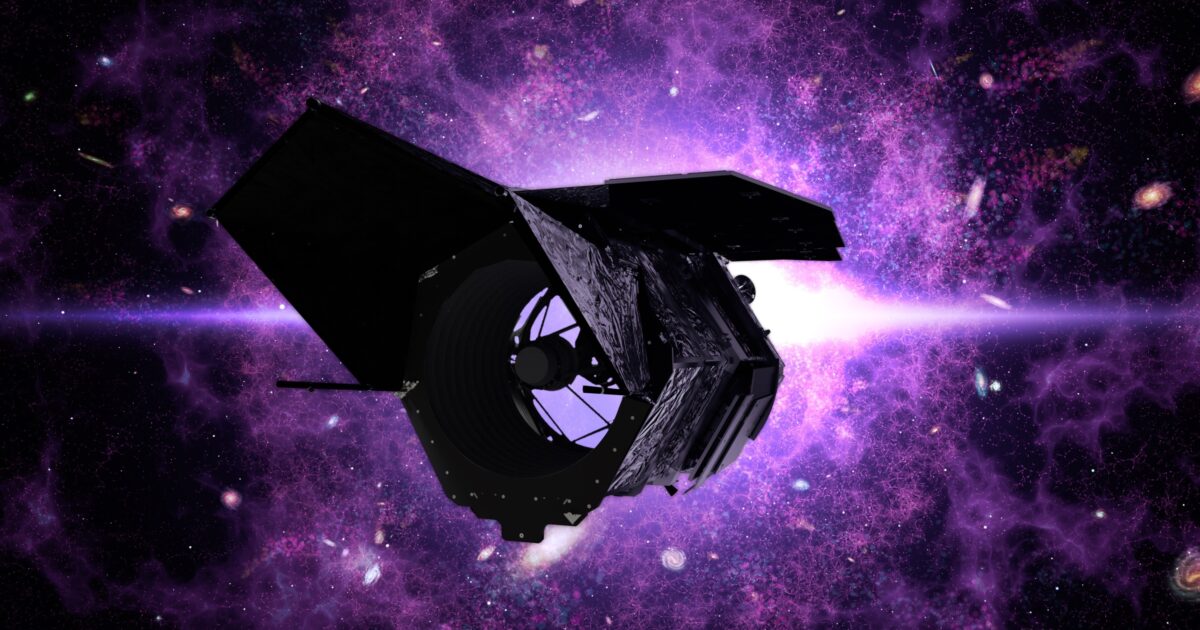
# Inside NASA's Next Great Eye: The Nancy Grace Roman Space Telescope
The Nancy Grace Roman Space Telescope represents NASA's boldest venture into wide-field infrared astronomy since the launch of the James Webb Space Telescope. Dr. Jason Rhodes, the Jet Propulsion Laboratory project scientist leading the mission, provides essential details on what this observatory will accomplish when it launches in the mid-2020s.
Roman will operate as a successor to the Hubble Space Telescope, inheriting and expanding its legacy of discovery. The telescope carries a primary mirror of 2.4 meters diameter, identical to Hubble's, but with vastly superior infrared sensitivity and a field of view that spans 100 times larger. This combination lets astronomers map cosmic structure at unprecedented scales while peering deeper into the infrared spectrum where dust-obscured galaxies and stellar nurseries reveal their secrets.
The mission targets three primary science goals. First, it will measure the expansion rate of the universe and the nature of dark energy with precision that current instruments cannot match. These measurements matter because they determine the universe's ultimate fate. Second, Roman will image millions of galaxies across billions of years of cosmic history, allowing astronomers to trace how galaxies form and evolve from the early universe to the present day. Third, the telescope will directly image exoplanets and circumstellar disks around distant stars, advancing the search for potentially habitable worlds beyond our solar system.
Rhodes emphasizes Roman's technological innovations. The telescope incorporates a coronagraph instrument that blocks starlight with exceptional precision, enabling direct imaging of faint planets orbiting bright stars. This represents a major leap from indirect detection methods that have dominated exoplanet science. The wide-field imaging capability, backed by advanced computational techniques, allows Roman to survey enormous swaths of sky in single observations, making it efficient for identifying rare cosmic objects and transient events.
The observatory's infrared capabilities prove particularly powerful because infrared light penetrates cosmic dust that visible light cannot traverse. Galaxies shrouded in star-forming dust become visible. The thermal radiation from young planets reveals their composition and temperature. Ancient galaxies from the universe's first billion years, redshifted far into the infrared by cosmic expansion, become observable for the first time with this sensitivity.
Roman launches aboard a SpaceX Falcon Heavy rocket, placing it at the Sun-Earth L2 Lagrange point, 1.5 million kilometers from Earth. This location provides the thermal stability necessary for infrared observations and keeps the telescope in alignment with Earth and Sun, simplifying mission design.
The naming honors Nancy Grace Roman, a pioneering NASA astrophysicist who championed space-based astronomy before her death in 2016. Roman led the agency's astronomy program and advocated for what became the Hubble Space Telescope, fundamentally transforming how humanity observes the cosmos.
The mission costs approximately $5.2 billion. Its five-year baseline mission can extend for a decade or more, depending on fuel reserves and component reliability. Once operational, Roman will usher in a new era of infrared astronomy, working in concert with James Webb on complementary science programs.