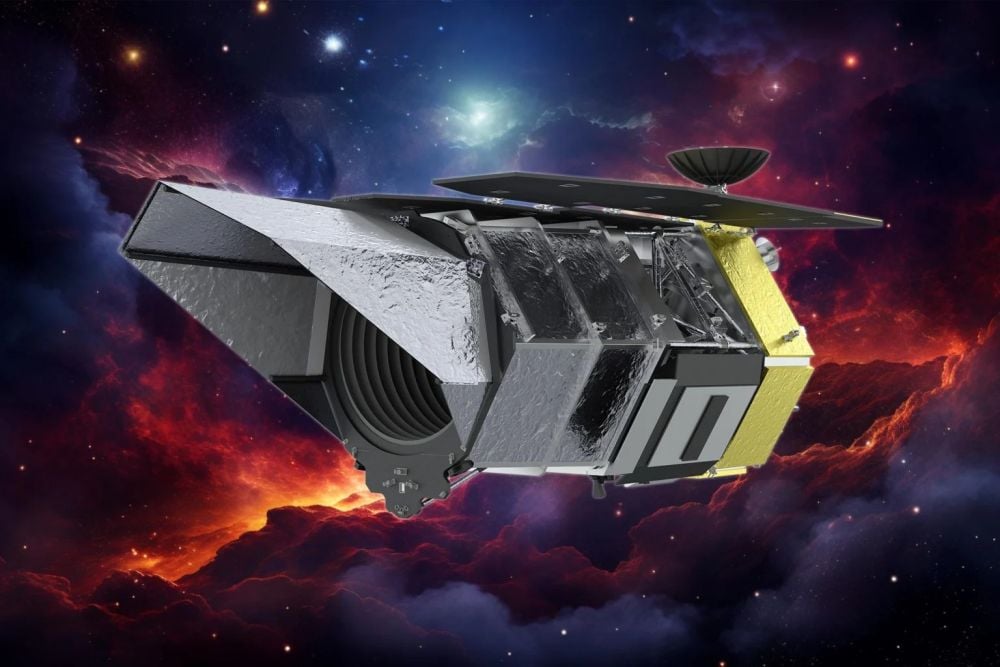
NASA has extended the Nancy Grace Roman Space Telescope's mission from its original 10-year baseline to approximately 22 years of operations. The extension stems from exceptional fuel efficiency during the telescope's first mid-course correction burn, which consumed only 10 percent of the allocated propellant.
The Roman Space Telescope, named after the pioneering NASA astrophysicist who established the foundations of space telescopes, launched in 2023 and currently operates at the Sun-Earth L2 Lagrange point, roughly one million miles from Earth. This location provides thermal stability and minimal interference from Earth and solar radiation, ideal conditions for infrared observations.
The mid-course correction maneuver demonstrated the engineering precision of the spacecraft's propulsion system. Engineers allocated a specific fuel budget for trajectory adjustments during the telescope's journey to L2. The actual burn required far less propellant than worst-case scenario planning assumed. This surplus fuel now enables the telescope to conduct station-keeping maneuvers and operational adjustments for an additional 12 years beyond the original decade-long mission profile.
Roman's scientific capabilities justify the extended timeline. The 2.4-meter primary mirror, matching the diameter of the Hubble Space Telescope, delivers infrared imaging and spectroscopy across wavelengths from 0.4 to 2.5 micrometers. The telescope carries two primary instruments: the Wide Field Instrument for broad surveys of the cosmos, and the Coronagraph Instrument designed to directly image exoplanets and circumstellar disks around nearby stars.
Direct exoplanet imaging represents one of Roman's defining capabilities. Unlike transit methods that detect planets by measuring starlight dimming as worlds pass in front of their host stars, Roman's coronagraph will physically resolve the light reflected or emitted by distant planets. This technique opens pathways to characterize atmospheric compositions and search for signs of habitability around dozens of nearby stars.
The extended mission transforms Roman's scientific agenda. A 22-year operational window allows for long-term studies of cosmic expansion through supernovae surveys, comprehensive catalogs of gravitational lensing events, and multi-epoch observations tracking changes in stellar populations and galactic structures. Deep field imaging campaigns can reach farther into the universe's history, potentially observing galaxies formed within the first billion years after the Big Bang.
Roman also carries a notable public engagement component. The telescope's design includes a built-in diffraction artifact that transforms out-of-focus starlight into patterns visitors can recognize. This feature turns optical limitations into teachable moments about how telescopes operate.
The fuel efficiency achievement reflects decades of spacecraft engineering refinement. Trajectory planning accounts for countless variables, from solar radiation pressure to gravitational perturbations by planets. Conservative estimates ensure mission success even under adverse conditions. When actual performance exceeds predictions substantially, the surplus becomes mission life insurance.
This extension places Roman alongside other long-running observatories that exceeded initial timelines. Hubble, launched in 1990 and originally planned for 15 years, continues operations after more than 30 years. The James Webb Space Telescope, another infrared observatory now operating well beyond its 5-year baseline, demonstrates how modern space telescopes can achieve remarkable longevity through thoughtful design and careful operations.
The Roman Space Telescope will begin full science observations following its commissioning phase. The extended timeline means this powerful observatory will shape our understanding of exoplanets, cosmic expansion, and the universe's structure across more than two decades of continuous operation.