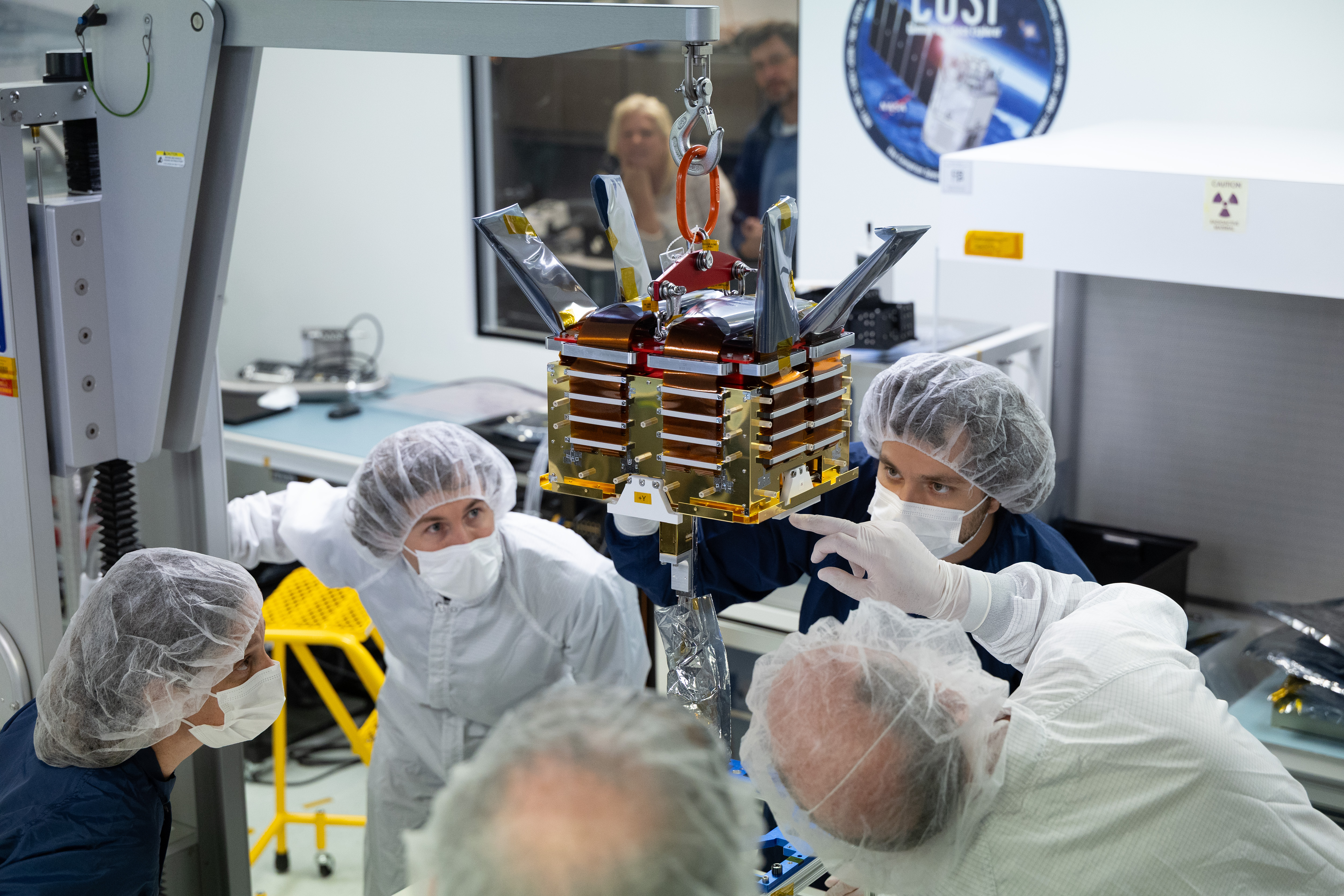
# COSI Telescope Comes Together for Gamma-Ray Mission
The Compton Spectrometer and Imager, known as COSI, has reached a critical assembly milestone at UC Berkeley. Engineers lifted the detector assembly into its final configuration in July 2026, marking progress toward launch of a mission designed to observe gamma-ray bursts, pulsars, and other high-energy phenomena across the universe.
COSI represents a new generation of gamma-ray astronomy. The detector contains sophisticated electronics and shielding arranged to capture photons at some of the most extreme energies observed in space. The silver flex circuits visible atop the detector box route electrical signals from the sensitive detector elements to the readout electronics, a design that allows engineers to maintain precise control over incoming data from distant cosmic sources.
The mission operates in a crowded field of gamma-ray observatories. NASA's Fermi Gamma-ray Space Telescope, launched in 2008, redefined our understanding of transient gamma-ray sources and their behavior. The Neil Gehrels Swift Observatory, also operational since 2004, tracks gamma-ray bursts with remarkable speed and precision. COSI enters this landscape with distinct capabilities. Its design emphasizes spectroscopic precision, meaning it can measure not just the presence of gamma rays but their exact energies with high resolution. This capacity opens new avenues for studying the physics of neutron stars, black holes, and the violent phenomena surrounding them.
Gamma-ray bursts themselves remain among the universe's most enigmatic objects. These transient explosions release more energy in seconds than our Sun will emit across its entire 10-billion-year lifetime. Their origins span multiple categories: some arise from the merger of two neutron stars, others from the core collapse of massive dying stars. COSI's spectroscopic abilities will allow astronomers to distinguish between burst types and trace the nuclear processes unfolding at their cores.
The detector assembly shown in the Berkeley image represents months of meticulous engineering. Each component must function flawlessly in the harsh environment of space, where radiation, thermal extremes, and vacuum conditions stress every material. The flex circuits carrying signals exemplify this precision work. These thin, flexible conductors connect thousands of detection elements to amplifiers and processors, every solder joint tested and validated.
UC Berkeley hosts COSI's development as part of the Space Sciences Laboratory, a center that has produced decades of cutting-edge space missions. The university's physicists and engineers bring together expertise in detector physics, radiation shielding, and spacecraft systems to realize ambitious observational goals.
COSI's planned orbit places it in a position to observe gamma-ray sources continuously, detecting sudden bursts and tracking how their brightness and spectrum evolve over seconds to minutes. This continuous monitoring capability distinguishes it from missions requiring ground-based coordination or rapid satellite slewing to catch fleeting events.
The assembly milestone indicates the mission approaches its launch window. Once deployed, COSI will join an international fleet of high-energy observatories working to decode the universe's most violent and energetic processes. Its data will feed directly into the broader scientific enterprise of understanding compact objects, stellar evolution, and the extreme physics that dominates near black holes and neutron stars.