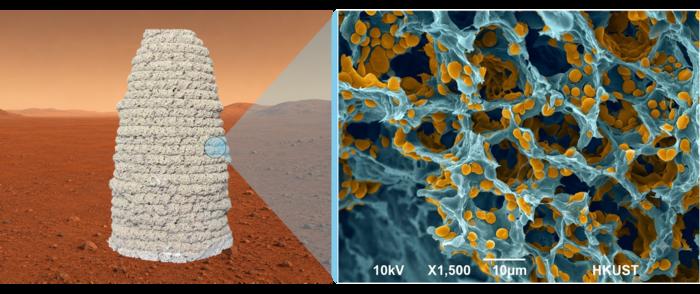
Researchers at Hong Kong University of Science and Technology have developed a method to manufacture construction materials on Mars using genetically engineered yeast, potentially solving one of the thorniest logistical challenges facing permanent human settlement on the Red Planet.
The team, led by Ning Liu, published their findings in Chem Circularity. Their approach harnesses biology to replace concrete and other structural materials typically shipped from Earth. The concept rests on a fundamental economic reality: launching payload to Mars costs roughly $1 million per kilogram. Building even a modest pressurized habitat entirely from Earth-sourced materials becomes financially ruinous. Self-sufficiency in construction resources becomes essential for any sustained outpost.
The researchers engineered yeast cells to produce a biological building material called engineered living building material, or ELBM. The process works by modifying yeast metabolism to synthesize structural compounds that bind together when exposed to Martian regolith, the loose surface material covering Mars. This approach leverages biology's capacity for rapid self-replication and complex chemistry without requiring heavy manufacturing equipment.
ELBM offers several advantages over conventional concrete for Martian construction. Yeast requires minimal resources to culture. Mars provides abundant regolith. The biological process generates its own binding agents through cellular metabolism rather than relying on chemical processing that demands energy-intensive equipment. Once established, a yeast culture can theoretically expand exponentially, producing building material at costs approaching those of local resource utilization (ISRU), the practice of using off-world materials to support exploration infrastructure.
The engineering challenge involves several layers. First, researchers must select or engineer yeast strains capable of surviving Martian environmental stresses, including radiation exposure, low atmospheric pressure, and temperature extremes. Second, the binding compounds must perform reliably in Martian conditions over extended periods. Third, the production process must remain stable without constant resupply from Earth.
Liu's team has already demonstrated proof-of-concept results showing that their genetically modified yeast can survive in simulated Martian conditions and produce functional binding compounds. The materials show structural integrity comparable to conventional concrete in preliminary testing, though scaled production and durability testing remain ongoing.
This biological approach fits within broader ISRU strategies NASA and other space agencies have pursued for decades. Mars Sample Return missions, scheduled for the late 2020s, will help clarify the precise composition of Martian regolith that future construction materials must bind. Simultaneously, SpaceX's development of heavy-lift capacity through Starship aims to reduce per-kilogram launch costs, yet even modest reductions in construction material transport would accelerate outpost development timelines.
The implications extend beyond Mars. Similar biological fabrication methods could support construction on the Moon, asteroids, or other extraplanetary environments. The technology represents a convergence of synthetic biology, materials science, and space engineering. If ELBM proves viable at scale, outposts no longer depend entirely on Earth supply chains. Colonists could grow their own infrastructure.
Adoption depends on successful field testing before human arrival. Future robotic missions to Mars will likely carry culturing equipment and test ELBM production in actual Martian conditions. If successful, genetically engineered yeast could become as essential to Mars settlement as wheels or solar panels, transforming how we think about extraplanetary construction and resource independence.